

I am bored right now and a thread about the ICW got me thinking mathematically about this. So try this on for size. If I am wrong, tell me. If I need a life, well, I do have access to the delete button. LOL
In theory
Given: My boat is 27' in length.
Given: My mast is 40' 9" above the waterline.
Given: My boom is 8' 6" above the waterline.
If I were at the water line and even with the mast with a triangle square looking at 45 degrees, any object that hits that angle will be 40' 9" away from the top of my mast. (about 2 boat lengths) Correct? Pythagoras's theorem
If I move the triangle square to the gooseneck, the angle must be adjusted to 38 degrees for the loss of vertical height to keep the same horizontal distance of 40' 9".
Therefore, if I site any object from that 38 degree angle, then the object is 40' 9" from the top of my mast.
So, lets assume that you are approaching a bridge. If you site the bridge at the 38 degree and the bridge is greater than 2 boat lengths away, then you can safely pass under that bridge. However, if you site the bridge and you are within the 2 boat lengths you are screwed because it will be too late to avoid a demasting.
So in essence, if you approach a bridge and the bridge appears to be higher that 38 degrees you are good to go. If you see that the bridge is still not making it to the 38 degree line, you probably should not try and pass under.
Like I said, I was bored. But the point is, if you know your mast height and you can find the correct angle from your helm that will equal about 2 boat lengths (maybe more - maybe less), then you should be able to judge if you have clearance. For me, the correct angle is a 31 degrees look angle. I would put a piece of white reflective tape on my forestay at 14' 7" from the bow plate. From my helm, that is 31 degrees.
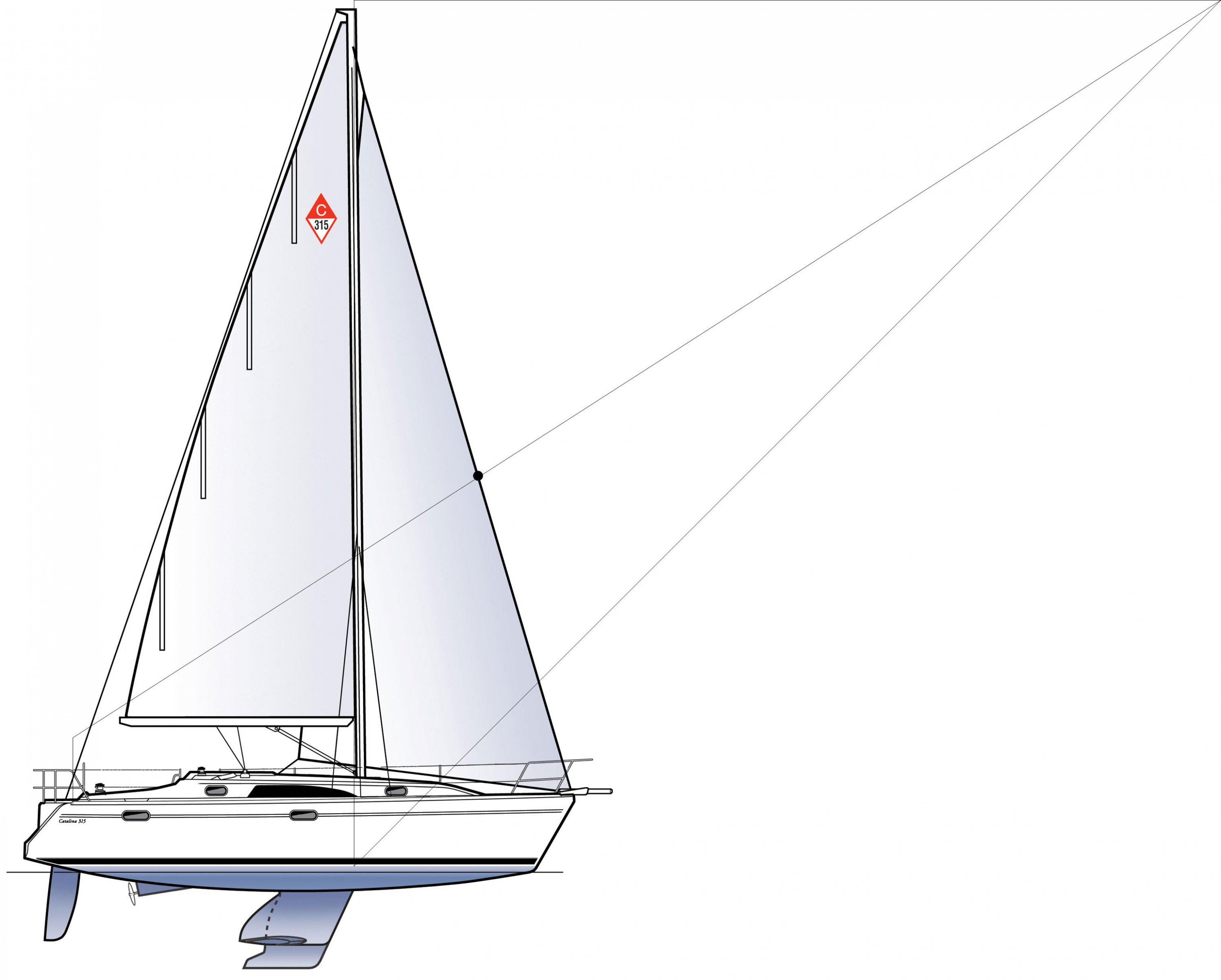
Here is an image of a Catalina 31 I just grabbed to illustrate my point. The angle from the waterline at the mast is 45 degrees. That put a horizontal line out the same distance as the waterline to the top of the mast, maybe 2 boat lengths or so. The angle from the helm is about 32 degrees. The black dot is where one would site from the helm to see if the object is below (not good) or above (very good) from a distance of say .25 miles.
In theory
Given: My boat is 27' in length.
Given: My mast is 40' 9" above the waterline.
Given: My boom is 8' 6" above the waterline.
If I were at the water line and even with the mast with a triangle square looking at 45 degrees, any object that hits that angle will be 40' 9" away from the top of my mast. (about 2 boat lengths) Correct? Pythagoras's theorem
If I move the triangle square to the gooseneck, the angle must be adjusted to 38 degrees for the loss of vertical height to keep the same horizontal distance of 40' 9".
Therefore, if I site any object from that 38 degree angle, then the object is 40' 9" from the top of my mast.
So, lets assume that you are approaching a bridge. If you site the bridge at the 38 degree and the bridge is greater than 2 boat lengths away, then you can safely pass under that bridge. However, if you site the bridge and you are within the 2 boat lengths you are screwed because it will be too late to avoid a demasting.
So in essence, if you approach a bridge and the bridge appears to be higher that 38 degrees you are good to go. If you see that the bridge is still not making it to the 38 degree line, you probably should not try and pass under.
Like I said, I was bored. But the point is, if you know your mast height and you can find the correct angle from your helm that will equal about 2 boat lengths (maybe more - maybe less), then you should be able to judge if you have clearance. For me, the correct angle is a 31 degrees look angle. I would put a piece of white reflective tape on my forestay at 14' 7" from the bow plate. From my helm, that is 31 degrees.
Here is an image of a Catalina 31 I just grabbed to illustrate my point. The angle from the waterline at the mast is 45 degrees. That put a horizontal line out the same distance as the waterline to the top of the mast, maybe 2 boat lengths or so. The angle from the helm is about 32 degrees. The black dot is where one would site from the helm to see if the object is below (not good) or above (very good) from a distance of say .25 miles.


