Judging object height clearance

Feb 17, 2006
5,274
Lancer 27PS MCB Camp Pendleton KF6BL
I am bored right now and a thread about the ICW got me thinking mathematically about this. So try this on for size. If I am wrong, tell me. If I need a life, well, I do have access to the delete button. LOL

In theory

Given: My boat is 27' in length.
Given: My mast is 40' 9" above the waterline.
Given: My boom is 8' 6" above the waterline.

If I were at the water line and even with the mast with a triangle square looking at 45 degrees, any object that hits that angle will be 40' 9" away from the top of my mast. (about 2 boat lengths) Correct? Pythagoras's theorem

If I move the triangle square to the gooseneck, the angle must be adjusted to 38 degrees for the loss of vertical height to keep the same horizontal distance of 40' 9".

Therefore, if I site any object from that 38 degree angle, then the object is 40' 9" from the top of my mast.

So, lets assume that you are approaching a bridge. If you site the bridge at the 38 degree and the bridge is greater than 2 boat lengths away, then you can safely pass under that bridge. However, if you site the bridge and you are within the 2 boat lengths you are screwed because it will be too late to avoid a demasting.

So in essence, if you approach a bridge and the bridge appears to be higher that 38 degrees you are good to go. If you see that the bridge is still not making it to the 38 degree line, you probably should not try and pass under.

Like I said, I was bored. But the point is, if you know your mast height and you can find the correct angle from your helm that will equal about 2 boat lengths (maybe more - maybe less), then you should be able to judge if you have clearance. For me, the correct angle is a 31 degrees look angle. I would put a piece of white reflective tape on my forestay at 14' 7" from the bow plate. From my helm, that is 31 degrees.

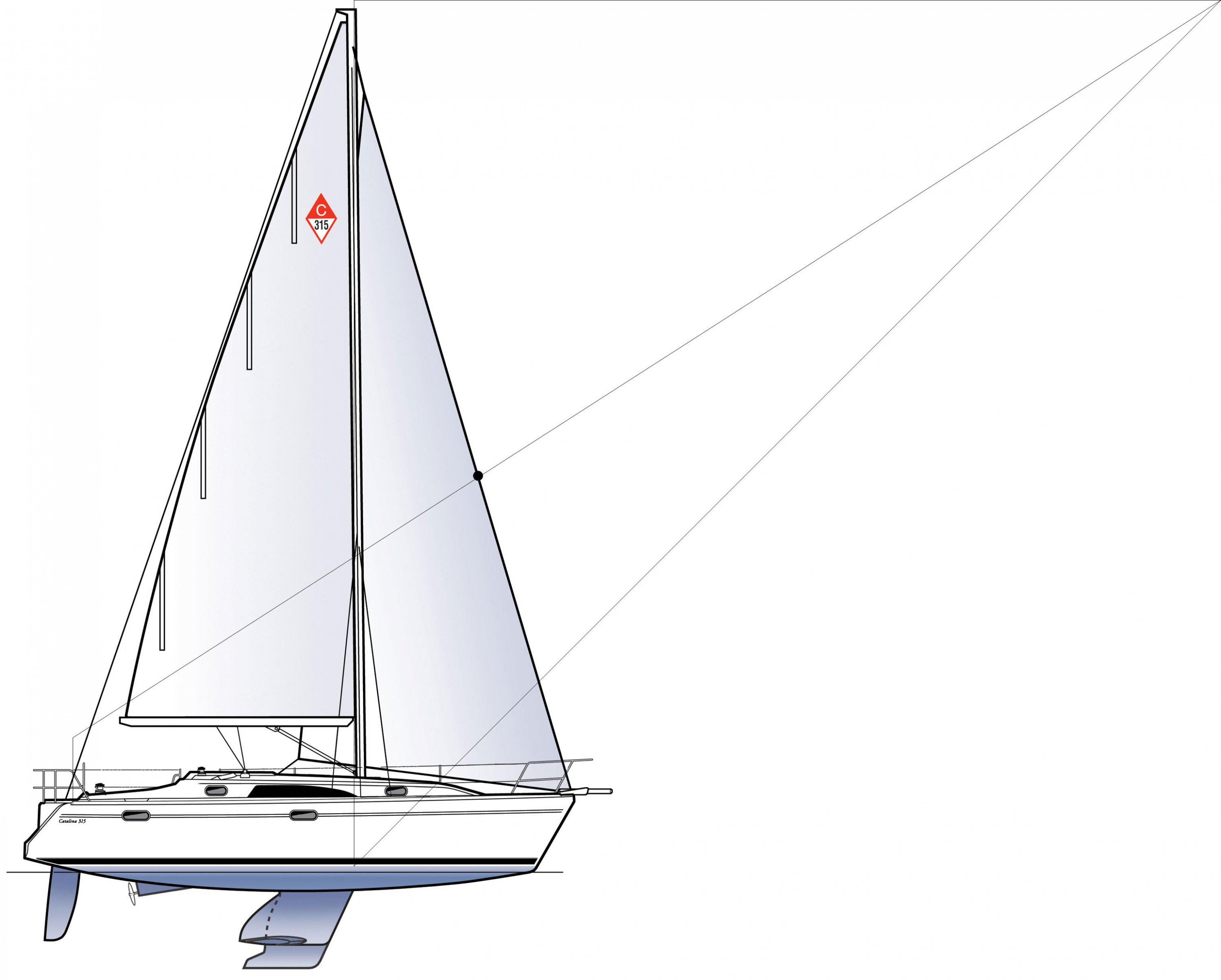
Here is an image of a Catalina 31 I just grabbed to illustrate my point. The angle from the waterline at the mast is 45 degrees. That put a horizontal line out the same distance as the waterline to the top of the mast, maybe 2 boat lengths or so. The angle from the helm is about 32 degrees. The black dot is where one would site from the helm to see if the object is below (not good) or above (very good) from a distance of say .25 miles.
boat.jpg
 
Nov 6, 2006
10,211
Hunter 34 Mandeville Louisiana
Correct, Brian.. but not repeatable; that is, not accurate enough.. Lots of times we are dealing with inches of clearance at the top.. I have heard my VHF antenna "tink" on the underside of the bridge beams a few times..
As a quick check, the method is valid ..
 
Nov 26, 2008
1,970
Endeavour 42 Cruisin
Yea, what is the error if you are 2% off? How accurate can you be if there are any waves?
 

Kermit

.
Jul 31, 2010
5,722
AquaCat 12.5 17342 Wateree Lake, SC
If I were at the water line and even with the mast with a triangle square looking at 45 degrees...
I never understood geometry but how can you be at the water line and even with the mast at the same time? (Maybe that's why I was never any good at geometry.)
 
Sep 23, 2009
1,477
O'Day 34-At Last Rock Hall, Md
Interesting thought. I think the problem will be accurate estimation of two boat lengths. Worth a try this season on known bridges.
 
Feb 17, 2006
5,274
Lancer 27PS MCB Camp Pendleton KF6BL
It is not to determine height of the object. But do you initially have the clearance angle to pass under that object. Don't have to be limited to the height of the mast alone. Extent to 3 boat lengths for safety. I just used the height of the mast from the waterline since that measurement is used as part of the boat's specifications. That should be the minimum.

Again, just a theoretical tool to help in determining if you have a potential risk of hitting a bridge. Yes there are a lot of what-if's.
 
  • Like
Likes: kloudie1
Oct 29, 2016
1,929
Hunter 41 DS Port Huron
45* measured at the WL to be even with the top of the mast would put the intersecting point of the mast projected to the WL 40'-9" from the obstruction.
The angle measured from the intersecting point (mast at WL) to the plane of the obstruction to be the same height as the mast 41' would be 37* when the mast is 54' from the obstruction.

I like the thought process of putting a reference point on the forestay from the Helm to estimate clearance height. But I would sure hate to rely on this type of measure, even with a safety factor, estimating distance from obstruction is a crap shoot.
 
Last edited:

jssailem

SBO Weather and Forecasting Forum Jim & John
Oct 22, 2014
24,524
CAL 35 Cruiser #21 moored EVERETT WA
Applying your theory I believe you would want to site both sides of the bridge to be comfortable proceeding under. The challenge is in the distance you are from the bridge. You could use a range laser finder (golf gadget) to give you a rough distance number. But then you might just as well use it in the bridge height. You can use gps. Good to within 10 feet average position from bridge. Trouble is the further you are from the bridge the less the angle is. You could be needing to lie on the boat deck to site a 5 degree angle so that you have time to consider the go / no go decision. Having to decide with 3 boat lengths from a bridge and a 2 knot current pushing me towards the bridge does not make me warm and fuzzy.
 

jssailem

SBO Weather and Forecasting Forum Jim & John
Oct 22, 2014
24,524
CAL 35 Cruiser #21 moored EVERETT WA
They call it Applied Mathematics. So does some one have a boat we can do some test runs.
 
  • Like
Likes: Kermit
Feb 17, 2006
5,274
Lancer 27PS MCB Camp Pendleton KF6BL
This axiom does to mind:

In theory, practice follows theory. In practice, that's just a theory.

;^)
Very true. But I think that looking at an object and a reference point would be beneficial in the decision process to pass under that object or not. Just another tool in you thought process. If the object rests above the reference point, you should be good to go. If it rest below your reference point then there is probably not enough clearance.

Would this not be the same theory as collision angles, just in a vertical sense?

Yeah, there are factors involved. Unknows such as swell height under the object. Clearance distance between the object and the waterline.
 
Jan 1, 2006
7,984
Slickcraft 26 Sailfish
...Would this not be the same theory as collision angles, just in a vertical sense? ...
It might! I'm at a loss to understand how to apply that but there's a way, I'm sure. You can use a sextant to get your distance from a object of a known height.
Speaking of the laser golf distance measuring device, how hard would it be in create a similar device for boater's which could measure distance. For instance, if you could measure the distance to the bridge at helm's eye level, and the distance to water at the bridge under it you would have two sides of a triangle and could calculate the height of the bridge above the water. Other functions could be picking a lay line, collision avoidance (Including in The Race of LI Sound, when you have maybe 10 minutes between when you can see a tug until you need to take action), distance to a aid to navigation, judging if you can cross in a port tack situation. Maybe it could be an app. I, of course, have no idea how to do it.
 
Jan 19, 2010
12,925
Hobie 16 & Rhodes 22 Skeeter Charleston
My son does forestry research and has an instrument similar to this one... he can site a tree from a distance and it will tell him how high it is..

upload_2017-1-27_9-44-20.png
 
  • Like
Likes: BudGates
Feb 17, 2006
5,274
Lancer 27PS MCB Camp Pendleton KF6BL
Without range fingers, height of any object can be found if the distance from that object is known and the angle to the object is known. The trigonometric for that is called SOH CAH TOA. I will leave it up to the individual to google the term. I can attest that the math does work as I used it to prove to the Army that a satellite can be seen when in a valley surround by tall mountains. However, this can be very complicated and it was my desire to give the sailor another tool to determine go or no go under a bridge.
 
Feb 17, 2006
5,274
Lancer 27PS MCB Camp Pendleton KF6BL
Wiff?

Anyway, for the not so math inclined. If you have a calculator that has trig functions (SIN, TAN, COS) then you can determine the height of a bridge if you know the distance from the bridge and the angle to the bridge from you helm.

Assume:
Chart plotter says you are 1000 feet from the bridge
An inclinometer says the angle is 5°.

On your calculator enter the following
1000
*
5
TAN
=
Answer will be 87.4 ft bridge height

Note: some calculators have a different method of entering functions. Try the example above with your calculator. Once you get the same results then you know the procedure to entering functions.
 

jssailem

SBO Weather and Forecasting Forum Jim & John
Oct 22, 2014
24,524
CAL 35 Cruiser #21 moored EVERETT WA
Oh the joy of the HP calculator flash back.

No more long hand formulas and memory aids.

Does work. Thanks for the flashback Brian.

The forest pro does work. Know a timber cruiser who swears by and at his. Could be adapted to bridge passage. Pretty high cost for a skill that should be expected of a boat owner with a tall mast and bridges to be passaged. I check my charts and the tide level when coming up to a bridge.
 
Nov 8, 2010
11,386
Beneteau First 36.7 & 260 Minneapolis MN & Bayfield WI
Oh the joy of the HP calculator flash back.

No more long hand formulas and memory aids.

Does work. Thanks for the flashback Brian.
HP flashback?? That was not RPN! Try:

1000
[enter]
5
*
TAN

(Make SURE you are in [DEG] mode!)
 
Last edited: