Sail twist

Sep 20, 2014
1,330
Rob Legg RL24 Chain O'Lakes
Something else I just learned, when I had previously heard talk about Cunningham, I assumed it was always just a down haul on the front of the boom. My boom gooseneck is fixed position, so nothing to adjust. Just pull up on the sail as hard as I can. Well, doing some more reading, I discovered that often there is a line tied to a loop well above the boom, that a line loops through. My sail does have a grommet about a foot above the boom. At first, I just assumed it was part of the reefing, but did not make much sense. Now I realize that is for the Cunningham, that I have not ever rigged up. So that looks like one more thing to add to my list for the next time I go sailing. I'm hoping to get at least one more sail in, before being done for the season. The temps have dropped pretty fast over the past couple of weeks. Jackdaw, I have to believe it would have been a bit cold last weekend, if you are that far north.
 

RichH

.
Feb 14, 2005
4,773
Tayana 37 cutter; I20/M20 SCOWS Worton Creek, MD
This boat has an 'arm' at the top of the mast that points aft ... correct?
You also have a multiple part block system to control back stay tension (which also BENDS the mast) ... correct?
The top 1/3 of the mast is 'tapered' (smaller in diameter/section than down near the deck) ... correct?

If so, the most probable reason for the mis-shapen main is not enough mast bend.... controlled by back stay tenson ( which supplies force to the 'moment arm' at the top of the mast) which bends the mast and causes the central part of the mainsail luff to be 'pulled' forward.
(On this boat you may also have a control adjustment to allow 'on-the-fly' lengthening or shortening of the FORESTAY - if so the usual forestay-length control is through a Harken-type 'magic-box', usually mounted near the base of the mast; and the whole forestay goes around a sheave near the top of the mast and 'terminates' down near the coach roof to a magic-box or other strong multipart block system. This system is for on-the-fly mast raking)

If my suspicions are correct (Look at the huge mast bend in the pic of the full battened BENDY RIG boat being sailed hard on the wind - post #10), do the following trials:
1. apply maximum backstay tension which will considerably bend the mast and in doing so FLATTEN the mainsail, especially in the upper and middle panels. Then adjust the outhaul to get the lower sections flattened to approximately the same shape as the upper and mid sections.
2. If the boat changes helm because of the applied mast bend AND If the boat has the forestay length adjustment, reposition the mast for/aft rake then 'redo' the mast bend until you get a fairly neutral helm. There's more to this for helm balance, but the above explanation is 'good enough' for now.

The fast sailing ILYA scows and other 'sport boats' all have similar control systems for 'bendy' masts; and, for 'normal 12-15 kts of wind sailing the mast usually will have 'considerable' mast bend. If the mast is left 'straight' and without sufficient bend --- you'll get the miserable shape of what I see in your pictures. For 'scows', etc. using this type of bendy mast, the top of the mast from the 'bending' usually is about 2 or more FEET back from its 'straight up' position, in 'real heavy' winds the mast may be bent back approx FOUR feet and the mainsail will become almost as flat as a sheet of plywood and with very little camber !!!!! The more you bend the mast, the FLATTER the sail will become.

You can also test to see how the mainsail was constructed and if it was 'cut' for a 'bendy' mast system ... as it will usually have a 'forward bowed/cut' luff section.
See the 'grey' sketch at the bottom of the attachment. BUT, what is shown there is a concave curve for a headsail and for a bendy rig boat that 'hollow' will be convex - the opposite luff shape of what is shown, not hollow as in the attachment but 'bulging'.
•Lay the mainsail on FLAT clean ground and make an accordion folded about 2 feet back from the luff (as shown in the attachment)
•Straighten out / remove all wrinkles in the luff area to get that first 2 feet of LUFF 'flat' on the ground. The accordion fold will allow this flattening on the ground to happen along the luff in a semi-spherical sail shape.
•Notice (measure) and REMEMBER that amount of convex curve to the luff of the sail ---- thats your 12-15Kt sailing shape and the mast should be 'bent' (by the backstay) to approximately the same shape. More bend for higher winds ... to 'pull' the mid panels forward for even more 'flattening'.
In such a bendy rig boat, the mast is strongly bent so the sail is FLAT for high winds and for when in 'light' winds to prevent separation stalls; moderate bend for 'moderate' conditions.
You really need a FULL set of tell tales to visualize what is going on with a 'bendy rig' boat.

The amount of mast bend in a 'bendy rig' boat .... is what SHAPES the mainsail !!!!!!!!!
Worse, if this IS a BENDY RIG boat and you dont have a moderate bend put into the mast the sail pressure even in moderate conditions can cause the straight mast to 'invert' to a negative bow which will cause the shape to considerably power up (draft significantly increases with increasing wind strength); the bending is what 'stiffens' such a mast.
 

Attachments

Sep 20, 2014
1,330
Rob Legg RL24 Chain O'Lakes
My gut feeling is that I have a sail designed for a bendy rig, but my mast is not designed to bend that far. I have not gone crazy on bending the mast. The mast is pretty heavy, and does not thin out at the top. I'm betting the sail was designed based on the Aussy boat specs, rather than the American boat specs. I'm going to try to see how much bend I can get out of the mast, but it won't be anything like the bendy mast rig.
 

RichH

.
Feb 14, 2005
4,773
Tayana 37 cutter; I20/M20 SCOWS Worton Creek, MD
That your mainsail is attached by 'slugs', instead of the boltrope fitting 'inside' the mast groove, I might agree with you.
Do the (accordion fold) test to see if the luff is cut straight or has a smooth curved 'bulge' along the luff - this will clarify any 'cross match' of a main for a bendy rig but having a straight luff or vice versa .... or even a replacement mast, etc. (its easy to break a 'bendy').

OK on no tapered mast.
But, do you have that little ~6-8" 'arm' pointing back at the top of the mast?
... and do you have a multipart block system to apply backstay tensions?
... are the spreaders 'loose' at their mast connection (a 'pin' connection) and possibly even slightly 'swept back'?
 
Sep 20, 2014
1,330
Rob Legg RL24 Chain O'Lakes
If I go sailing today, I won't get time to practice the accordion before I go.

I know I can get some bend out of of the mast, but just not a full foot even. The spreaders are slightly swept back, but the attachment point is fixed, so they do not move. The back stay only has a turn buckle, no block and tackle set up. If I get to take it out today, it will need flattening as the winds are predicted in the teens. Low teens on land means high teens on the water. If I do get to sail today, I will start with the forestay tight. Loosen up the baby stays and then start tweaking and see what I can get. I will have inexperienced crew, but they have great interest in sailing, as well as technical stuff, so they will tolerate messing around. (The guy has a degree in aeronautics)
 
Nov 8, 2010
11,386
Beneteau First 36.7 & 260 Minneapolis MN & Bayfield WI
Interesting this boat was built in Minnesota, under licence I assume at Johnson Boatwarks.

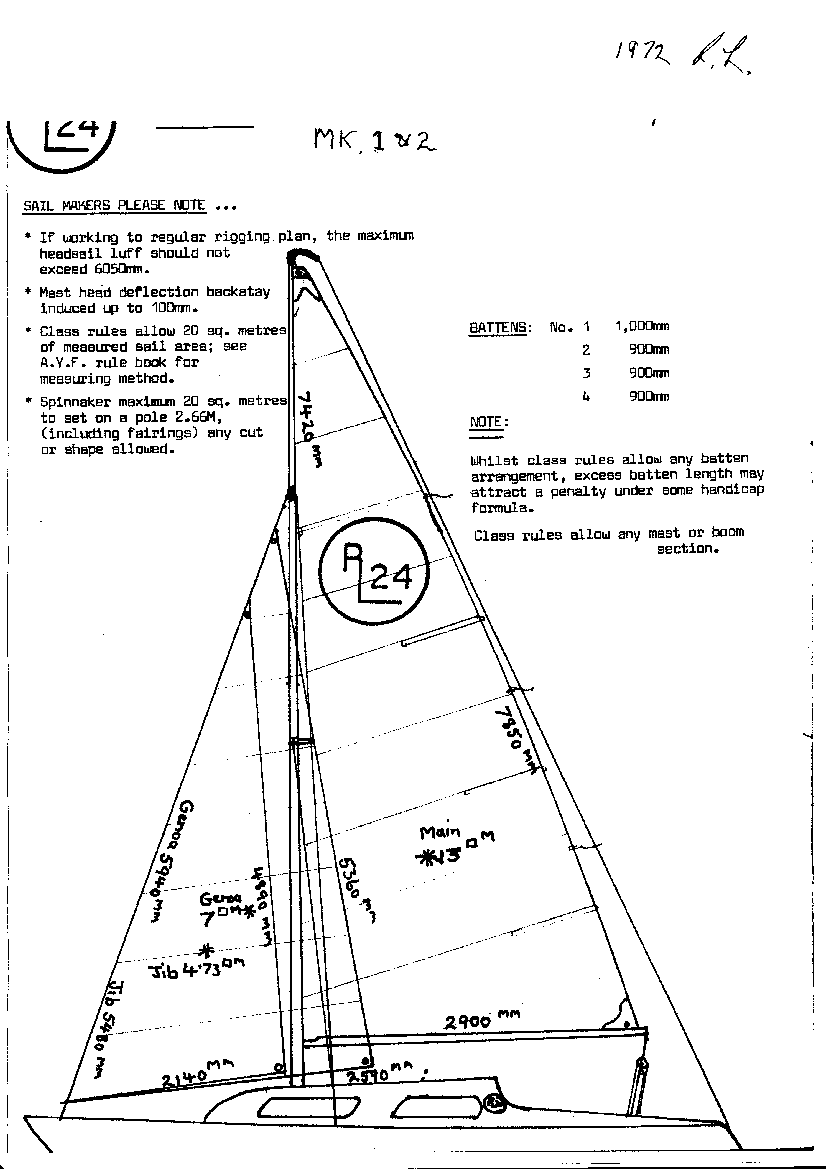
I found this diagram of your rig. It's a pretty standard fractional setup for the 70s and 80s; 3/4 fractional with single swept spreaders and lowers. No-one uses 3/4 fractional anymore, its all 7/8 or 9/10.

As you can see, the spec calls for a max masthead defection of 4 inches. That is done with an adjustable backstay. You NEED that to bend the mast. As Joe notes, your sail would be designed for that.

But to start, make sure you have PRE-BEND in your mast. That is set up with the correct tension on your V1 (outer) shrouds. Tightening these to correct tension will bend the mast. The lowers must be loose enough not to inhibit this. The correct pre-bend would probably be 2-4 inches at mid-mast. This will help to draw some of the belly out of the sail. Going full backstay might come close to doubling that.

Note that bending the mast with the backstay only flattens the mid-section. As the backstay pulls back, the mast bends with the forestay as a pivot. Only the part below the forstay is flattened, mostly in the middle. The bottom of the sail is flattened with the outhaul. The top above the forestay cannot.

Hope some of this helps.
 
Sep 20, 2014
1,330
Rob Legg RL24 Chain O'Lakes
Thanks, in everything I have read, I did not see that specific setup info. This information is shown for the MK1 and 2 versions, which did not specifically have a bendy mast, but the mast is lighter than the American versions. My boat is most like the MK3 version, but I would surmise that the max bend is probably still a good guideline to go by, even though it is for the earlier versions.

It looks like what I need to do is set this thing up in my driveway where I can do some real measurements and the mark stuff down. Then put some hash marks on the turn buckles, so I can repeat the setup at the launch ramp. Since its been so cloudy lately, I can probably site the mast with a laser. (I'd rather play with toys then use a plumbob)

Something else interesting to note, the drawing shows the head sail as low to the deck as possible. I asked on the RL website which is better, because this leaves about a foot gap at the head. No one seemed to know for sure, other than suggested copying what ever the racers are doing.
 
Nov 8, 2010
11,386
Beneteau First 36.7 & 260 Minneapolis MN & Bayfield WI
Thanks, in everything I have read, I did not see that specific setup info. This information is shown for the MK1 and 2 versions, which did not specifically have a bendy mast, but the mast is lighter than the American versions. My boat is most like the MK3 version, but I would surmise that the max bend is probably still a good guideline to go by, even though it is for the earlier versions.

It looks like what I need to do is set this thing up in my driveway where I can do some real measurements and the mark stuff down. Then put some hash marks on the turn buckles, so I can repeat the setup at the launch ramp. Since its been so cloudy lately, I can probably site the mast with a laser. (I'd rather play with toys then use a plumbob)

Something else interesting to note, the drawing shows the head sail as low to the deck as possible. I asked on the RL website which is better, because this leaves about a foot gap at the head. No one seemed to know for sure, other than suggested copying what ever the racers are doing.
Normally any 3/4 fractional mast will be somewhat bendy, just by design. But ones with tapered tops will be even more so. If yours is not tapered it will not bend as much, but it will still bend, both under the static tension of standing rigging, and the pressure of the backstay.

The uppers shrouds on frac boats with swept spreaders (like yours) are always rather tight. Typically 20% of the shroud breaking strength. I'd get (or borrow) a loos gauge to do it the first time. Where are you located?

For best aerodynamic performance (plate effect), the foot of a headsail should be as close to the deck as possible. I did note that the class limits sail size based on area and not dimension, so it's slightly less important to have a deck sweeper.
 
Sep 20, 2014
1,330
Rob Legg RL24 Chain O'Lakes
I live west of Chicago. I do not know any other sailors around, so the chances of me coming up with a gauge is slim to none. I think I can make something to measure the shroud tension.
 

RichH

.
Feb 14, 2005
4,773
Tayana 37 cutter; I20/M20 SCOWS Worton Creek, MD
Disagree about setting up mast pre-bend / pre-bow on this boat - impossible to do without forward lower shrouds, check stays, etc. The drawing shows that this mast can be bowed only by backstay tension (working against a tight forestay).

Special consideration: setting up mast bend via backstay tension will be inhibited by the tension in the single aft lower stays. To set this up with max. mast bend, do this in order: -
1. LOOSEN the aft lower stay,
2. apply your desired backstay tension / mast bend, then ...
3. 'run up' the tension on the aft lowers until strong 'hand-tight'.
Note: when finished sailing for the day, the mast should be brought back to 'straight-up'.

Especially if this is a Johnson (White Bear Lake, MN) built boat, Id expect that the side stays are rapid hand adjustment turnbuckles - a BIG hex-nut and a spring-type nut restrainer that 'rides' on TWO 'indexed' chain plate 'extensions'. This was the typical Johnson rigging hardware - for about 90 years until they stopped (?) making 'scows' and other sport boats.

Does this mast fit into a deep 'socket' on the coach roof, or alternately a wedge shaped metal 'bar' with the apex of the wedge pointing 'up'?
Are there thick 'wood wedges' placed along the side of the mast at its base on the coach roof?
If yes, the cap shrouds are just run up 'hard' hand tight after the maximum backstay tension is applied to bend the mast ... in accordance to the day's conditions.

Your location is on the periphery of 'ILYA scow country'. FWIW and If possible, Id recommend for you to seek out a big scow owner (M20, I20, C or D-scow, E-scow or larger) locally to help you set up and show you how to bend this mast and to set the tension of the rigging ... especially if there is a 'deep 'socket' for the base / butt of the mast to 'fit in'.

Again, Id recommend that you 'measure' the mainsail on flat ground to determine if or how much the luff is 'forward curved'.
Also, if the mast can easily be bent ...if 'easy' and the mast groove is sufficiently large, Id recommend that you consider to attempt to remove the slugs and see if the mainsail luff 'boltrope' (a three strand dacron rope inside a sleeve tape) can fit inside the mast 'groove'. Reason: if you 'can' significantly bow/bend this mast the boltrope IN the groove will affect a smooth luff shape. With slugs and a bended mast, the space/distance between the mast and the sail will be 'variable' and you wont get 'prime' sail 'shape'.

More: for a 'fast' boat like yours, you generally want the maximum draft to be 'well forward' and the luff leading edge shape 'well rounded'; therefore, HEAVY halyard tension for other than light wind sailing.
 

RichH

.
Feb 14, 2005
4,773
Tayana 37 cutter; I20/M20 SCOWS Worton Creek, MD
BTW, the drawing in post #26 is showing a 'tapered' mast.
 
Nov 8, 2010
11,386
Beneteau First 36.7 & 260 Minneapolis MN & Bayfield WI
Disagree about setting up mast pre-bend / pre-bow on this boat - impossible to do without forward lower shrouds, check stays, etc. The drawing shows that this mast can be bowed only by backstay tension (working against a tight forestay).
Simply incorrect. Every fractional boat with swept spreaders sets prebend by dialing in rig tension. The aft sweep forces a bend in the mast when the tension come on. We typically dial in 3 inches or our 260 and 4 on our 36.7 this way. The pogo 12.50 has no backstay and runs with 6 inches of prebend set by shroud tension.
 

RichH

.
Feb 14, 2005
4,773
Tayana 37 cutter; I20/M20 SCOWS Worton Creek, MD
Your talking oranges when Im talkin' apples. ;-)

Only if the spreaders are socketed to the mast. Most swept spreaders on these sized (RL24) boats are usually pin-set to the mast ... free to swing. Most 'sport boats' and scows (bendy rigs) are set up this way and for that very reason - on-the-fly adjustment of mast bend (and Im not referring to normal mast 'pre-bow').

Without a 'restraining' stay (ie. check, fwd lower, etc.) there is 'nothing' for any 'reaction' to take place on SINGLE spreader rig when dynamically bending the mast to meet specific and varying sailing conditions such as flattening or powering up. Note where the capshrouds terminate on the RL24 --- at the forestay hounds; how do you bow above the hounds on a single cap shroud boat? Simple 'static' analysis.

With 'spreader to spreader' intermediates as on a multispreader rig, you are not adjusting for mast bend in the true sense of flattening/powering-up, youre setting a static 'pre-bow', an entirely different function and purpose; not dynamically 'bending' the mast in accordance to varying sailing conditions.
Pre-bow is set and forgotten until the end of the season.
My point is on-the-fly 'dynamic' mast bending. With dynamic mast bending the mast goes towards un-bent shape coming out of a tack to accelerate and then bend is gradually applied incrementally for faster and faster speed ... and then reversing the sequence going into a tack when radically powering up to power-pinching as before a roll-tack. etc. When racing one of my scows, I might change the mast bend 4 or 5 times ... per leg (flatter is faster for any planing hulled or semi-planing hulled boat. One uses mast bend to flatten ... or power up). Dynamic mast bending on such sport boats is commonly used INSTEAD of reefing. Also the reason you'll hardly ever see a twisted-up sail on a planing hull sport boat or scow -- those that do get a 'dunkin' when the surprise power-up occurs.
Tell me that youre constantly readjusting your mast bow on a multi-spreader rig on-the-fly in order to change sail shape and control heel angle. I Dont think so. ;-)
BIG functional difference between setting up a static 'pre-bow' and radically changing mast bend to flatten or power-up constantly when on the water. We're talking entirely different functions of mast bending here ... your setting up a static bend to match what the sailmaker cut into the luff; my discourse is all about on-the-fly sail SHAPING on sometimes quite sophisticated and complex rigs. VERY BIG difference. ;-)
 
Sep 20, 2014
1,330
Rob Legg RL24 Chain O'Lakes
Thanks for the link to the write up. It is interesting that they state there should not be any slack on the leeward shroud until 20 degrees of heel. While I've not ever gone up and felt the tension, I have not seen any slack at any heel. I've never tensioned the rig, but when I raise it, I use the jib halyard to pull the mast forward enough to pin the forestay. I can't think that is 20% of rated tension, but it does not show slack under sail.

I will have a look at the ruler method when I set it up. That will be much simpler than what I was imagining and should put me in the ballpark.

Something I just thought of last night. The photo of my sail was taken with a POV camera, which means it has a super wide angle lens. The result is a fish eye affect as you get to the outer edges of the picture. That may make the pocket look deeper than it really is down low. I really need to get this thing set up in my driveway on a breezy day, so I can mess with it when I don't have to sail the boat.
 
May 17, 2004
2,111
Other Catalina 30 Tucson, AZ
Speaking of messing with the sails on the trailer in the driveway. My first BIG boat was a MacGregor 22. I loved that boat but I didn't "get" sail trim at the time. I purchased the boat in Lake Havasu, AZ where we had a second home. On this section of the Colorado River it either blow "90 or zero". Some days were a waste of time to put the boat in the water so I'd use my driveway.

I'd turn the trailer in the driveway towards the wind and hoist the sails trying to figure out what the sail trim controls were all about. My wife and neighbors thought I was nuts but I was trying to learn sail trim. Unfortunately, i didn't know what I was adjusting. I'd push/pull all the controls trying to see the effect on the main and jib. All went well until one day along came a heavy gust and I almost tipped the boat off the trailer. I didn't give up and on another day when I encounter another even heavier gust I almost "sailed" the boat/trailer through my fence!! The wind is a powerful force.
 
Sep 20, 2014
1,330
Rob Legg RL24 Chain O'Lakes
So when the boat went forward toward the fence, rather than almost flipping over, that meant you finally figured it out? Guess I'll leave the boat attached to the car. And yes, my neighbors have told me I'm a constant source of entertainment.
 
May 17, 2004
2,111
Other Catalina 30 Tucson, AZ
Daveinet: Actually, one thing I did learn from "sailing in my driveway" and it was just by accident and that was to release the traveler in a gust.
 
Nov 8, 2010
11,386
Beneteau First 36.7 & 260 Minneapolis MN & Bayfield WI
Your talking oranges when Im talkin' apples. ;-)

Only if the spreaders are socketed to the mast. Most swept spreaders on these sized (RL24) boats are usually pin-set to the mast ... free to swing. Most 'sport boats' and scows (bendy rigs) are set up this way and for that very reason - on-the-fly adjustment of mast bend (and Im not referring to normal mast 'pre-bow').

Without a 'restraining' stay (ie. check, fwd lower, etc.) there is 'nothing' for any 'reaction' to take place on SINGLE spreader rig when dynamically bending the mast to meet specific and varying sailing conditions such as flattening or powering up. Note where the capshrouds terminate on the RL24 --- at the forestay hounds; how do you bow above the hounds on a single cap shroud boat? Simple 'static' analysis.

With 'spreader to spreader' intermediates as on a multispreader rig, you are not adjusting for mast bend in the true sense of flattening/powering-up, youre setting a static 'pre-bow', an entirely different function and purpose; not dynamically 'bending' the mast in accordance to varying sailing conditions.
Pre-bow is set and forgotten until the end of the season.
My point is on-the-fly 'dynamic' mast bending. With dynamic mast bending the mast goes towards un-bent shape coming out of a tack to accelerate and then bend is gradually applied incrementally for faster and faster speed ... and then reversing the sequence going into a tack when radically powering up to power-pinching as before a roll-tack. etc. When racing one of my scows, I might change the mast bend 4 or 5 times ... per leg (flatter is faster for any planing hulled or semi-planing hulled boat. One uses mast bend to flatten ... or power up). Dynamic mast bending on such sport boats is commonly used INSTEAD of reefing. Also the reason you'll hardly ever see a twisted-up sail on a planing hull sport boat or scow -- those that do get a 'dunkin' when the surprise power-up occurs.
Tell me that youre constantly readjusting your mast bow on a multi-spreader rig on-the-fly in order to change sail shape and control heel angle. I Dont think so. ;-)
BIG functional difference between setting up a static 'pre-bow' and radically changing mast bend to flatten or power-up constantly when on the water. We're talking entirely different functions of mast bending here ... your setting up a static bend to match what the sailmaker cut into the luff; my discourse is all about on-the-fly sail SHAPING on sometimes quite sophisticated and complex rigs. VERY BIG difference. ;-)
Hey Rich,

Interesting discussion!

First on both our boats (single spreader First 260 & double spreader First 36.7) the backstay is an active sail control that is played and much as the traveler in breezy conditions. On both boats is is run double ended to a position where the maintrimmer has it in hand on either board. So backstay/mastbend is very much an active control.

Of course when setting prebend, above the hounds the mast section follows the angle of the bend below it without any more curve. And you are right the backstay will pull this section back further. But any curve ABOVE the hounds does nothing to flatten the sail; indeed as the mast section here is moving backward, not forwards, the sail gets fuller, not flatter.

Indeed in my book on fractional rigs, the only control of the SHAPE of the sail above the hounds you have is via traveler (AOA) and mainsheet/vang (twist).

On fractional boats without runners (most nowdays) prebend is added to create tension in the rig and help prevent the mast from inverting. The sailmakers simply accommodate this with the static shape of the sail. Mast bending (via backstay) is still a very vital part of sail trim, just as it is in your so-called 'complex' rigs.

I don't understand your comments about pin-set spreaders, can you try again? To my understanding, if a swept upper shroud is tightened, the spreader (if loose/pinned) will settle on the position that gives SHORTEST shroud run (a straight line) as turns are taken on. It can't move as any sideways movement or swing would require the shroud to be longer (basic geometry). As the spreader will not compress,that section under the spreader is pushed forward, bending the mast. I don't see how this is any different than a fixed base spreader. Am I missing something?
 
Sep 20, 2014
1,330
Rob Legg RL24 Chain O'Lakes
Don, Something I have played with is using a bungy on my traveler. Tends to be somewhat self adjusting, once you get the tension right.


...
Of course when setting prebend, above the hounds the mast section follows the angle of the bend below it without any more curve. And you are right the backstay will pull this section back further. But any curve ABOVE the hounds does nothing to flatten the sail; indeed as the mast section here is moving backward, not forwards, the sail gets fuller, not flatter.
...
OK, I'm trying to think purely from a mechanical stand point (as opposed to sailing experience) If you hold a rigid post at near midpoint, and pull on one end, the arc will be distributed over the complete surface, won't it? If the arc is evenly distributed, then the affect would be evenly distributed as well, no?

On fractional boats without runners (most nowdays) prebend is added to create tension in the rig and help prevent the mast from inverting. ...
Inverting? Is that a PC term for capsize? :)