Sail twist

Sep 20, 2014
1,330
Rob Legg RL24 Chain O'Lakes
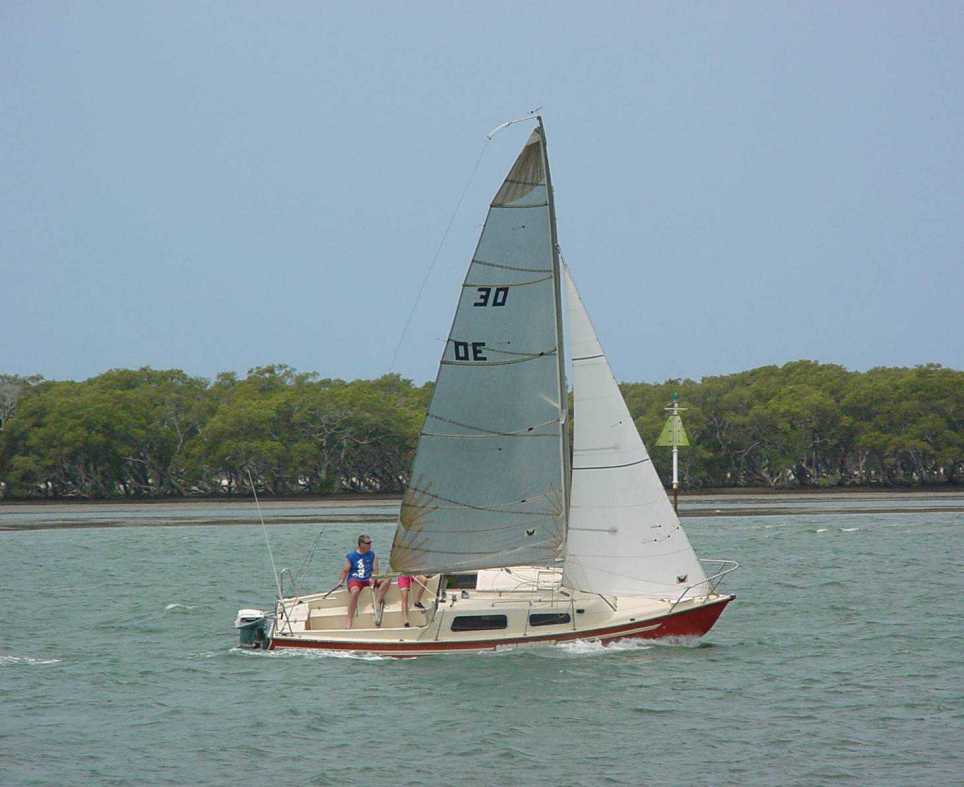
I bought a new to me boat this summer, and while I'm fairly happy with the performance, I'm not satisfied with the shape of my main. Seems like what ever I do, and regardless of the conditions, I can not get the top of the sail to twist open. It always seems to sag under its own weight. I end up with a crease right behind the start of the battons that extends from the top all the way down to just below the middle of the sail. I can run the main car to either side, very the tension on the main, seems like everything I do has little affect on the sail twist. I have a photo here of the sail (extracted from a random video). At that point we were over powered, so the sail is out as far as it will go and not flap. Even when the boat is not over powered, I still end up with nearly the same shape, although the luff will fill out some, but still leaves a crease. I tried cranking in some backstay tension, but that did not seem to change anything.


And with no wind, just hanging there.

 

Joe

.
Jun 1, 2004
8,323
Catalina 27 Mission Bay, San Diego
pull the traveler to windward, then ease out the mainsheet, no vang. What you're doing is reducing tension on the leech allowing the top battens to open, but keeping the boom somewhat centered.
 
May 17, 2004
2,111
Other Catalina 30 Tucson, AZ
Cranking on the back stay won't help your situation. Probably all you've done is increase weather helm because the boat thinks you picked up the mast and moved it aft.

The primary mainsail trim control for TWIST is the the BOOM VANG, which I can barely see in the picture. Release the tension on the vang and the top 1/3 of the sail should open. Crank on it and the top will close. You don't have to be sailing to see it work - you can see if it works right in your slip.

All of the sail trim controls for the main and jib are only adjusting 4 things -- draft depth, draft position, twist and angle of attack. A sailor has to know which sail trim controls adjust each of those element or it's like shifting a sports car into 2nd, flooring the accelerator and then pulling on the emergency brake!! In other words, the actions could be working against each other.

With each SAIL TRIM CHART I provide a FREE QUICK REFERENCE which outlines all the sail trim controls for the main and jib and tells you which way to pull or push them to get the effect you desire to adjust the 4 elements I outlined above.
 

Sprega

.
Sep 12, 2012
115
O,day 27 Brownsville Marina
How old is this sail? Can you adjust the max. Depth of draft into the front third of the sail? If not, it is probably time for a new main.
 
Nov 8, 2010
11,386
Beneteau First 36.7 & 260 Minneapolis MN & Bayfield WI
Joe called the procedure to add twist.

The sail looks very old. In the bottom picture, are all your tell tails flying?

Before you add twist to a sail, you need to be able to flatten it out. Try with the sail up on a calm day. It looks like a fractional rig, so full backstay, full outhaul, full Cunningham, full vang.

Ideally, you could make it look like a curved piece of sheet metal. That's what a new sail would look like. I'm guessing you will be able to pull the edges right, but the body of the sail will sag.

If it still sags and has lots of belly, it's blown out. The bolt rope trick might help a bit, but Dacron does stretch and loose its shape.
 
Sep 20, 2014
1,330
Rob Legg RL24 Chain O'Lakes
The boom vang was not to particularly tight in this photo. Most of the time, the vang is drooping, as I would normally be too busy to do anything with it. In more moderate winds, I have tried to physically lift the boom, Which doesn't seem to change much, other than fold at the bottom. The back of the sail just seems to always hook around. There is a leach tension line, which I have played with. I can only make it worse. After playing with it, I decided it was doing nothing for me, so I left it completely loose. The sail seems to just have a permanent shape, no matter what I do to it. The sail is not particularly baggy, the lower section does flatten out if you pull it tight. It almost seems as if the leach is cut too short. In light to moderate winds, the boat is very fast, but as the winds pick up, the boat is a little too tender to get top speed out of it. That is why I'm trying to get the top of the sail to do something other than hook. The boat is designed to plane easily, which I have had it just barely do, but I know I'm not anywhere near close to design speed. In 15 to 20, this boat should easily do 10 knots +. Designer states the boat will cruise at 14 knots, although that is with full batton main.
 
Jul 27, 2011
5,180
Bavaria 38E Alamitos Bay
Designer states the boat will cruise at 14 knots, although that is with fully battened main.
GET ONE!--As long as you have a boat like that one, you may as well have FUN with it!! (That sail looks really tired in the pics!]
 
May 17, 2004
2,111
Other Catalina 30 Tucson, AZ
Obviously, it's hard to tell the condition of your sail from the two pictures but it (looks?) to be in good shape. Before I'd dash out and buy a new sail I'd contact a sail maker in your area and have him take a look at it. For a few bucks, it's amazing what a "nip & tuck" will do for your sail and you might be able to get a few more years out of it.

One suggestion is GOD put all the sail trim controls for your main and jib on your boat for a reason and you should learn their function so you can obtain 100% efficiency. Maybe you'll be able to get the boat up to 20MPH!!!
 

Joe

.
Jun 1, 2004
8,323
Catalina 27 Mission Bay, San Diego
Did a little research on the RL24... very popular racing class in Australia. Comparing the sail in your picture with the one below.... do you see a difference? Was your sail made for your boat? Notice the fractional rig design and the backstay kicker. That is to accommodate a full roach main and give some leverage for bending the mast. If you peruse other racing rl24 pics you'll readily notice the bendy masts.
 
May 17, 2004
2,111
Other Catalina 30 Tucson, AZ
Joe: Thanks for your research. We were off on a tangent with incorrect advise when it looks like his sail doesn't match his boat.

Under the best of wind conditions, the proper sail trim and the correct sails - do you think he could get 14 knots out of that boat??
 
May 24, 2004
7,215
CC 30 South Florida
It looks like the boat may have been re-rigged and the sail whether original or not does not fit the re-rig. It does not look like a planning hull so top speed 5.5 knots and not much better.
 
Jul 27, 2011
5,180
Bavaria 38E Alamitos Bay
Joe: Thanks for your research. We were off on a tangent with incorrect advise when it looks like his sail doesn't match his boat.

Under the best of wind conditions, the proper sail trim and the correct sails - do you think he could get 14 knots out of that boat??
Yeah--notice the fully-battened mainsail, as well!
 
Jan 1, 2006
8,008
Slickcraft 26 Sailfish
If you're going to go 14 knots I recommend tilting the outboard up or taking it off. Otherwise the water will tear it off.
do you think he could get 14 knots out of that boat?? No!
 
Last edited:
Sep 20, 2014
1,330
Rob Legg RL24 Chain O'Lakes
It believe it will plane, as I have seen a solid 7.8 mph on the GPS. Most of the photos you will find are of the Aussy boats. The bendy mast and gaf rig are unique to the Mark IV version. From what they tell me, the Mark III Oz boats are like the USA built boats. (no gaf rig) They state when they race between the 2 boats, the difference between the speed is mostly seen in acceleration. Not much difference in the way of actual speed. I don't have a backstay kicker, just a short little stub to miss the top of my more conventional sail. I am told the American boats have a heavier rig. I don't know if my mast will bend as far as the picture shows, or if I should ever really try to.
The boat is pretty light for the sail area - SA/D is 26.85. From what I've read, realistic numbers are 10 to 12 knots. The hull is flat, but it is not wide in the stern like modern race boats.

Back to the main sail. All of the OZ boats have a light weight mast, regardless of the sail type. If I theorize from a mechanical standpoint, it seems if I bent the top of the mast back, that would put some slack in the leach, which would allow it to twist. If this is mechanically correct, it makes me wonder if the sail was built to OZ specs, which has a mast that easily bends, which would put some slack in the leach. Since my American mast is fairly stiff, I wonder if it holds the leach too tight. I don't think these are original sails, as there is not a sail number or brand insignia on the sail. (The only other American boat I have seen did have the logo on the sail). This kind of brings me back to if a sail maker can tweak it, assuming that is what is wrong.

If you're going to go 14 knots I recommend tilting the outboard up or taking it off. Otherwise the water will tear it off.
do you think he could get 14 knots out of that boat?? No!
Or start it :). The picture does not show the motor in the stock location, which is inside the boat under the tiller. With a short shaft motor, you can tilt it out. Mine came with a long shaft, so I have to lift it out. If I have a lot of people in the back, it goes in the cabin.
 
Nov 8, 2010
11,386
Beneteau First 36.7 & 260 Minneapolis MN & Bayfield WI
It believe it will plane, as I have seen a solid 7.8 mph on the GPS. Most of the photos you will find are of the Aussy boats. The bendy mast and gaf rig are unique to the Mark IV version. From what they tell me, the Mark III Oz boats are like the USA built boats. (no gaf rig) They state when they race between the 2 boats, the difference between the speed is mostly seen in acceleration. Not much difference in the way of actual speed. I don't have a backstay kicker, just a short little stub to miss the top of my more conventional sail. I am told the American boats have a heavier rig. I don't know if my mast will bend as far as the picture shows, or if I should ever really try to.
How very cool.

Oz and NZ had a long and vibrant history of building smaller-mid sized keelboats that plane. Most sailors from that region can no longer stand to get on a boat that does not! If you (or anyone) is interested in an EPIC read on the subject, can I suggest LIGHT BRIGADE? Its available in free ebook form here.

http://www.boatdesign.net/forums/at...rter-tonners-magic-bus-new-light-brigade1.pdf

On to the sail. It being a traditional pinhead like you have, or a max roach sail should not matter much in this case. The max roach sail is designed to generate more lift in light airs. Indeed in a breeze it becomes just extra sail area and pressure you have to deal with. Net-net, you boat should sail just fine with a well fitted pinhead sail. We have both for one of our boats and use them interchangeably.

The backstay 'flicker' shown in the picture that Joe posted does not add leverage to the backstay. It is simply a fiberglass batten that lifts the slackened backstay over the full roach when tacking in light airs. When the backstay is on full it bends under the pressure and has no effect on sail shaping.

Now for shape. You HAVE to try and flatten it out. As you allude to, the fractional rig should allow a degree of bending (via the backstay) that will flatten out the mid section. It does nothing for the bottom (outhaul for that) or the top (nothing you can do!)

A good cunningham will help flatten a bit, and more importantly pull the position of max draft forward.

Make sure your D1 shrouds (lower diagonal) are not too tight; they stop forward motion of the mast and resist the bend.

As shown below, your max draft is 18%. If that is a flat as you can make you sail its done with. That number should be in the 8% range. Note that trying to over-flatten a blown out sail actually 'hooks' the leech to windward, making the problem worse.

You can also see that yoursail IS twisted off. it's just too full for it to matter.


Sprega

.
Sep 12, 2012
115
O,day 27 Brownsville Marina
Did a little research on the RL24... very popular racing class in Australia. Comparing the sail in your picture with the one below.... do you see a difference? Was your sail made for your boat? Notice the fractional rig design and the backstay kicker. That is to accommodate a full roach main and give some leverage for bending the mast. If you peruse other racing rl24 pics you'll readily notice the bendy masts.
It should be pointed out that the RL24 was reconfigured many times and only the last reconfiguration had the full battened main with the back stay kicker. That model became a very popular racing class. It also had a drop keel in place of the centerboard found on earlier models.
 
Sep 20, 2014
1,330
Rob Legg RL24 Chain O'Lakes
Thanks for all the feedback. Jackdaw, Drawing over the top of my photo really helps. I was thinking the sail was reasonable flat, especially as you get to the lower part of the sail. however when you compare the stitch lines to a straight line, then it becomes much more obvious. The photo is extracted from a video that happened to cross the sail at a random moment in time. One thought I have it that I was spilling air off the sail because I was over powered. However you have sent me down a path, that now that I'm thinking about it, normally when the sail is too far leeward, the leech should flap. Instead the luff is billowing. If I am interpreting things correctly, the fact that the luff is billowing before the leach flaps suggest the sail is too full. Is that a correct?
 
Nov 8, 2010
11,386
Beneteau First 36.7 & 260 Minneapolis MN & Bayfield WI
Thanks for all the feedback. Jackdaw, Drawing over the top of my photo really helps. I was thinking the sail was reasonable flat, especially as you get to the lower part of the sail. however when you compare the stitch lines to a straight line, then it becomes much more obvious. The photo is extracted from a video that happened to cross the sail at a random moment in time. One thought I have it that I was spilling air off the sail because I was over powered. However you have sent me down a path, that now that I'm thinking about it, normally when the sail is too far leeward, the leech should flap. Instead the luff is billowing. If I am interpreting things correctly, the fact that the luff is billowing before the leach flaps suggest the sail is too full. Is that a correct?
Sorry was sailing all weekend!

Yea. If the sail is too full and cannot be flattened, then the Angle Of Attack (AOA) of the luff will be too open an will flap/luff/flutter.

It can also be caused by the very deep belly of the sail being back winded by the jib.
 
Nov 8, 2010
11,386
Beneteau First 36.7 & 260 Minneapolis MN & Bayfield WI
PS - that is a North Sails sailscan app that drew those curves and measurements on your sail. Quick and easy. Recommended.