Hi all,
I would like to add a fuel polisher to an existing tank. I have a dual Racor filter system that I can switch, but was wondering if adding a polisher would help eliminate some stirred up sediments? Could I use one of those filters and just add a pump? Would tapping another hole in the aluminum tank suffice? The other option would be to have the fuel polished by a yard.
All U Get
Neither options will get what you want.
1. If you have sediment or a 'black scum' growing on the tank walls ... no polishing system will work, effectively. Recirculation polishing WILL NOT clean the tank walls / bottom !!!!!!!
What you need to do is get inside the tank and mechanically scrub ALL the debris to the bottom ... and discard the 'sludge' one 'handful of rags or paper towels' at a time.
2. The primary purpose of fuel polishing system is to *keep the sludges/growth, etc. from building up* ... a polishing system removes very small (essentially submicronic sized) particles continually thus removiing the 'nucleation site' upon which such particle agglomerate (grow in size). The typical 'boat system' recirculation polisher will be 'high turnover' (3 gpm / 100 gallon tank) using CHEAP filters of about 10-15µM ... filtering MANY MANY MANY times through such a large sized filter will ultimately reduce the 'particle distribution' down to
optically clear (less than 5µM) in about 3-6 HOURS. Racors are EXPENSIVE and only hold about 25-35 grams of 'crud', dont use them in a recirculation polishing system.
3. EXPENSE. for a 50 gallon tank if you threw away or 'properly disposed' it $4.00 X 50 = $200.00 A recirculation polisher estimate cost for 50 gallon tank Pump - $150, Steel filter housing $90, 3pcs. depth type 2.5"Ø X 10in long filter $20 ea. X 3 = $60.00, SEPARATE piping system - Est. $50.00 ........ for a total of ~$450.00
Its much simpler and cheaper to: drain the tank, get INSIDE and clean the tank, burn the crud in your home heating furnace. Cost ... a couple of rolls of paper towels and gallon of STRONG detergent.
4.
Tank taps ... DONT DO IT !!! will cost you a fortune if one of YOUR fittings 'gets loose' and fills the bilge and gets pumped overboard. Only 'tap a tank' through a TOP manhole or hand hole or other access port ... NEVER through the tank walls or bottom - or if you do 'pollute' your insurance carrier may not pay for the damages because YOUR modifications were not following 'state of the art' practices .... tap ONLY through the TOP of the TANK (through a reinforced 'plate'), not the walls nor the bottom.
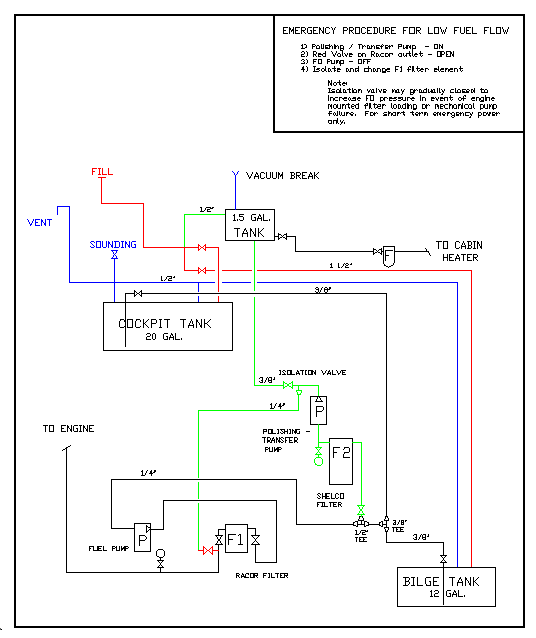
A reciruclation polishing system should be TOTALLY INDEPENDENT of the fuel delivery system .... TANK recirculation loop DIP TUBE (to the VERY bottom of the tank) --> PUMP (with integral screen) --> filter housing ---> back to tank. You 'may' cross-valve connect to use the recirculation system in an EMERGENCY to '
pressurize' the main fuel distribution system ---- but otherwise if non-emergency should be 'locked out' and
'separate' from the MAIN FUEL DELIVER SYSTEM.
If you do a lot of long distance cruising or cruise in the 'remote' places of the planet and NEED an onboard recirc. polisher, we can help with your design ... otherwise I suggest you buy a 'case' of paper towels and a long handled scrub brush. If after tank cleaning the tank quickly (1-2 years) forms a lot of 'sludge',
then consider to put on a recirculation polisher.
Rx:
Clean the tank (as clean as your mothers dishes), then see how long it takes before you need to clean it again, then make a decision to add an onboard 'recirculation polisher'. Filters cannot 'clean out a tank', they only clean up the oil not the crud thats stuck to the tank walls.
;-)