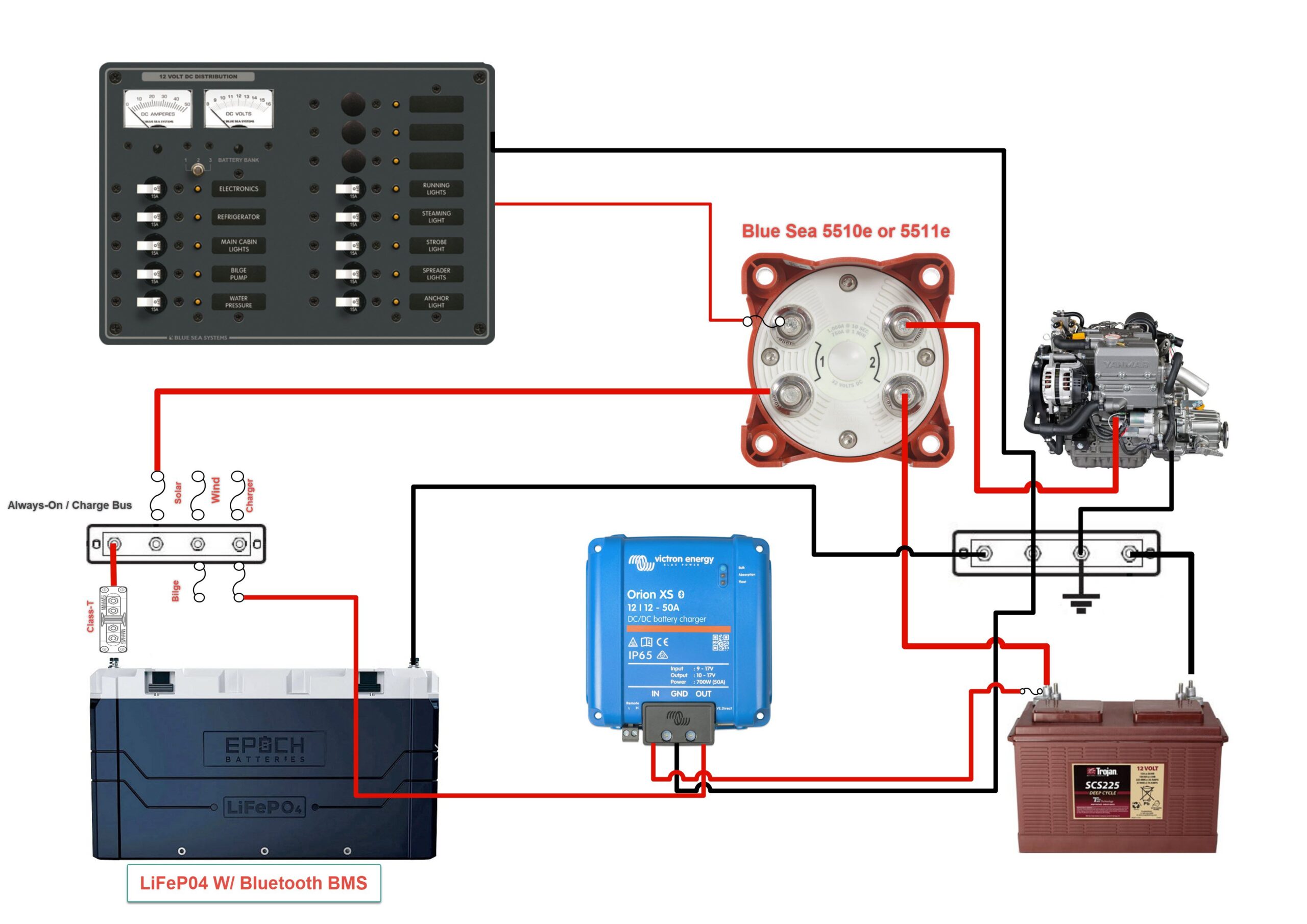
1. What brand of LiFePO batteries did you install? Why did you chose this brand? How satisfied are you with those batteries?
On my previous boat I installed a 300Ah EPOCH Essentials V2 with Victron Comms. On my current boat I am installing two EPOCH Essentials 460Ah. Originally the Victron Comms could not be daisy chained, so current boat batteries do not have comms. I believe they have changed that now so multiple batteries can be all talk to a Victron system.
Epoch batteries get a good review on Will Prowse's youTube channel, and they are made local to me. They have not let me down yet.
2. Have you had any failures and or a need to replace your Lithium batteries? Was it an inherent problem with the batteries or an installation issue? Was it covered under warranty?
No issues.
3. How many AH did you install and what is basis for your decision on size - what type of sailing do you do?
Previous boat (1985 Catalina 30) I put in a 300Ah house bank and a 98Ah AGM start bank. I originally replaced the two FLA batteries with two AGM batteries for a mixed use bank. When they aged out, I replaced with LFP and kept one AGM for a start battery. Replacing two AGMs with a single LFP almost tripled my usable capacity.
Current boat(1995 Catalina 36 Mk II) will have a 920Ah capacity house bank and a 150 Ah AGM start bank. Originally it had two 198Ah AGMs as a house bank and the 150 AGM start bank. I am adding a Victron Multiplus 12|3000|120 inverter/charger and want a bank large enough to run all the DC & AC loads while not at the dock.
4. Did you upgrade your charging system for this installation? If so, what was your choice for the upgraded alternator and Battery Charger? Why
Lithium batteries REQUIRE a change to the charging systems unless those systems are already Lithium capable.
See the MarineHowTo, BoatHowTo and other articles on the web for more information.
The Victron Inverter/Charger will charge both the house and the Start banks. I am installing 400W of solar to keep the house bank charged while away from the dock. The start bank will be charged by the engine alternator. I could add a DC-DC charger to charge the start bank from the house bank but do not see the need at this point. You could also use a DC-DC charger to charge the House bank from the Start bank while the engine is running.
5. If you had to do it again, what would you do differently? Different Brand, different capacity, different charging system, different location?
I would likely keep things the way they are.
If you have any additional thoughts that would be useful for those of us considering this change please share them with us.
There is NO SUCH THING as a 'drop in replacement' LFP battery unless you are only talking physical size. Low power dumb alternators will eventually be killed by a lithium system. Charge sources that can not be programmed for Lithium banks will harm the batteries and possibly be damaged themselves. Most cabling is not up to the carrying the amps that a lithium bank can provide. Nearly ALL LFP batteries will need a Class T fuse to have the AIC (Amperage Interrupt Current) capacity to handle the Short Circuit Current (SCC) in case of a catastrophic failure that can produce 20,000+ amps. Most cheaper fuses only handle up to 10,000 amps. YOu still size the fuse for the cables ampacity.
Just because someone is on a forum does NOT make them an expert. If in doubt, ask a qualified person or research it web sites run by reputable people. (Not all websites have good information either.) One of the best things I've read was someone saying 'Experience s the WORST teacher'. People get away with ignoring the requirements and proper procedures and think it is all a waste of money and you don't have to follow them to be safe. They may get away with it for a long time and may even never have a problem. That doesn't mean YOU will be as fortunate.
Be aware that even if the battery has a high amp hour rating, that does not mean the BMS can supply that much on a continuous basis. Make sure your batteries can provide the amount of power you -may- need on a continuous basis or you will be disappointed in them.
BMSes are great, but they are not fool-proof. Don't skip the primary circuit protections thinking that having a BMS removes the need for it. They don't.
DC and AC electricity can be dangerous. If you do not fully understand what you are doing, PLEASE get someone qualified to help (and teach) you. A bad wiring job can cause your boat to burn and even kill someone (including YOU) either in the boat or in the water near your boat.
DO NOT CHEAP OUT. Buying cheap, undersized, untinned welding cable all in the same insulation color may seem like a deal, but when the connections corrode, the cables break internally and your systems start to fail you WILL regret the cheap economy. You can't run out into the front yard to await help if you have a fire while out on the water. Marine requirements are strict, but they are there to save your boat and your life.