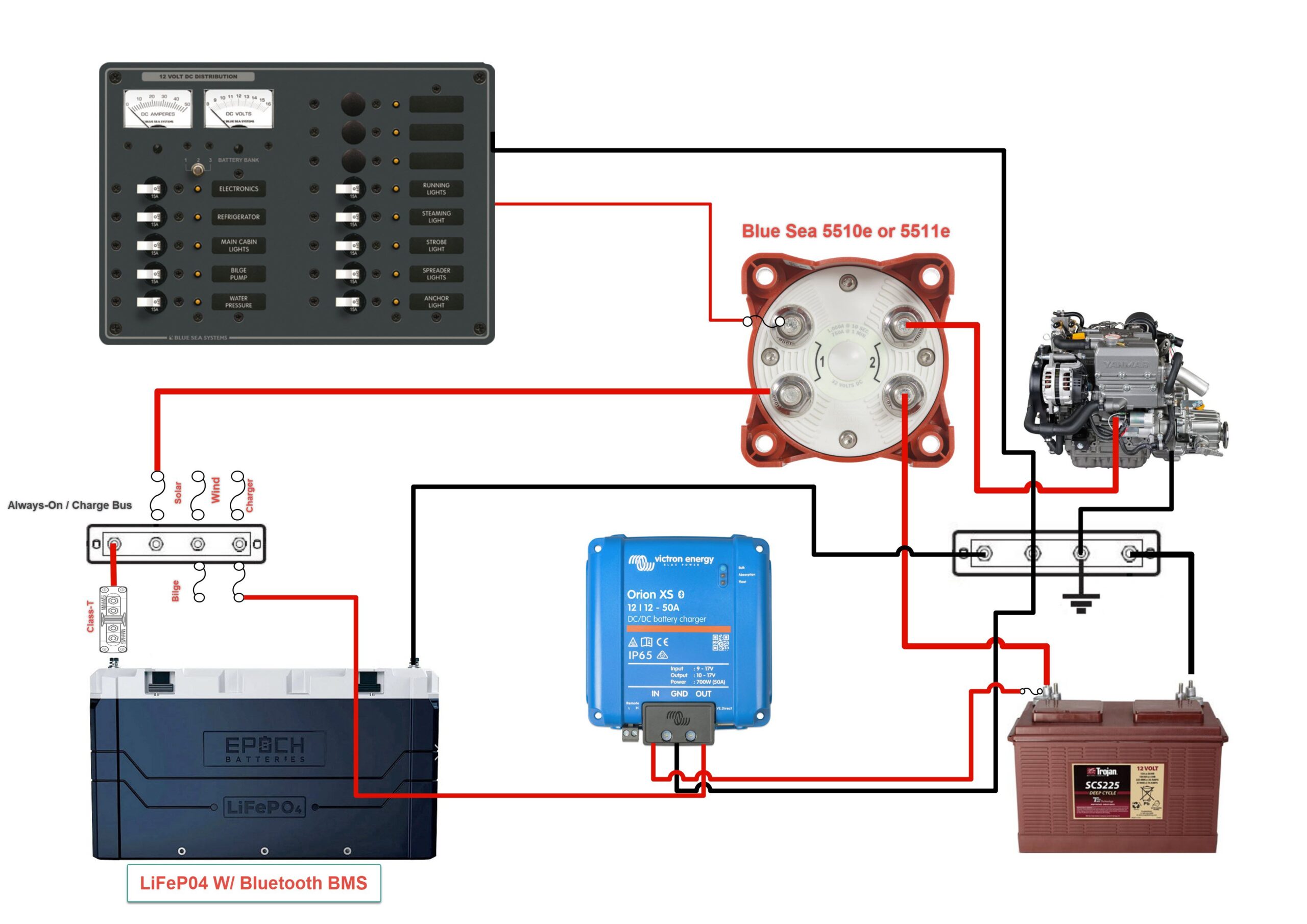
Lithium Battery Installation feedback requested

Feb 26, 2004
23,308
Catalina 34 224 Maple Bay, BC, Canada
Yes... but when I'm at anchor for 7 days, we like to have hot water for showers, dishes, etc.... We never use the engine to charge or heat water.
Good idea, now I understand. Wet cells don't hold their voltage if we tried to do that. I did it once running the engine and using the alternator to keep the voltage up for my inverter.
 
Jun 17, 2022
518
Hunter 380 Comox BC
You need a mighty house bank to heat hot water.... I've often wondered if an instantaneous propane hot water heater might work but water needs a lot of energy to heat...

dj
No, not really. About 65 Ah to go from cold to 135 F. Assuming the batteries are fully recharged by 1 or 2 pm daily (solar), might as well use the free excess energy for something? We also use the micro almost daily, blender for cocktails at 3pm and most importantly the coffee grinder :)

Running a water heating is nothing compared to folks who run air fryer, washer, air con, induction stoves off their batteries.

If you have 3-4 days of typical usage in storage, then add 300-600 W of solar, it either extends your stay or makes it almost unlimited (with the right sun and daylight hours). This was almost undoable 10 years ago in a sub 40 ft boat because of the space and weight of the batteries. I cut my battery space by half (gained a whole bench for food storage) and more than doubled my usable Ah. I took several hundred lbs out of the boat.

I know of a few boat explosions due to on demand propane water heater....
 
Last edited:

dLj

.
Mar 23, 2017
5,024
Belliure 41 Back in the Chesapeake
No, not really. About 65 Ah to go from cold to 135 F. Assuming the batteries are fully recharged by 1 or 2 pm daily (solar), might as well use the free excess energy for something? We also use the micro almost daily, blender for cocktails at 3pm and most importantly the coffee grinder :)

Running a water heating is nothing compared to folks who run air fryer, washer, air con, induction stoves off their batteries.

If you have 3-4 days of typical usage in storage, then add 300-600 W of solar, it either extends your stay or makes it almost unlimited (with the right sun and daylight hours). This was almost undoable 10 years ago in a sub 40 ft boat because of the space and weight of the batteries. I cut my battery space by half (gained a whole bench for food storage) and more than doubled my usable Ah. I took several hundred lbs out of the boat.

I know of a few boat explosions due to on demand propane water heater....
You have like a 5 gallon hot water tank?

I think mine is 15 gallons... I'd need closer to 200 Ah...

dj
 

colemj

.
Jul 13, 2004
1,033
Dolphin Catamaran Dolphin 460 Mystic, CT
I'm not sure how much ventilation is "enough". I assume we are talking passive ventilation like grates low and high and a few inches around the battery as would be described in their installation instructions?

Also I would assume they should have a hold down system sufficient to keep them from moving around and probably enough to handle a knockdown? I have found oun manufacturer that claims that at least one of their batteries is ABYC compliant. It probably has sufficient capacity for how I sail.

Ventilation of LFP isn't as critical as for lead batteries because there is no off-gassing. As for temperature, LFP internal resistance is so low that they don't create much heat. I can charge ours at 0.4C (400A) while monitoring with a thermal camera and all that happens is the 4/0 wires going to the bus bars get slightly warmer. So if you have air space around the batteries, and this space has some connection to other air space (difficult not to have this), then you will be fine.

I've never heard of the allowance of 1" of movement in any direction. It is certainly not something I would allow for anything more than maybe a small start battery with loose flexible wires connected to it. Our Group 24 start batteries are strapped to a shelf and maybe they could move 1" if pushed around hard enough. I think anything more than 0.0 inches on a house bank made from multiple cells or batteries is asking for trouble.

Mark
 

colemj

.
Jul 13, 2004
1,033
Dolphin Catamaran Dolphin 460 Mystic, CT
No, not really. About 65 Ah to go from cold to 135 F. Assuming the batteries are fully recharged by 1 or 2 pm daily (solar), might as well use the free excess energy for something? We also use the micro almost daily, blender for cocktails at 3pm and most importantly the coffee grinder :)
We are the same. We have a 6gal heater and use ~50Ah to fully heat it to shutoff. It takes ~17Ah to get the water hot enough to make my wife happy showering in warm weather (I'm a pure cold water shower in the tropics).

Of course, in the tropics the "cold" water in the tank is starting out at 85F...

We used to have a 12gal heater, and this would take over 2x as much Ah to heat water. However, we found we never needed that much hot water since it is only two of us. The 6gal heater is more than enough for 2. Could likely easily get by with a 3gal tank, but we are mostly in the tropics, so don't need steaming hot showers.

Mark
 
  • Like
Likes: marcham
Jan 11, 2014
13,951
Sabre 362 113 Fair Haven, NY
I've never heard of the allowance of 1" of movement in any direction. It is certainly not something I would allow for anything more than maybe a small start battery with loose flexible wires connected to it. Our Group 24 start batteries are strapped to a shelf and maybe they could move 1" if pushed around hard enough. I think anything more than 0.0 inches on a house bank made from multiple cells or batteries is asking for trouble
ABYC 10.7.4

10.7.4 Batteries, as installed, shall be restrained to not move more than one inch (25 mm) in any direction when a pulling force of twice the battery weight is applied through the center of gravity of the battery as follows:
10.7.4.1 vertically for a duration of one minute, and
10.7.4.2 horizontally and parallel to the boat's centerline for a duration of one minute fore and one minute aft, and
10.7.4.3 horizontally and perpendicular to the boat's centerline for a duration of one minute to starboard and one minute to port.
 
May 7, 2011
238
Catalina 36 1430 Lake Lanier
1. What brand of LiFePO batteries did you install? Why did you chose this brand? How satisfied are you with those batteries?
On my previous boat I installed a 300Ah EPOCH Essentials V2 with Victron Comms. On my current boat I am installing two EPOCH Essentials 460Ah. Originally the Victron Comms could not be daisy chained, so current boat batteries do not have comms. I believe they have changed that now so multiple batteries can be all talk to a Victron system.

Epoch batteries get a good review on Will Prowse's youTube channel, and they are made local to me. They have not let me down yet.

2. Have you had any failures and or a need to replace your Lithium batteries? Was it an inherent problem with the batteries or an installation issue? Was it covered under warranty?
No issues.

3. How many AH did you install and what is basis for your decision on size - what type of sailing do you do?
Previous boat (1985 Catalina 30) I put in a 300Ah house bank and a 98Ah AGM start bank. I originally replaced the two FLA batteries with two AGM batteries for a mixed use bank. When they aged out, I replaced with LFP and kept one AGM for a start battery. Replacing two AGMs with a single LFP almost tripled my usable capacity.

Current boat(1995 Catalina 36 Mk II) will have a 920Ah capacity house bank and a 150 Ah AGM start bank. Originally it had two 198Ah AGMs as a house bank and the 150 AGM start bank. I am adding a Victron Multiplus 12|3000|120 inverter/charger and want a bank large enough to run all the DC & AC loads while not at the dock.

4. Did you upgrade your charging system for this installation? If so, what was your choice for the upgraded alternator and Battery Charger? Why
Lithium batteries REQUIRE a change to the charging systems unless those systems are already Lithium capable.
See the MarineHowTo, BoatHowTo and other articles on the web for more information.

The Victron Inverter/Charger will charge both the house and the Start banks. I am installing 400W of solar to keep the house bank charged while away from the dock. The start bank will be charged by the engine alternator. I could add a DC-DC charger to charge the start bank from the house bank but do not see the need at this point. You could also use a DC-DC charger to charge the House bank from the Start bank while the engine is running.

5. If you had to do it again, what would you do differently? Different Brand, different capacity, different charging system, different location?
I would likely keep things the way they are.

If you have any additional thoughts that would be useful for those of us considering this change please share them with us.
There is NO SUCH THING as a 'drop in replacement' LFP battery unless you are only talking physical size. Low power dumb alternators will eventually be killed by a lithium system. Charge sources that can not be programmed for Lithium banks will harm the batteries and possibly be damaged themselves. Most cabling is not up to the carrying the amps that a lithium bank can provide. Nearly ALL LFP batteries will need a Class T fuse to have the AIC (Amperage Interrupt Current) capacity to handle the Short Circuit Current (SCC) in case of a catastrophic failure that can produce 20,000+ amps. Most cheaper fuses only handle up to 10,000 amps. YOu still size the fuse for the cables ampacity.

Just because someone is on a forum does NOT make them an expert. If in doubt, ask a qualified person or research it web sites run by reputable people. (Not all websites have good information either.) One of the best things I've read was someone saying 'Experience s the WORST teacher'. People get away with ignoring the requirements and proper procedures and think it is all a waste of money and you don't have to follow them to be safe. They may get away with it for a long time and may even never have a problem. That doesn't mean YOU will be as fortunate.

Be aware that even if the battery has a high amp hour rating, that does not mean the BMS can supply that much on a continuous basis. Make sure your batteries can provide the amount of power you -may- need on a continuous basis or you will be disappointed in them.

BMSes are great, but they are not fool-proof. Don't skip the primary circuit protections thinking that having a BMS removes the need for it. They don't.

DC and AC electricity can be dangerous. If you do not fully understand what you are doing, PLEASE get someone qualified to help (and teach) you. A bad wiring job can cause your boat to burn and even kill someone (including YOU) either in the boat or in the water near your boat.

DO NOT CHEAP OUT. Buying cheap, undersized, untinned welding cable all in the same insulation color may seem like a deal, but when the connections corrode, the cables break internally and your systems start to fail you WILL regret the cheap economy. You can't run out into the front yard to await help if you have a fire while out on the water. Marine requirements are strict, but they are there to save your boat and your life.
 
Last edited:

colemj

.
Jul 13, 2004
1,033
Dolphin Catamaran Dolphin 460 Mystic, CT
ABYC 10.7.4
Thanks. I am going to just ignore that one. One of several ABYC recommendations I don't agree with, and can present reasonable arguments against.

Mark
 
Jun 17, 2022
518
Hunter 380 Comox BC
Lithium batteries REQUIRE a change to the charging systems unless those systems are already Lithium capable.
See the MarineHowTo, BoatHowTo and other articles on the web for more information.
That's a bit of a myth... Any charger with adjustable absorption and float voltage will do.

Any charger that will do absorption at 13.8-14.4V and float at 13.6V is fine for lifep4, as long as they don't have a recondition mode.... That means the majority of AGM chargers are fine for lifepo4.

I used to charge at 14.4 and float at 13.8V. I now charge at 13.8V and float at 13.55V. There is a very very small increase in charge duration (the last 1 %), compared to 14.4 but the batteries will last longer when exposed to lower voltages. There's also less chance of developing cell imbalance. Cell manufacturers usually specify <= 3.65V / cell. Note that they don't specify a specific voltage, just a max charging voltage. Less than 3.65V is fine. Too low and you won't get 100% SOC. 13.8V is the sweet spot for most packs. They can be charged with a simple constant voltage power supply, no need for fancy chargers. You need to now at what voltage your BMS starts balancing to calibrate your pack's charge voltage. If the manual doesn't stipulate this, don't buy that brand. That's why some pack builders specify 13.8V, 14.0, 14.4, 14.6V. If you can get full capacity at 13.8V and your balancer kicks in, then there's no real benefit to charge higher.
 
Last edited:
Jun 17, 2022
518
Hunter 380 Comox BC
not move more than 1 inch in any direction

ABYC 10.7.4...

ventillation...
Not true for lithium. (I think you were quoting E10?)

For lithium, ABYC E13 applies, they specify no visible movement. This is not difficult to do. A 3/4" x 1" strip of wood will prevent lateral movement. The battery must be able to be suspended upside down without movement as well (in case of a knock down, to avoid breaking electrical connections or causing shorts). Thus, many of the new / better quality batteries come with brackets to bolt them down. This greatly simplifies installation.

If doing a lifepo4 install, do yourself a favor and pay a few $$ to get temporary access to ABYC standards, it will be worth it (a drop in the bucket compared to the cost of refitting your electrical system). Keep in mind, ABYC specifies the MINIMUM recommended. You can always do better. Your surveyor (in NA) will likely quote ABYC standards if they find defects in your insurance survey.

Don't trust ABYC pdf you may find on the internet (not from ABYC website), they are likely old standards and there's been a lot of changes in the past 4 years. There's more than one chapter required when working on your electrical (E11, E13, A28, A 31)

No need for ventilation for Lifepo4. Unlike flooded cells, they don't off gas and they don't noticeably heat up during charge. This is also covered in ABYC E13. I have never installed a Lifepo4 batt where the manufacturer stipulated ventilation requirements. Yes, if you charge a cell to 100 V (400V for the pack), the valve will release some gases.

There is still a lot of misinformation out there when it comes to Lifepo4 (even in this forum, and this thread...). Get your data from the source . OEM install manual, ABYC, RCD, CE, etc... If you are doing a self-install, get educated from the source, not just from the forums before crimping your first wire ! :)

Bad electrical is the #1 source for recreational boat fires.... do it perfect the 1st time, or don't do it all.

1770651942908.png
(source: boatus.com)
 
Last edited:
Jan 11, 2014
13,951
Sabre 362 113 Fair Haven, NY
Thanks. I am going to just ignore that one. One of several ABYC recommendations I don't agree with, and can present reasonable arguments against.

Mark
It only states the maximum movement, which if anything seems a bit liberal. I think it may date back to FLA batteries contained in a box and movement within that box. We have about an ⅛" gap around the bottom of the battery and 0" vertical as they are strapped down to the base.
 
Jan 11, 2014
13,951
Sabre 362 113 Fair Haven, NY
If doing a lifepo4 install, do yourself a favor and pay a few $$ to get temporary access to ABYC standards, it will be worth it. Keep in mind, ABYC specifies the MINIMUM recommended. You can always do better. Your surveyor (in NA) will likely quote ABYC standards if they find defects in your insurance survey.
No need to spend any money. ABYC offers a short term "Recreational Membership" for free which gives read only access to the Standards. With a little computer savvy the individual standards can be downloaded as PDFs.
 
  • Like
Likes: marcham

colemj

.
Jul 13, 2004
1,033
Dolphin Catamaran Dolphin 460 Mystic, CT
Less than 3.65V is fine. Too low and you won't get 100% SOC. 13.8V is the sweet spot for most packs. They can be charged with a simple constant voltage power supply, no need for fancy chargers. You need to now at what voltage your BMS starts balancing to calibrate your pack's charge voltage. If the manual doesn't stipulate this, don't buy that brand. That's why some pack builders specify 13.8V, 14.0, 14.4, 14.6V. If you can get full capacity at 13.8V and your balancer kicks in, then there's no real benefit to charge higher.
We also charge to 13.8V. Many times after the battery has reached 13.8V and the charge source turned off, I have re-engaged the charge and brought them to 14.5V. This usually only takes a minute, and represents an additional 0.1% of battery capacity (which is a whopping 1Ah of our 1000Ah bank). So unless charging >0.5C, specifying higher charge voltage is just stressing the chemistry for no reason.

Higher charge rates do need higher voltages, and in the same vein lower charge rates can get by with lower voltages. We are usually charging at ~0.2C with solar. On days when the solar is low and charging 0.05C or less, the batteries get completely full at ~13.6V.

I guess the charge voltage is based on the BMS balancing for the companies recommending higher voltages, but a good battery should not need much balancing, or very often. We have an external balancer that can be turned on if needed, but we haven't had any of our cells go out of balance more than 15mV at the top of the charge in a couple of years. If the battery is good, one should only need to occasionally bring it to higher voltages to check and maintain balance.

Mark
 
  • Like
Likes: marcham

dLj

.
Mar 23, 2017
5,024
Belliure 41 Back in the Chesapeake
ABYC 10.7.4
I think that's a very good example of when we say - the standards are a minimum requirement.

I have never tolerated that much movement for my batteries. They are not allowed to move. I can't imagine being in a serious storm where being in your boat is like being in a washing machine for several days with batteries thrashing around like that.

dj
 
Feb 6, 1998
11,756
Canadian Sailcraft 36T Casco Bay, ME
The Wattcycle 314Ah mini is a killer value. Some of the best physical internal construction I have seen other than Epoch.


This article shows how easy it is..
 
Feb 6, 1998
11,756
Canadian Sailcraft 36T Casco Bay, ME
We also charge to 13.8V. Many times after the battery has reached 13.8V and the charge source turned off, I have re-engaged the charge and brought them to 14.5V. This usually only takes a minute, and represents an additional 0.1% of battery capacity (which is a whopping 1Ah of our 1000Ah bank). So unless charging >0.5C, specifying higher charge voltage is just stressing the chemistry for no reason.

Higher charge rates do need higher voltages, and in the same vein lower charge rates can get by with lower voltages. We are usually charging at ~0.2C with solar. On days when the solar is low and charging 0.05C or less, the batteries get completely full at ~13.6V.

I guess the charge voltage is based on the BMS balancing for the companies recommending higher voltages, but a good battery should not need much balancing, or very often. We have an external balancer that can be turned on if needed, but we haven't had any of our cells go out of balance more than 15mV at the top of the charge in a couple of years. If the battery is good, one should only need to occasionally bring it to higher voltages to check and maintain balance.

Mark
As you know the battery I built for my own boat back in 2009, way before drop-ins even existed, was only ever charged to 13.8V. It will be 17 years old in May and still delivers 100% of rated capacity. Contrast that to Battleborn that recommends 14.6V and many of them are barely capable of delivering 60%..
 
  • Like
Likes: marcham

dLj

.
Mar 23, 2017
5,024
Belliure 41 Back in the Chesapeake
The Wattcycle 314Ah mini is a killer value. Some of the best physical internal construction I have seen other than Epoch.

@Maine Sail A rather fortuitous post. I listened to your video but I have some questions - mainly I didn't understand well how to get the discount on the batteries you are recommending. Do I have to send you a note somehow to get the discount? Or is that button on your website all that's needed. Also, will that discount work on any of thier batteries or just that 314Ah battery?

I will buy through you if that helps you. Plus, the prices are excellent!

dj
 
Oct 26, 2010
2,213
Hunter 40.5 Beaufort, SC
Thanks Rod, Curious to see the Victron IP65 "plug in" charger in the circuit. I would think you'd want to charge from the alternator (if correctly sized) or from Shore Power/Generator through a Sterling programmable charger. Why the plug in charger. I'll read the LiFePo 101 and maybe it will be answered there. Tried to do some funding on the MHT page but it rejected it. I'll try again tomorrow.

By the way, everybody out there. If you haven't put some funding in to keep the MHT site alive consider all the advice that has appeared on there and ask yourself what you would have done without it. Some of you might not have needed it, but for me, it was my go to site for everything from how to set up floats on my mooring line to considerations like this for installing Lithium Batteries..
 

jssailem

SBO Weather and Forecasting Forum Jim & John
Oct 22, 2014
24,453
CAL 35 Cruiser #21 moored EVERETT WA
:plus:
Buy Rod a cup of Coffee. He is a good guy.