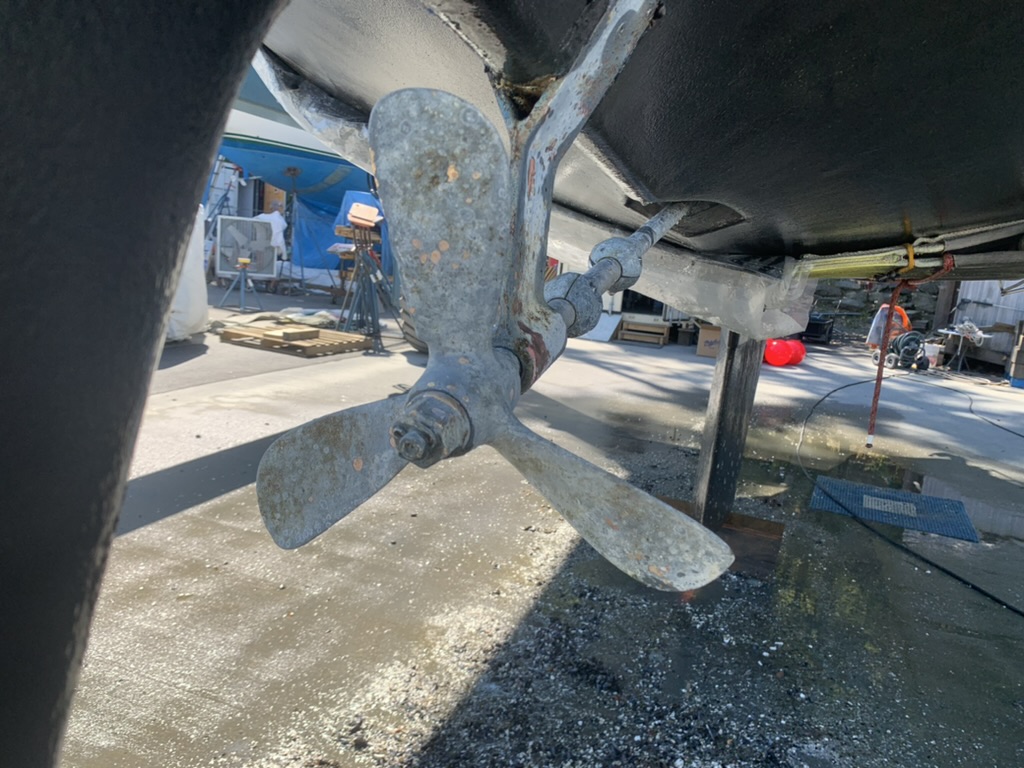
Stu inspired me to a deeper dive.
Here is Don Casey in Sail saying that it is the angle of the shaft:
Ask SAIL: Walking the Prop Walk
Honestly I don’t see his explanation as convincing, although he may be trying to make the point in the last paragraph below.
The Wikipedia explanation makes more sense to me:
https://en.wikipedia.org/wiki/Propeller_walk
Basicly, it says that the interaction of the reverse prop wash with the hull is the issue. There is no explanation of the lessor effect of prop walk when going forward however. Note that according to this explanation, shaft angle does play a secondary role by increasing the interaction of the prop wash with the hull in reverse.
Prop walk does turn the boat in forward gear when starting up. It also requires constant opposing rudder pressure at cruising speed while motoring. I speculate that this might be due to a lessor interaction with the short run of the hull behind the prop, and/or a similar asymetric interaction with the rudder in forward gear. If the Wikipedia article is correct, then I would expect an outboard motor prop to show no prop walk in forward gear, (no hull or rudder behind the prop) and some prop walk in reverse (reduced hull interaction because the prop shaft is horizontal and usually lower relative to the hull.)
Finally, I read this article on “yaw” (turning force) from airplane propellers while climbing, diving or taxiing with the prop at an angle to the horizontal.
https://en.wikipedia.org/wiki/P-factor This is because the prop blades moving down and into the air when at an up angle have a higher velocity into the air than the blades moving up and away from the air. Note the mention of an additional “slipstream” effect which I understand to be the interaction of the propwash/slipstream with the hull of the aircraft. This argues that both the angle of the prop and interference of the hull or rudder with the prop wash generate the prop walk effect. I find this most convincing.