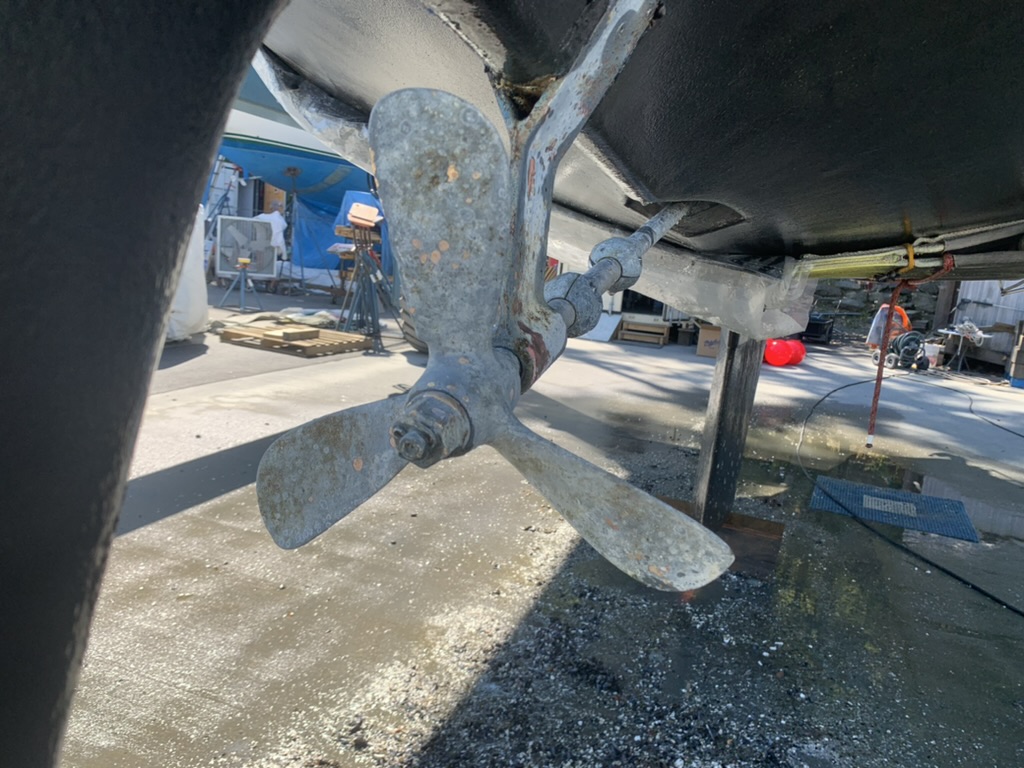
Hunter 30 and prop walk

FigBug

.
Oct 1, 2021
7
Catalina 30 Oak Bay Marina
Just got a 1981 Hunter 30 and really struggling with the prop walk. Compared to the 1976 Catalina 30 I had before, docking is much more of a challenge. I understand with a skeg the boat isn't going to turn as easy. It really seems with this boat you need to be thinking 30 seconds ahead. When I want to go forwards again I can't seem to just give it a blast and get the boat to pivot. I'm wondering if the boat has the wrong propellor or a different one would help. Here is what it has, the blades seem a lot narrower than other propellors I've seen on similar boats. Any thoughts on the propellor with the lest prop walk?

Here's what I've got:

 
Jan 7, 2011
6,017
Oday 322 East Chicago, IN
That looks like a Campbell Sailor prop…

Here is an article by Mainesail


Greg
 
  • Like
Likes: Ken13559

Mikem

.
Dec 20, 2009
824
Hunter 466 Bremerton
That is a Campbell sailer prop. My son has one on his 2000 H410 and prop walk is not an issue. My daughter has a CS prop on her 1984 H37C and prop walk is huge. I think your 30 and the 37 are both Cherubini designs.
 
May 25, 2012
4,338
john alden caravelle 42 sturgeon bay, wis
top of the line prop

prop walk can be your friend

captains should be thinking 30 seconds ahead, 60 seconds ahead, 5 minutes ahead, 20 minutes ahead, .....

practice practice practice.

get a crew, make 20 docks or slips in one afternoon, then make 20 more, same afternoon. you'll then start to get the hang of it.

it ain't the boat or the prop, it's you :cool:

free advice, worth what you paid for it.
 
Jan 1, 2006
8,189
Slickcraft 26 Sailfish
I'm not sure if the OP is complaining about too little prop walk or too much. Most posters on this subject are complaining about too much. I regard prop walk as an essential property of single engine boat maneuvering. Admittedly it is mostly effective in fin keel boats. Maybe long keeled boats would be happier on moorings.
 
May 17, 2004
6,262
Beneteau Oceanis 37 Havre de Grace
Campbell props are generally well regarded for maneuvering. I agree with Jon to practice. Docking can be stressful but it only makes it worse if you only do it once a week. Take an afternoon and go out to open water. Pick a spot on the water and practice maneuvering around it. Back up to it and try to stop the boat with it just off your transom a few times. Approach it from different angles and see how the boat responds when you turn the wheel in forward, reverse, and neutral. Once you have some familiarity with that then go make some practice dockings, seeing how it works if you turn sooner, later, faster, slower. Stay slow enough that you don’t damage anything. After that you’ll be much more comfortable with how the boat will handle going forward.
 
  • Like
Likes: jon hansen
Dec 28, 2015
1,946
Laser, Hunter H30 Cherubini Tacoma
I became dependent on my prop walk with my fixed pitch original prop. When I switched to a Autoprop (which eliminated almost all walk) I immediately missed the walk. Prop walk is the best way to move your boat sideways, you just have to be wanting to move that way. Now I give it some hard reverse then hard forward in the direction I want to pivot. The boat with pivot on the keel with little forward movement is you give the right throttle input and pull it back correctly.
 
Nov 8, 2007
1,619
Hunter 27_75-84 Sandusky Harbor Marina, Ohio
First of all, in my understanding and experience (replaced the original prop with a Campbell), the Campbell prop is the most efficient fixed blade prop available.
Second, I understand that prop walk is a side effect of the angle of the prop shaft from the horizontal. Our h27 certainly exhibits it.
Finally, my experience is that:
- the real problem is the sideways propulsion before enough speed (between 1 and 2 knots on our boat) is developed for the rudder to be effective. It is worse in reverse since the prop is not directing its wash over the rudder.
- a little bit of thought and practice as described above will develop a routine to use or counter propwash as you leave and enter a dock. In our case, I counter prop walk with our boat hook on a dock cleat to keep the boat straight as we begin to back out. Then, the prop walk actually helps us to back through a turn into the fairway. Returning to the dock, wind issues are more important, since we have enough forward headway for the rudder to control direction until (and after) we get our spring line attached to the dock.

Good luck with your new boat! You will overcome this issue, I’m sure.
 
Feb 26, 2004
23,544
Catalina 34 224 Maple Bay, BC, Canada
Second, I understand that prop walk is a side effect of the angle of the prop shaft from the horizontal.
Consistent with another current thread which discusses misinformation and the correction thereof, this ^^^ is just wrong.
Prop walk is determined by the rotation of the propeller.
 
Nov 8, 2007
1,619
Hunter 27_75-84 Sandusky Harbor Marina, Ohio
Thanks, Stu. Can you suggest a reference for me?

In either case, it seems basic to some designs, and, as the OP and others say seems to be worse on some designs than on others.
 
Nov 8, 2007
1,619
Hunter 27_75-84 Sandusky Harbor Marina, Ohio
Stu inspired me to a deeper dive.

Here is Don Casey in Sail saying that it is the angle of the shaft: Ask SAIL: Walking the Prop Walk
Honestly I don’t see his explanation as convincing, although he may be trying to make the point in the last paragraph below.

The Wikipedia explanation makes more sense to me:https://en.wikipedia.org/wiki/Propeller_walk
Basicly, it says that the interaction of the reverse prop wash with the hull is the issue. There is no explanation of the lessor effect of prop walk when going forward however. Note that according to this explanation, shaft angle does play a secondary role by increasing the interaction of the prop wash with the hull in reverse.

Prop walk does turn the boat in forward gear when starting up. It also requires constant opposing rudder pressure at cruising speed while motoring. I speculate that this might be due to a lessor interaction with the short run of the hull behind the prop, and/or a similar asymetric interaction with the rudder in forward gear. If the Wikipedia article is correct, then I would expect an outboard motor prop to show no prop walk in forward gear, (no hull or rudder behind the prop) and some prop walk in reverse (reduced hull interaction because the prop shaft is horizontal and usually lower relative to the hull.)

Finally, I read this article on “yaw” (turning force) from airplane propellers while climbing, diving or taxiing with the prop at an angle to the horizontal. https://en.wikipedia.org/wiki/P-factor This is because the prop blades moving down and into the air when at an up angle have a higher velocity into the air than the blades moving up and away from the air. Note the mention of an additional “slipstream” effect which I understand to be the interaction of the propwash/slipstream with the hull of the aircraft. This argues that both the angle of the prop and interference of the hull or rudder with the prop wash generate the prop walk effect. I find this most convincing.
 
Last edited:

RoyS

.
Jun 3, 2012
1,742
Hunter 33 Steamboat Wharf, Hull, MA
Prop walk with a right hand prop will pull the stern to port. When selecting your slip, choose one that gives you a port side tie up. When you approach the dock and put her in reverse to stop, your stern will come into the dock where you want it. If you try that with a starboard side dock, your stern will move away from the dock and into your neighbor's boat. As others have said, you will come to rely on your prop walk.
 

JamesG161

SBO Weather and Forecasting Forum Jim & John
Feb 14, 2014
8,111
Hunter 430 Waveland, MS
My OEM 2-blades has little propwalk in reverse. Docking Port Side was easy.

IMG_2192:1.jpeg

I just got the new one, not installed yet.
Jim...

PS: Purchased from SBO to match my Transmission which is very important.
 
Jan 1, 2006
8,189
Slickcraft 26 Sailfish
I read somewhere that prop walk is an inevitable result of a slanted blade moving thru water. The explanation went like this: As the blade first slices thru the water there are two forces. One sideways and one forward. Before the boat gains weigh in the forward direction the sideways force pushes the stern of the boat sideways. I'm avoiding the technicalities since I don't understand them very well.
My point is that I never hear that explanation now. Was it debunked? Or have I mis-quoted it?
 
Aug 9, 2020
32
Hunter 23 Charlestown Md
In the ASA 103/104 classes you learn about and practice prop walk and wash and learn to use them to your advantage (standing turn etc). Practice makes better!
 
Dec 28, 2015
1,946
Laser, Hunter H30 Cherubini Tacoma
My sailboat walked to port ( with the fixed blade) and my wakeboard boat walked to the starboard. It gets a little frustrating at the beginning of summer when both are being used for the first time of the season
 
Nov 6, 2017
78
Catalina 30 5611 Stratford, Ct
I might add to all this by saying Neutral is your friend. When approaching the dock you need enough speed to maintain rudder control. That does not mean you need the boat in gear. You can use short bursts of forward throttle just long enough to maintain your speed and then return to neutral. The point is to get enough speed to get the boat into the slip leaving space between the dock and the boat. Once you get to the point where the boat needs to be stopped put the boat in reverse and use enough throttle to stop the boat's forward motion. Once the boat is stopped you can toss a line over a cleat midship on the dock to hold the boat in place. Once you have a line on the dock the boat can be put in reverse gear at an idle long enough to pull the stern over to the dock so you can safely disembark and finish tying up the boat. This method almost completely eliminates prop walk unless you need it to pull the stern over to the dock. I personally advocate a safety rule on our boat that no one leaves the boat until at least one line is on a dock cleat and the boat is stopped. Lastly, know that just because this is how it works on our boat, your boat will be different and like many others have said here practice, practice practice. Know the speed your boat needs to maintain steering and also be sure you know the distance it takes to stop your boat from that speed. You also need to pay attention to the wind speed and its direction along with the current at the dock. This will save you the embarrassment of crashing into the dock. Ask me how I know! Happy Docking.
 

FigBug

.
Oct 1, 2021
7
Catalina 30 Oak Bay Marina
I'm not sure if the OP is complaining about too little prop walk or too much. Most posters on this subject are complaining about too much. I regard prop walk as an essential property of single engine boat maneuvering. Admittedly it is mostly effective in fin keel boats. Maybe long keeled boats would be happier on moorings.
Too much. In my Catalina 30 my process was get somebody to hold the stern line, I'd give it a blast of reverse to get moving and the person holding the line would counteract the prop walk until I got moving, then I could get it into neutral, have a bit of speed and get the boat to turn to starboard.

With the Hunter, I find it takes a lot longer for the boat to accelerate, I'm not sure if it's because it has less power or it's something about the propellor. It's a 2000 lbs lighter boat, so I'd think it would accelerate faster. By the time I'm up to speed and the rudder is doing anything I've walked too far to port to even think about a starboard turn. Port turn is hard since I need to hit the gap between the breakwater and another boat.

The Catalina had the motor mounted much further forward so I guess less angle on the prop shaft and less prop walk. Curious if anybody has sailed boat the Hunter 30 and Catalina 30 and can comment on how they handle compared to each other.