electric plan omissions and alterations?

Status
Not open for further replies.

njl

.
May 30, 2011
64
Westsail 32 NYC
...
Your DC side seems a tad confusing and perhaps incorrect.

Batteries should go TO the switch. ...
To explain, the battery bank will probably have four 6V batteries, so the switch on there is a simple 1/2/Both suggested by MaineSail. I just didn't bother drawing that all out.

...if you want to fuse your starter...
I've moved the starter to the DC breaker panel based on yours and others comments; seems cleaner.
 

Attachments

njl

.
May 30, 2011
64
Westsail 32 NYC
njl

The sockets are usually 15 amp. The incoming shorepower is commonly 30 amp. It doesn't make sense to plug a 30 amp shorepower cord into a 20 amp breaker. You should keep the 30 amp double breaker and from there go to separate 15 amp breakers for each load - charger, outlets, etc. Below are pics of the one Maine suggested as well as an alternative with 2 less breaker positions.
Thanks, I've redrawn this as you suggest.
 
Sep 28, 2008
922
Canadian Sailcraft CS27 Victoria B.C.
njl

The starter should go to the common on the 1,2,both switch, or whatever main switch you will be using.

AC looks much better now.
 

njl

.
May 30, 2011
64
Westsail 32 NYC
njl

The starter should go to the common on the 1,2,both switch, or whatever main switch you will be using.

AC looks much better now.
Could you explain this comment further?

1,2,Both in my case would refer to the two 12V battery sets (with two 6V in series). I understand the reason for having a switch on there for the purposes of off-lining a bad bank. MaineSail suggested fusing the starter so I've re-drawn the starter running through the breaker box.
 
Feb 6, 1998
11,760
Canadian Sailcraft 36T Casco Bay, ME
Could you explain this comment further?

1,2,Both in my case would refer to the two 12V battery sets (with two 6V in series). I understand the reason for having a switch on there for the purposes of off-lining a bad bank. MaineSail suggested fusing the starter so I've re-drawn the starter running through the breaker box.
If you only had one bank, as in 4 6V golf cart batteries wired in series parallel, then all you need is an on/off switch. If you have four 6V batts and a separate reserve bank then you would want a 1/2/BOTH/OFF switch.

You can place two 6V batts on bank #1 and two on bank #2 but then you run the risk of unbalancing your banks and aging them prematurely unless you are diligent about always using them in the all position. You would then have the 1/2/BOTH/OFF already in place for when you wanted to add a reserve bank.

If using a "jumper battery" with a dead 6V bank of 450 Ah's you'll first want to completely isolate the house bank so that bank is not sucking the life out of the "jumper battery". Your jumper will jump your motor but not likely jump your motor while at the same time being tapped by a 450 Ah bank..

Just had that situation on a customers boat the other day and was able to demonstrate just how bad using ALL is with a dead bank. With his house bank flat dead I switched to ALL and his motor barely turned over. I switched from the ALL position to the good battery #2, let it sit for a few minutes, and the motor fired up without issue..
 
Sep 28, 2008
922
Canadian Sailcraft CS27 Victoria B.C.
njl

Your breaker box/panel will have circuits up to 15 or 20 amps for loads like lights, electronics and pumps. A starting load can be well over 100 or 150 amps and requires different fusing. The best type of fuse for a battery bank is an ANL or MRBF if you are fusing it. Or go direct from the C post on the switch to the starter. Any fuse in your panel would blow immediately when trying to start the engine.

Fuse information here:
http://bluesea.com/category/5/22/productline/overview/135
http://bluesea.com/category/5/22/productline/overview/379
 
May 26, 2004
168
- - Oriental, NC
Mainesail

You mentioned being able to hand start a diesel on a boat if necessary. I agree and have been looking for a process to hand start a M25XP on an O'Day 35 and therefore have a decompression lever. There is a lot of room in front of the crankshaft pulley. What would be the approach.
Thanks
DaveM
 

njl

.
May 30, 2011
64
Westsail 32 NYC
If you only had one bank, as in 4 6V golf cart batteries wired in series parallel, then all you need is an on/off switch. ...
OK—since the breaker panel has an all off switch, I've removed the 1/2/B. The starter will have a separate switch with oversized wires and no fuse. I've updated the drawing.

I'm skipping the fuse on the starter wire per the BlueSeas circuit protection page:
"Except for those wires that are intended to carry starting currents, every positive wire in the DC main power distribution system must be protected by a fuse or circuit breaker."

If using a "jumper battery" with a dead 6V bank of 450 Ah's you'll first want to completely isolate the house bank so that bank is not sucking the life out of the "jumper battery". Your jumper will jump your motor but not likely jump your motor while at the same time being tapped by a 450 Ah bank.. ...
This is a great tip; I'll be sure to remember.
 

Attachments

Sep 28, 2008
922
Canadian Sailcraft CS27 Victoria B.C.
njl

I see what you have done. That leaves you without any battery bank fusing. You should fuse the battery bank as it is used for both house loads and starting. The way to do this is to use one of the 2 types of fuse I linked to - either at the battery bank with a MRBF or within 7" with an ANL fuse. After the fuse go to the switch and the switch output can go to both the main panel and the starter.

You do not need a fuse on a bank used exclusively for starting but your bank is used for both starting and house loads.
 
Feb 6, 1998
11,760
Canadian Sailcraft 36T Casco Bay, ME
I'm skipping the fuse on the starter wire per the BlueSeas circuit protection page:
"Except for those wires that are intended to carry starting currents, every positive wire in the DC main power distribution system must be protected by a fuse or circuit breaker."
.
That Blue Seas page follows the ABYC standards which allows an exemption for starting circuits. The reasoning is that many LARGE engines can not be fused economically. A small diesel can easily be fused but if not the wires can still chafe, short and catch your boat on fire.

Feel free to read this on battery bank fusing.

Battery Fuse Sizing - How?

P.S. Nigel Calder has this to say on fusing small sailboat AUX engines...

"The net result is that nowadays, electrical shorts are probably the number-one cause of fires on boats."

There is simply no excuse for not protecting all high-current circuits , including the cranking circuit."

Nigel Calder Cruising Handbook
 
Feb 8, 2009
118
Sabre 34 MK-1 Annapolis, MD
Could you explain this comment further?

1,2,Both in my case would refer to the two 12V battery sets (with two 6V in series). I understand the reason for having a switch on there for the purposes of off-lining a bad bank. MaineSail suggested fusing the starter so I've re-drawn the starter running through the breaker box.
The starter should be fused, but it need not be separately fused. The starter is about the largest load on the boat (with the exception of inverters and windlasses), and arguably needs to be "over-fused" in the sense that you really don't want the fuse to ever blow except for a disaster (that's part of the reason for the ABYC exemption, and THE reason why some people reject fusing the starter). Fusing the starter cable is most easily, and most effectively, done by fusing the battery. A 200A fuse, someplace near the battery, will protect the starter, the starter cable, the battery switch, and everything else that has those #1/0 battery cables hanging on it.

A note on battery fuse size. My Volvo MD11C, with a huge flywheel and something around 25HP, has a 1.2KW starter. That equates to 100A, and is in line with what I have measured. While there is a sizeable "inrush" current, that current is measured in microseconds (or perhaps milliseconds). Main has done some nice documentation on starter inrush, if you search around. A fuse will only blow at rated current after a fair length of time -- many seconds -- and at times of a few seconds is actually good for well above the rated current. Net result is that a 200A battery fuse, at least on my boat, is very generously sized for my starter load, and I suspect our starter loads are rather similar.

On a related note, Trojan has told me that while T-105's are not specifically "rated" for a cranking current, they "estimate" the batteries at about 560 CCA's. Since CCA's are measured at 0F, you can count on much more than that at cruising temperatures -- and with your double bank of batteries, you can put out a LOT of current if you ever get a short without a battery fuse (like well over 1000A)! To put that in perspective, take a look at rated current for welding machines.....

Harry
 
Feb 8, 2009
118
Sabre 34 MK-1 Annapolis, MD
Fuses on starters or starter batteries is really a bad idea. Chuck

As I said in my post above, intelligent and experienced folk, like ABYC, Nigel Calder, MainSail (and perhaps me? Nah. I agree with them, I just don't have the cred they do) think that fusing a start circuit is a really good idea. But, as you can see, there is an equally intelligent and experienced cadre that feels equally strongly about the opposite position.

Harry
 
Sep 28, 2008
922
Canadian Sailcraft CS27 Victoria B.C.
I fuse starters for customers on engines up 60 hp or so and have never had a problem. An ANL fuse will handle about 160% of its rating for 500 seconds (over 8 minutes) and a great deal more amperage for a short period of time. I would not try to fuse large engines and that is the reason for the ABYC exemption.

Here are the ANL blow points at 500 seconds.

I wouldn't use a lesser fuse for this.
 

Attachments

Feb 6, 1998
11,760
Canadian Sailcraft 36T Casco Bay, ME
Fuses on starters or starter batteries is really a bad idea. Chuck
Chuck,

We'll just have to agree to disagree on this one. I have yet to see evidence it is a bad idea on small sailboat aux motors but many examples of where it was a bad idea not to.

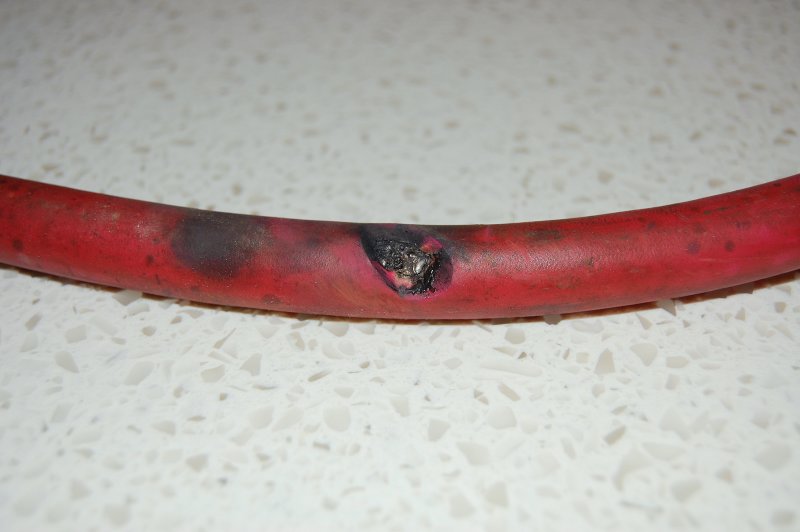
Our own 2005 Catalina came from the factory with two 4D batteries as individual banks and due to the ABYC E-11 exemption Catalina chose to only install one ANL fuse. Before delivery I installed a second one for the reserve bank. In mid August of that year the fuse I added blew. Catalina ran the wire to the starter far to short and when the motor moved forward under load the starter cable chafed. This was in an area that was next to impossible to see by myself or the surveyor. It still arc welded to the motor but the fuse prevented us from a potentially dangerous boat fire.

This happened last summer to one of the chase boats in our clubs junior sailing program. Just a few seconds before it went up in flames there was a bunch of young kids, under 10, on board. Our entire fleet, including the launches that are started perhaps 60-80 times per day for 5.5 months, all have fuses on the starting circuits.


In perhaps thousands and thousands of motor starts on motors I know are fused, including my own boats, I have yet to see even one nuisance blow on a properly sized fuse. I even had my Cummins 220 fused on our old express boat. We used that boat in the winter and in temps to the teens and the fuse still never blew, because it was properly sized.

I came across this one on a customers boat a few months ago after a plastic zip tie failed and it rubbed on the engine driven refrigeration pulley. Thankfully this boat was fused..


Nigel Calder feels the same way I do when it comes to small aux engines. On a personal level John A., ABYC technical director, and Eric J. (formerly of the ABYC) have both agreed that fusing all batteries on a boat is wise if it can be done and done reasonably, on most sailboats it can. John and I have had many conversations about this subject.. The exemption exists because of engines far larger than ours.

I have no problem not fusing a starter circuit but only if the wire is fully protected from the bank all the way to the starter and I've yet to see many boats I'd feel comfortable not fusing, but that's just me. I give my customers both sides of the story and let them decide. Very few ever decline start bank fusing on sailboats..

For me the option of boat fire vs. tripped fuse is simple....
 
Feb 8, 2009
118
Sabre 34 MK-1 Annapolis, MD
say no more, fuse back in.
Your latest diagram is getting closer -- but still not there. Fusing is serious stuff. It is designed to protect a wire that gets to ground, so look at your wires and say "what happens if this goes to ground right HERE?" A fuse better blow. So, with that in mind, a few comments:

* The charger needs a fuse, right close to the battery.
* The alternator needs a fuse, right close to the battery.
* You show the bilge pump with a fuse, right close to the battery, and this is correct.
* You need a fuse on the wire going to the main panel, right close to the battery (and a switch, too).
* You have a mombo fuse on the battery lead going to the switch.

The way you have the circuit laid out, all those items are right on the battery terminal. Two problems -- first, it's messy, and second, it's more than the ABYC limit of 4 lugs on a terminal.

My suggestion is to get ALL those items on the protected side of a big battery fuse. A nice MRBF, or my preference, an ANL mounted close (ideally under 7") to the battery. Then you have ONE wire going to the battery. You can then connect everything else to the fuse block. If you really want some loads to be uninterrupted, you could connect on the battery side of the fuse (I wouldn't), else you can put them on the protected side of the fuse (my preference). Also, I would connect both the starter and the breaker panel on the same switch (you turn the switch, the boat is "live" -- you have a problem and you turn the switch and the boat is "dead"). I would also take the smaller (non-starter) loads to a small fuse panel (no need for breakers) off of the battery fuse (or off of the "battery in" lug on the switch if it is more convenient). This fuse panel, with one wire off the fuse, would then have fuses for: Alternator (this may be a bit of a problem with size), battery monitor, bilge pump, and battery charger.

The connections then would be:
* Battery has a lead to the fuse
* Fuse has a lead to a small fuse panel and the main switch
* Main switch feeds house panel and starter
You would still need to put in a fuse/breaker, right at or near the switch, to feed your house panel.

Or, you could put in an MRBF, and run a lead to a Blue Sea 8686
http://bluesea.com/files/images/products/8686.jpg
It would then feed the starter without any extra fuse needed, feed the house panel through a breaker (both start and house would be switched, too), feed the bilge pump through a breaker, feed the "memory" (memory, battery monitor, other such loads), and has a nice empty spot for a breaker for the charger. Not my preference, as there is still a lot more distribution required after the 8686 (and you still have an alternator to deal with).

Harry
 
Sep 28, 2008
922
Canadian Sailcraft CS27 Victoria B.C.
I agree with the above with the exception of the Blue Seas 8686. For one he only has 1 bank. For another, if he did have 2 banks that switch lacks flexibility to start from either bank, combine being its only option. Combining a battery that is incapable of engine starting with a charged bank makes no sense.

I would go to one on/off switch and from there to both the panel and starter. If a second bank is planned for the future a 1,2,both switch makes sense.
 
Status
Not open for further replies.