OK. So where am I? Ariel says the wire from my galvanic isolator should go to the "negative system". But I don't know what the "negative system" on my Hunter 31 is? I am assuming it is the ground wire on the engine. Main sail says this should consist of a "ground buss and then only the one large negative ground wire . . . to the engine". It seems then, that we are agreed that we use the same ground for ac and dc. For my ground buss, I am thinking of using a stainless distribution block with a 0/1 input strap to the block, and 4 guage and 8 gauge outputs. I will abandon the idea of a second ground strap to the engine mount based on what seems to be concensus over a single wire system.

Best Ground Point
- Thread starter wufibugs
- Start date
- Status
- Not open for further replies.

Sorry to bring this up again, but if your prop is currently isolated, why would you want to tie it into a system of electricity? I know a lot of props are connected by the coupling that has no insulator in it, such as the Vdrive on maine sails boat. But if it is currently isloated what good can come from it?
I am not asking a rhetorical question here, because I honestly don't know. If the ABYC standards and Maine Sail say it, there must be a reason. Like others most of my experience with electricity is not on a boat.
I am not asking a rhetorical question here, because I honestly don't know. If the ABYC standards and Maine Sail say it, there must be a reason. Like others most of my experience with electricity is not on a boat.

Common Ground Point
Question: Why do folks think it's grounded to the water? That's the last thing you want for stray current corrosion.
On our former boat, a C25 with an outboard, the DC electrical system went: RED positive to switches/fuses/breakers, appliance (load, light, etc.) BLACK went back to the negative side of the battery. No inboard engine.
Older alternators were case grounded so then their ground was directly to the engine without a separate negative wire. My new alternator has it's own ground.
The engine "collects" the grounds, but they are ALL connected back to the negative side of the battery banks, and could just as well have never touched the engine at all.
I don't have my Calder's with me (I'm on vacation) but the engine doesn't "have" to be the ground, the battery negative serves just as well.
Any comments?
Question: Why do folks think it's grounded to the water? That's the last thing you want for stray current corrosion.
On our former boat, a C25 with an outboard, the DC electrical system went: RED positive to switches/fuses/breakers, appliance (load, light, etc.) BLACK went back to the negative side of the battery. No inboard engine.
Older alternators were case grounded so then their ground was directly to the engine without a separate negative wire. My new alternator has it's own ground.
The engine "collects" the grounds, but they are ALL connected back to the negative side of the battery banks, and could just as well have never touched the engine at all.
I don't have my Calder's with me (I'm on vacation) but the engine doesn't "have" to be the ground, the battery negative serves just as well.
Any comments?

ABYC Says:Question: Why do folks think it's grounded to the water? That's the last thing you want for stray current corrosion.
On our former boat, a C25 with an outboard, the DC electrical system went: RED positive to switches/fuses/breakers, appliance (load, light, etc.) BLACK went back to the negative side of the battery. No inboard engine.
Older alternators were case grounded so then their ground was directly to the engine without a separate negative wire. My new alternator has it's own ground.
The engine "collects" the grounds, but they are ALL connected back to the negative side of the battery banks, and could just as well have never touched the engine at all.
I don't have my Calder's with me (I'm on vacation) but the engine doesn't "have" to be the ground, the battery negative serves just as well.
Any comments?
Nigel Calder / Boat Owners Mechanical & Electrical Manual - likes a grounding plate, me too in an ideal world, and kind of stays away from to much discussion or disagreement with ABYC on using the engine as the main source to ground other than to say it is a good idea to use a shaft brush or strap if grounding through the prop shaft.ABYC said:11.5.2.7.2. The negative terminal of the battery, and the negative side of the DC system, shall be connected to the engine negative terminal or its bus. On boats with outboard motors, the load return lines shall be connected to the battery negative terminal or its bus, unless specific provision is made by the outboard motor manufacturer for connection to the engine negative terminal.
Seeing as we know the vast majority of sailboats boats, other than some cruisers, do not have a grounding plate, the engine, by default, usually becomes the path to ground.
Charlie Wing / Boatowners Electrical Handbook Second Edition - Shows the engine as the main ground point but suggests a grounding plate for lightning protection in which case the engine would also be tied to this.
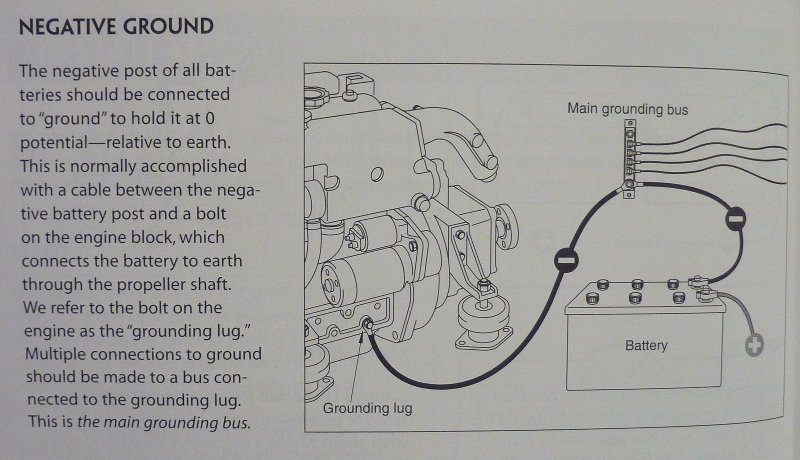
Don Casey / Sailboat Electrics Simplified - shows connecting the ground system to the "grounding lug" on the engine.
One concern I have always had with a grounding plate is that it is nearly impossible to isolate the engine as a second ground source when using a grounding plate. Even with a Drivesaver, that decouples the shaft, the raw water cooling system still creates as second path to ground other than the grounding plate. I guess this is why bonding would be very important using two separate places that contact ground. Just food for thought..?
Older alternators were case grounded so then their ground was directly to the engine without a separate negative wire. My new alternator has it's own ground.
quote]
I was greasing the bearings and jsut generally cleaning and inspecting my old alternator hitachi35, and it has a seperate ground but when you look inside it's still connected to the case. I guess some are truly seperate and some aren't.

I have been doing electrical wiring repairs on mine due to the fact that it was wired like a house ac(including solid wire)aka nightmare and lots of work to redo. from the shore cord, the hot wire(black) is wired the same but the nuetral(white) wire is not connected to the boats ground in any way, shape or form. The shore cord ground wire is connected to the boats ac ground wire and is an insulated wire. all wiring should be multiple strand flexible wiring. there is a wire that runs from the ac ground at the breaker box to the engine block so that if something breaks and the current cannot go to the shore ground, it will go in the water, preventing shocks on the boat, the current will pass accross the engine and leave thru the prop shaft. if someone is swimming nearby, it is best to unhook the shore cord on the dock or turn off generator and/or invertor. Read Don Caseys 'sailboat electrics simplified' or something similar or have it wired by a professional. This book was available at the library or order online. READ all the safety info at the front of the book. I work on airplanes that carry 12, 28 and 110 volts. marine ac is very dangerous and all safeguards should be adhered to. weather or not you wire the ac ground to the engine is up to you and will work either way, extra ground wire is just an additional measure of safety(something about shorted work lights near the engine and you being the connection to ground). also if your battery charger happened to short from the ac to the 12 volt. solar panel is advised rather than 110 volts to keep battery charged. My boat uses 110 for several appliances also so disconnecting is not an option(unless someone in water)
I haven't cut into the outer sheathing to pull the ground wire for the galvanic isolator, but it looks to me like Hunter used a variant of romex from the shore power plug to the rest of the ac system in 1986. My guess is that I'm going to find solid wire, not stranded.
This kind of stuff is important to me because I don't plan on hauling my boat for a few years.
This is from Don Casey's book. Some of his advice is dated in light of new technology. And maybe he just doesn't know what's best. But on this topic it just makes common sense to me.
This is from Don Casey's book. Some of his advice is dated in light of new technology. And maybe he just doesn't know what's best. But on this topic it just makes common sense to me.
Attachments
-
 35.8 KB Views: 257
If I recall that is from his section on bonding and lightning protection. In that same book this photo is from page 38.This kind of stuff is important to me because I don't plan on hauling my boat for a few years.
This is from Don Casey's book. Some of his advice is dated in light of new technology. And maybe he just doesn't know what's best. But on this topic it just makes common sense to me.
Jim,from the shore cord, the hot wire(black) is wired the same but the nuetral(white) wire is not connected to the boats ground in any way, shape or form.
That is actually correct wiring (except for the solid conductors). The white/neutral is to be grounded back on-shore, not to the boat.
The green/ground wire but NOT the white/neutral is to be grounded to the boat.The shore cord ground wire is connected to the boats ac ground wire and is an insulated wire.
This is the description for the other diagram of Casey's I posted. There does seem to be some conflicting information in the same book.If I recall that is from his section on bonding and lightning protection. In that same book this photo is from page 38.
In the diagram for "corrosion control" grounding, the battery is shown not connected to the prop shaft. That being preferred. The pic you show he seems to assume the only way to do it is to ground through the shaft.
Attachments
-
 50.9 KB Views: 255

Calder's book also favors a separate ground "Buss", with a ground wire to the engine. This, as opposed to running all ground wires to use the ENGINE as a ground buss.
Myself, I can't see connecting the DC neg/ground to the AC ground that then connects your boat to the one in the next slip- and to the whole marina , but I'll go with assuming that those book writers know more about it than I do. Having done alot of wiring projects on my 2006 B323, I don't recall seeing any AC-to-NEG ground connection, but this thread makes me want to look closer for one. If it's not there, i will not add it.
Myself, I can't see connecting the DC neg/ground to the AC ground that then connects your boat to the one in the next slip- and to the whole marina
, but I'll go with assuming that those book writers know more about it than I do. Having done alot of wiring projects on my 2006 B323, I don't recall seeing any AC-to-NEG ground connection, but this thread makes me want to look closer for one. If it's not there, i will not add it.
Ground paths and AC grounding
2. Ron, as I recall, Calder's discussion gives pros and cons for doing so with a very good diagram showing how two boats' grounding (AC & DC) can serve to set up stray current corrosion. I think he concludes it is good to connect them, but the text doesn't make it an absolute. Again, I don't have the book here with me, but remember going through this same thought process years ago, and deciding that for me, for my boat, the excellent wiring in our marina, and because of our boat's use (rarely, if ever, plugged in) that I did not pursue it any further. I will re-read it all when I get home. I know -- sometimes I could be plugged in at a strange marina. I think we've all been to pretty strange marinas in our times! Or my marina's wiring could go belly up. For those with inverters on board that are used, remember, you don't have to be plugged in to need to deal with this issue. Or a lot of other bad electrical things could happen. Good point, thanks for bringing it up in that way.
BTW, Calder's is the best I've seen in discussing the WHY, as compared to just saying you should or shouldn't do something. That's why I like his book so much better than some other reference sources. I know it's a heavy read for some, but I've been forced to plow through engineering textbooks for altogether too many years, and now that I can do so voluntarily, WOW, it's fun!
Hmm, I don't understand how that could happen with hoses between the HX and the muffler.Even with a Drivesaver, that decouples the shaft, the raw water cooling system still creates as second path to ground other than the grounding plate.
1. The diagrams in the Casey book references from Scott and MS make it very clear why a ground bus is preferred --- electrically. In addition to the electrical issue with varying "potentials" that certainly would be the case with a bunch of different wires even if they all were connected to the same position on the engine, it is also a simpler wiring technique. It's simply a heck of a lot easier to install a ground bus bar, or a Power Post, and then run one single wire from it to the engine, because you can add more grounds to the bus bar in the future much more easily than you can to an engine bolt .1. Calder's book also favors a separate ground "Buss", with a ground wire to the engine. This, as opposed to running all ground wires to use the ENGINE as a ground buss.
2. ... but I'll go with assuming that those book writers know more about it than I do ... but this thread makes me want to look closer for one. If it's not there, i will not add it.
2. Ron, as I recall, Calder's discussion gives pros and cons for doing so with a very good diagram showing how two boats' grounding (AC & DC) can serve to set up stray current corrosion. I think he concludes it is good to connect them, but the text doesn't make it an absolute. Again, I don't have the book here with me, but remember going through this same thought process years ago, and deciding that for me, for my boat, the excellent wiring in our marina, and because of our boat's use (rarely, if ever, plugged in) that I did not pursue it any further. I will re-read it all when I get home. I know -- sometimes I could be plugged in at a strange marina. I think we've all been to pretty strange marinas in our times!
Or my marina's wiring could go belly up. For those with inverters on board that are used, remember, you don't have to be plugged in to need to deal with this issue. Or a lot of other bad electrical things could happen. Good point, thanks for bringing it up in that way. BTW, Calder's is the best I've seen in discussing the WHY, as compared to just saying you should or shouldn't do something. That's why I like his book so much better than some other reference sources. I know it's a heavy read for some, but I've been forced to plow through engineering textbooks for altogether too many years, and now that I can do so voluntarily, WOW, it's fun!
Stu,Hmm, I don't understand how that could happen with hoses between the HX and the muffler.
The way I see it is, water is ground. The raw water intake hoses are filled with water (ground) all the way to the water pump or HX. If you are using a ground plate as the boats primary ground the engine is also a ground because of the water/ground in it so now you have two ground points where the path to ground is present. No?
The water pump and HX are grounded to the engine and filled with "ground"
. The only possible way I can see to possibly isolate the engine from ground would be to have a closed Marelon seacock. The exhaust would not be a ground point due to the air entrapped in the water-lift muffler but the raw water intake is almost always filled with ground. Unless you close the seacock and run the impeller dry.?Perhaps I have missed something about water being ground or earth?
Ground & Prop shafts
I agree, 'ceptin' that the water lift muffler creates a disconnect (pun intended !!!:dance when the engine is off and electricity can be on.
Perhaps folks are thinking of this backwards. They keep saying "using the prop shaft for the ground" which implies "current flowing outwards" engine to prop to water (ground), when instead they maybe should be thinking that the prop is connected to the ground and is being protected from corrosion by the engine. Or maybe it works both ways...
I agree, 'ceptin' that the water lift muffler creates a disconnect (pun intended !!!
:dance when the engine is off and electricity can be on.Perhaps folks are thinking of this backwards. They keep saying "using the prop shaft for the ground" which implies "current flowing outwards" engine to prop to water (ground), when instead they maybe should be thinking that the prop is connected to the ground and is being protected from corrosion by the engine. Or maybe it works both ways...
Yes, and I mentioned that, but on the other side, the intake side, there is, in most cases, no "disconnect" from ground even with the engine off.I agree, 'ceptin' that the water lift muffler creates a disconnect (pun intended !!!
My point is that even with an isolated prop shaft with a drive saver, and a sintered bronze ground plate as "ground", you still have two ground paths, the raw water intake is one and the ground plate the other.
Only a small percentage of boats will separate from ground at the raw water intake.
Drats, I completely forgot about that side.
See? This forum is great. I read recently that one need not use the word "obvious" because if it is, then ya don't need to even use the word.
Thanks for pointing out the obvious! Doh...
See? This forum is great. I read recently that one need not use the word "obvious" because if it is, then ya don't need to even use the word.
Thanks for pointing out the obvious! Doh...
Don't worry, many of the authors have missed this one too. It has always seemed obvious to me but yet no one discusses this, yet they all talk about one common ground point.Thanks for pointing out the obvious! Doh...
Kind of tough to have "one ground" with an engine and a sintered bronze plate..?I was talking with Nigel Calder at the Maine Boat Builders Show and meant to ask him his thoughts on this but forgot about it. Maybe he'll be there this year..
There have been several mentions of "sintered bronze plates" as ground points. These devices are only intended for radio grounds. They are not meant for use as a lightning ground as they will probably explode.
While I mentioned Dynaplates (sintered bronze) for grounds it was in the context of DC & AC grounds and bonding not necessarily lightning. I keep my lightning separate and to the keel, as I assume many external ballast boats do, but folks have different preferences on how to deal with lightning grounds..There have been several mentions of "sintered bronze plates" as ground points. These devices are only intended for radio grounds. They are not meant for use as a lightning ground as they will probably explode.
Explosion could probably happen if a sintered plate is not sized appropriately. I have seen a boat that sunk when a thru-hull exploded from a strike..
The ABYC has specific sq. ft. requirements for lightning grounding plates, copper, copper alloys such as bronze, stainless steel etc. and their min size. ABYC calls for 3/16" thick by 1 sq ft of ground plate for lightning grounds. This is why I direct lightning to my keel ,for the surface areal.
Guest does actually make a sintered bronze Dynaplate that is ABYC compliant for lightning bonding but it's huge 8.5" X 18". They are not only intended for radio grounds according to the manufacturer.
I think with lightning there is little predictability and there really is not a heck of a lot one can do. I have seen some amazing damage done by lightning. Four years ago the guy right behind me in the mooring filed took a direct hit. He was 30 yards off my stern with a shorter mast. His boat was fully decked out in lightning defense garb, mine was not. Other than the mast and shrouds being grounded to the keel I have no other lightening protection. He suffered nearly 12k in damage, I only lost my Sea-Talk buss from the proximity to his strike. Still don't know why it liked his boat better than mine..?
I try hard to keep my lightning ground separate from the boats ground but if lightning hits it will probably all connect when the mast wires melt anyway..
I agree with Tom in that I still don't think I'd use a Dynaplate, no matter how big or "ABYC rated" for a lightning ground. If you have internal ballast this can be a tough one to nail down without sacrificing some speed..
- Status
- Not open for further replies.