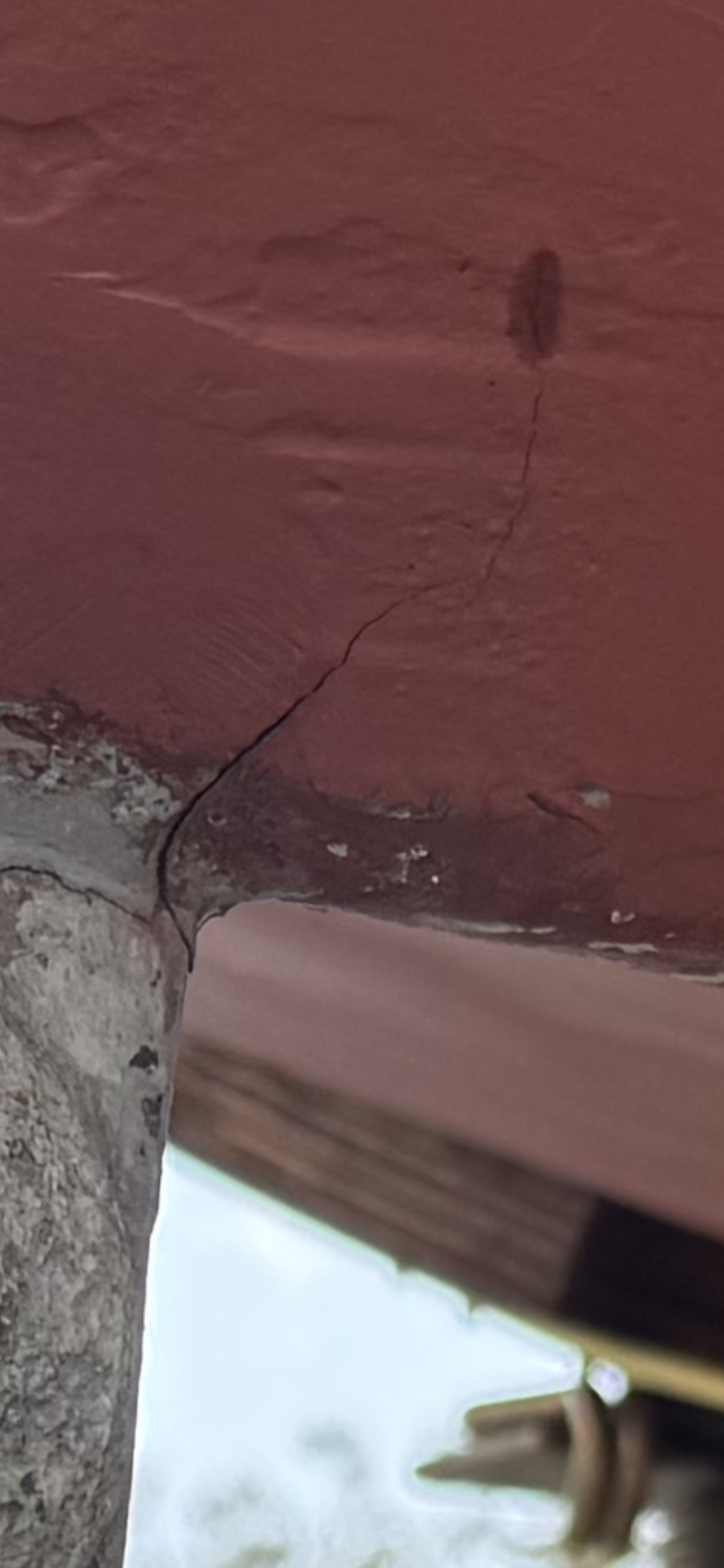
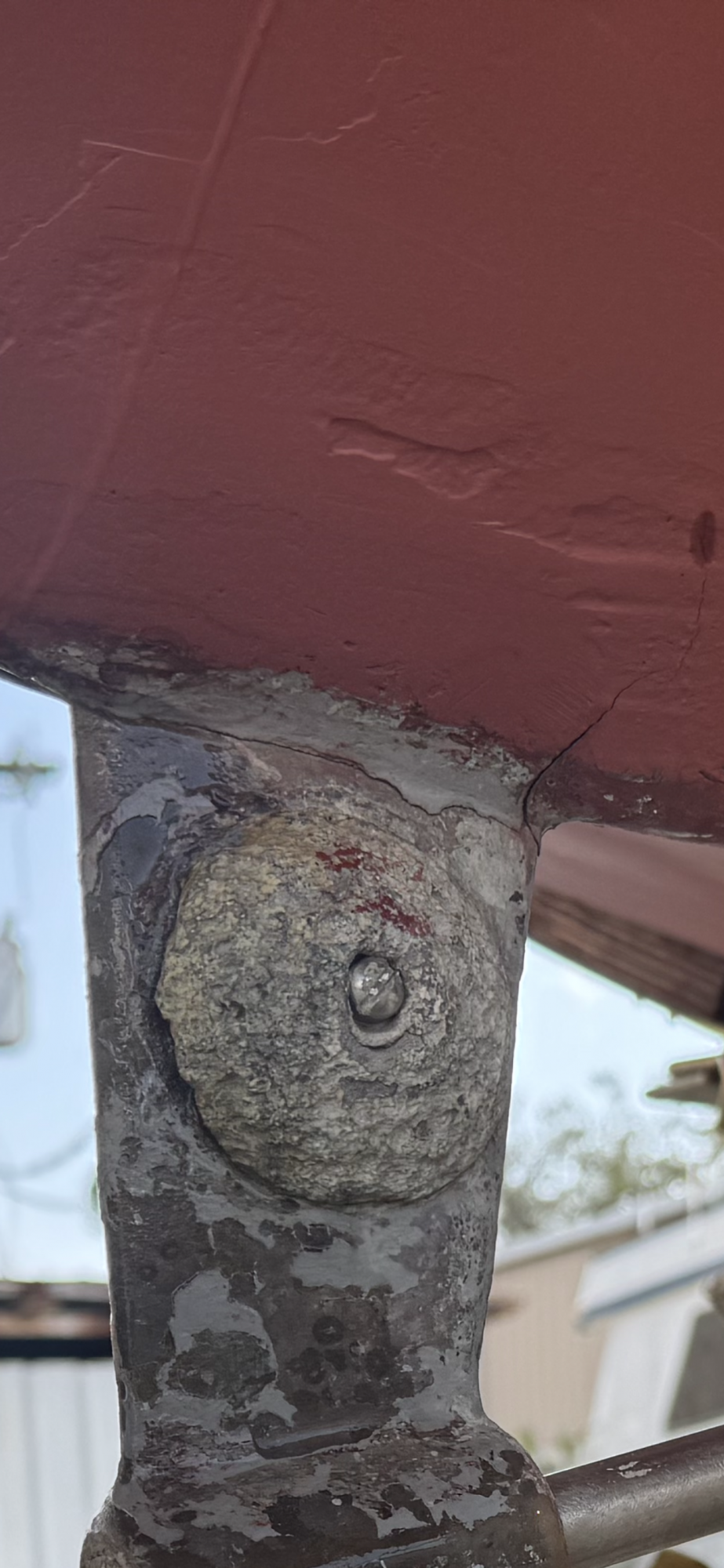
Hi all. I have been looking at boats for about a year and a half. I think I have finally found a good match. The boat is currently out of the water and I noticed something going through the pictures that I would like to run past all you more knowledgeable folks. This is right above the drive shaft support. I know that zinc needs replacing but it’s the crack I concerned with.

New boat purchase hull concern
- Thread starter ringo350
- Start date

jssailem
SBO Weather and Forecasting Forum Jim & John
- Oct 22, 2014
- 24,745
That is one of those issues, with mature boats that validates the value of having a professional surveyor look at a boat before purchase.
There are any number of possible answers. They would require investigation to determine the severity of the issue and identify solutions. It could be something easy or difficult to repair. Did something hit the strut?
A strut looks something like this.
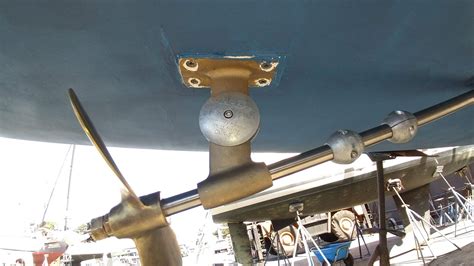
It is bolted to the hull.
It appears on your boat that a previous owner covered the bolts and upper plate with fiberglass. Perhaps the crack is superficial. On the other hand it could mean there is structural damage. That is why I would get a marine boat professional to take a look and offer an opinion.
There are any number of possible answers. They would require investigation to determine the severity of the issue and identify solutions. It could be something easy or difficult to repair. Did something hit the strut?
A strut looks something like this.
It is bolted to the hull.
It appears on your boat that a previous owner covered the bolts and upper plate with fiberglass. Perhaps the crack is superficial. On the other hand it could mean there is structural damage. That is why I would get a marine boat professional to take a look and offer an opinion.


There’s a range of possibilities that are a little hard to narrow down from just the picture. This could be anything from a crack in just the paint to more serious damage running through all of the laminate. A first step would probably be to check inside the hull and see if there’s any evidence of a crack there. If there is I’d say that’s reasonably severe damage and in need of significant repair to redo the laminate. If the crack doesn’t go through to the inside I’d make sure a surveyor took a good look at it to determine how much risk there could be.
What kind of boat is it? I vaguely remember some boats having a more integral strut like that rather than the bolt on like jssailem pictured, but I can’t remember which builders may have done that. Others might know that better to be able to figure out whether the strut was glassed over by a previous owner.
What kind of boat is it? I vaguely remember some boats having a more integral strut like that rather than the bolt on like jssailem pictured, but I can’t remember which builders may have done that. Others might know that better to be able to figure out whether the strut was glassed over by a previous owner.
It would be helpful to know the make of the boat.
This could be something really simple, like the polyester fairing compound has shrunk (it does over time) or much more serious involving structural damage.
Given the hull shape, I don't think the base of the strut is flat, it may be V-shaped to match the hull or more likely it is just vertical and held in place by fiberglass. Getting a look at from the inside would be helpful.
A side note, the anode needs to be replaced. It is worn and looks like it has been painted over.
This could be something really simple, like the polyester fairing compound has shrunk (it does over time) or much more serious involving structural damage.
Given the hull shape, I don't think the base of the strut is flat, it may be V-shaped to match the hull or more likely it is just vertical and held in place by fiberglass. Getting a look at from the inside would be helpful.
A side note, the anode needs to be replaced. It is worn and looks like it has been painted over.

Even if that is a bolt on strut, and even if the crack is in the fairing around the strut mount and not structural, removing the strut immediately leads to shaft alignment issues. These alignment issues can be out of a DIYer's realm.

I too suspect it’s just a problem with the fairing compound, but it needs to be investigated. I would not buy it without having a surveyor look at it. (If you buy it you’ll need the survey anyway, to show an insurance company before they will underwrite it). The surveyor will be able to state how to correct it and estimated cost.
The noninvasive things you can do as an amateur is tap it and compare the sound to the surrounding area, wiggle and shake it to know if it’s firmly attached (by feel and look for slight changes in the width/relief of the crack while trying to move it) and examine the inside of the bilge to see if you can detect any visible cracks or delaminated material there.
The noninvasive things you can do as an amateur is tap it and compare the sound to the surrounding area, wiggle and shake it to know if it’s firmly attached (by feel and look for slight changes in the width/relief of the crack while trying to move it) and examine the inside of the bilge to see if you can detect any visible cracks or delaminated material there.

ok, i was going to ask what the hull is made from. Normally, we wouldn't fare on top of the strut. The strut is bedded and tiltted to match the shaft to the shaft log and the coupler to the transmission. The bolt holes are sealed. Generally, we avoid putting anything over the bolts, as it makes removal or adjustment much more complicated.
I'd look for photos of other boats of the same model, do they have the same amount of fairing? Any signs of water intrusion inside?
I'm wondering if maybe they wrapped a rope around the prop and didn't bother hauling out, inspecting and repairing. Wrapping a rope puts a huge twisting force on the strut which can crack gelcoat and break fiberglass (before the engine stalls).
What did the surveyor have to say about it?
I'm assuming it no longer has the original Atomic 4 gas engine?
I'd look for photos of other boats of the same model, do they have the same amount of fairing? Any signs of water intrusion inside?
I'm wondering if maybe they wrapped a rope around the prop and didn't bother hauling out, inspecting and repairing. Wrapping a rope puts a huge twisting force on the strut which can crack gelcoat and break fiberglass (before the engine stalls).
What did the surveyor have to say about it?
I'm assuming it no longer has the original Atomic 4 gas engine?
jssailem
SBO Weather and Forecasting Forum Jim & John
- Oct 22, 2014
- 24,745
Oh, A Bob Perry designed boat. He is from our neck of the woods. The boat is mature, having been built from 1976-1979. 211 boats are stated as being constructed by Island Yachts.
There are often many issues to check on the boat. The crack, while important, may not be the one of greatest concern to a new owner.
If this is your first big boat purchase, I would definitely get a survey. Boats of this age are not easily insured. If you will be in a marina, then insurance will be required. Insurance will require a current survey. Hire your own. That way, the surveyor is working for you and should have your best interest in mind, not a boat broker or seller.
It should be a capable boat if in good seaworthy condition.
There are often many issues to check on the boat. The crack, while important, may not be the one of greatest concern to a new owner.
If this is your first big boat purchase, I would definitely get a survey. Boats of this age are not easily insured. If you will be in a marina, then insurance will be required. Insurance will require a current survey. Hire your own. That way, the surveyor is working for you and should have your best interest in mind, not a boat broker or seller.
It should be a capable boat if in good seaworthy condition.
I think this has been answered pretty well. I would just add/emphasize that the only way to really know what is going on will be to, at minimum, sand down to whatever is beneath the paint. And, very likely, beyond that. Even if this turns out to be superficial cracking, its repair is not trivial. I see some things that suggest this is fairing over the underlying structure. But, also some things that suggest that the underlying structure was compromised.
Again, just speculation until you sand down to bare material and have a proper look. Ultimately, you will need to grind down to remove all compromised material, at minimum, but you might be able to see what's going on by just removing the paint.
A good surveyor will be able to tell you what is "probably" going on. But, I would not run the engine without doing a proper fix. I would be surprised if this did not involve underlying structural compromise.
One thing that makes me go "Hmm..." is that little wet patch in the upper end of the crack. Very hard to say because I don't have any other context for the photos, but unless we had a good explanation for why there is moisture there, I would be inclined to think that crack runs deep. At worst, that is water making its way from the bilge. More likely, it is water retained in the crack from being sprayed - but even then, it suggests this is more than just a shallow surface crack.
I would be very cautious about this. I don't know what the asking price is, but the repair cost could potentially approach the purchase price. If you purchase, you might get a great deal. Just get a reliable estimate for the repair and factor that into the price. If the repair is done properly, you will be better off than if nothing had been overtly wrong in the first place.
Don't have the current owner do the repair as a condition to the sale. If you do, they will not be incentivized to do the repair properly - just cheaply.
Again, just speculation until you sand down to bare material and have a proper look. Ultimately, you will need to grind down to remove all compromised material, at minimum, but you might be able to see what's going on by just removing the paint.
A good surveyor will be able to tell you what is "probably" going on. But, I would not run the engine without doing a proper fix. I would be surprised if this did not involve underlying structural compromise.
One thing that makes me go "Hmm..." is that little wet patch in the upper end of the crack. Very hard to say because I don't have any other context for the photos, but unless we had a good explanation for why there is moisture there, I would be inclined to think that crack runs deep. At worst, that is water making its way from the bilge. More likely, it is water retained in the crack from being sprayed - but even then, it suggests this is more than just a shallow surface crack.
I would be very cautious about this. I don't know what the asking price is, but the repair cost could potentially approach the purchase price. If you purchase, you might get a great deal. Just get a reliable estimate for the repair and factor that into the price. If the repair is done properly, you will be better off than if nothing had been overtly wrong in the first place.
Don't have the current owner do the repair as a condition to the sale. If you do, they will not be incentivized to do the repair properly - just cheaply.

While all the input has been helpful, to a new boat prospector who has...
Is this his first "big boat" purchase? Lots of other basic kinds of questions.
Me? Having owned boats since 1983, and knowing that the folks who have replied in this thread have owned "big boats" themselves, are all well meaning and well intentioned, I have to ask:
Why is no one suggesting that the original poster Run Run Run as far and as fast as he can from this obviously damaged boat? I would just based on those pictures.
Why is no one asking: if this is the best you can find in a year and a half?
What is your budget? Is it reasonable in comparison to the size of boat you are seeking? If not, either prepare for a project boat (which 99% of the time ends up a disaster) or seek a smaller boat.
Good luck.
...we simply do not know what he doesn't know.been looking at boats for about a year and a half.
Is this his first "big boat" purchase? Lots of other basic kinds of questions.
Me? Having owned boats since 1983, and knowing that the folks who have replied in this thread have owned "big boats" themselves, are all well meaning and well intentioned, I have to ask:
Why is no one suggesting that the original poster Run Run Run as far and as fast as he can from this obviously damaged boat? I would just based on those pictures.
Why is no one asking: if this is the best you can find in a year and a half?
What is your budget? Is it reasonable in comparison to the size of boat you are seeking? If not, either prepare for a project boat (which 99% of the time ends up a disaster) or seek a smaller boat.
Good luck.
jssailem
SBO Weather and Forecasting Forum Jim & John
- Oct 22, 2014
- 24,745
Why is no one suggesting that the original poster Run Run Run as far and as fast as he can from this obviously damaged boat?
Perhaps because @ringo350 started his query with the above statement.I have been looking at boats for about a year and a half. I think I have finally found a good match.
Looking at the image selected by the poster reveals one issue. One that needs more investigation before forming a definitive conclusion. If the OP feels the boat is “His good fit” then with help from an onsite surveyor he can identify the risks vs rewards.
I would want more information before abandoning a “good fit” after a year and a half of searching. There are many boats on the water. When you see one that pulls on your heart strings then it is worth investigating.
1) It’s repairable.Why is no one suggesting that the original poster Run Run Run as far and as fast as he can from this obviously damaged boat? I would just based on those pictures.
Why is no one asking: if this is the best you can find in a year and a half?
2) We don’t know OP’s situation or context

1). Fiberglass is repairable. I had to replace the prop stut on my Catalina. The factory faired around the strut with thickened resin which could be prone to this kind of cracking.
2). Most surveyors will tell you there’s a crack and it’s hard to know what’s really going on without doing something invasive. But they may be able to spot something you didn’t, like a bent shaft.
3). As others have said, you need to figure out how the strut is attached to the hull and if the crack compromises its integrity. Or if is perhaps evidence of some kind of adverse event.
2). Most surveyors will tell you there’s a crack and it’s hard to know what’s really going on without doing something invasive. But they may be able to spot something you didn’t, like a bent shaft.
3). As others have said, you need to figure out how the strut is attached to the hull and if the crack compromises its integrity. Or if is perhaps evidence of some kind of adverse event.
I am in agreement that there is likely fairing compound there. It was repowered so it may have been done then.
The shaft spins easily and seeming true, without a dial indicator.
That water spot caught me also but it had just come in on trailer and driven through the rain on the way so could be from that. And the bilge is dry as a bone.
Will investigate more tomorrow. Thanks guys
The shaft spins easily and seeming true, without a dial indicator.
That water spot caught me also but it had just come in on trailer and driven through the rain on the way so could be from that. And the bilge is dry as a bone.
Will investigate more tomorrow. Thanks guys
Why? We don't know anything else about the boat or the poster.Why is no one suggesting that the original poster Run Run Run as far and as fast as he can from this obviously damaged boat? I would just based on those pictures.
Maybe its a great boat and this is the only thing wrong with it, and he is able to get it for a steal. Maybe he is very handy and interested in a project. Maybe this really is just superficial damage and can be fixed in a weekend. (I don't think so, but it is premature to advise running away based on a few photos that focus specifically on this one defect.)
To me, the best boat is one that is overall in great shape, but has one defect that the current owner does not want to fix. You can almost always get the boat for a price lowered by far more than the cost of the repair, in today's market.
My current boat died and refused to start ... during the sea trial. If I had run away before finding out WHY this happened, I would have missed out on a great deal. The failure gave me a bunch of leverage to bring the price down. And, the repair just involved a $0.27 connector and about 20-30 minutes of diagnostic time.
Inexperienced boat shoppers often walk away from great boats and good deals, just due to an emotional response. Every boat has something that needs to be fixed. Nothing makes me more nervous than a boat with no obvious defects and with a price to match.

This is a great example, foswick, thx.
It is the reason I framed my post as a question, to elicit responses like this.
Often, an OP question can be misinterpreted, too. If he'd asked "how would you approach repair to this strut...?" I may have responded differently because I read his question of one of a newbie who could potentially be getting in over his head and asked my question.
That said, having had experiences of buying three boats, I spent en entire year actively looking for each of the last two. I saw a of lot of horrible neglect that I walked away from. I was a knowledgeable buyer. I would walk from this example unless foswick is right and everything else is pristine. Given these photos, I doubt it, but it could be...
Your boat, your choice. Good luck, again.
It is the reason I framed my post as a question, to elicit responses like this.
Often, an OP question can be misinterpreted, too. If he'd asked "how would you approach repair to this strut...?" I may have responded differently because I read his question of one of a newbie who could potentially be getting in over his head and asked my question.
That said, having had experiences of buying three boats, I spent en entire year actively looking for each of the last two. I saw a of lot of horrible neglect that I walked away from. I was a knowledgeable buyer. I would walk from this example unless foswick is right and everything else is pristine. Given these photos, I doubt it, but it could be...
Your boat, your choice. Good luck, again.
To me, the best boat is one that is overall in great shape, but has one defect that the current owner does not want to fix. You can almost always get the boat for a price lowered by far more than the cost of the repair, in today's market.
My current boat died and refused to start ... during the sea trial. If I had run away before finding out WHY this happened, I would have missed out on a great deal. The failure gave me a bunch of leverage to bring the price down. And, the repair just involved a $0.27 connector and about 20-30 minutes of diagnostic time.

I think it’s worth getting this surveyed if you like the rest of the boat.
It looks to me that this strut was repaired at some point, but not well. There appears to be some fiberglass layers that are sitting proud around the area and some low spots that weren’t faired. The cracked areas look like the edges of either fiberglass or filler that are starting to peel up under stress. There is water getting under the areas that are starting to peel. That can freeze (I’m not sure where this boat is) and continue to peel the laminate back.
Regardless, this area needs further investigation in-person by someone that is qualified. The quality of the repair raises questions about how thorough the rest of the job was done. Tapping on the repair area will yield some information about how much of the repair is delaminating, but again, the repair as a whole is suspect. The prop shaft may never have been aligned well after the repair. The prop shaft could be bent. These factors could be stressing the repair and failing it slowly over time. There’s a lot of what-ifs here that need to be investigated. Having someone qualified to investigate it will cost money, which is worth it if you really love the boat.
If you really like the rest of the boat, I wouldn’t think twice about investigating this and getting some estimates of what a quality repair will cost. All of this is negotiable with the seller and really isn’t all that out of routine for an aging boat.
It looks to me that this strut was repaired at some point, but not well. There appears to be some fiberglass layers that are sitting proud around the area and some low spots that weren’t faired. The cracked areas look like the edges of either fiberglass or filler that are starting to peel up under stress. There is water getting under the areas that are starting to peel. That can freeze (I’m not sure where this boat is) and continue to peel the laminate back.
Regardless, this area needs further investigation in-person by someone that is qualified. The quality of the repair raises questions about how thorough the rest of the job was done. Tapping on the repair area will yield some information about how much of the repair is delaminating, but again, the repair as a whole is suspect. The prop shaft may never have been aligned well after the repair. The prop shaft could be bent. These factors could be stressing the repair and failing it slowly over time. There’s a lot of what-ifs here that need to be investigated. Having someone qualified to investigate it will cost money, which is worth it if you really love the boat.
If you really like the rest of the boat, I wouldn’t think twice about investigating this and getting some estimates of what a quality repair will cost. All of this is negotiable with the seller and really isn’t all that out of routine for an aging boat.
Last edited:
Aside from the crack is anyone else concerned about the electrolysis on the strut? It seems to me, over all maintenance has been lacking on this boat.. I agree with Stu, run! There lots of other boats out there.
dano
dano