Electrical Assistance

Dec 28, 2015
1,945
Laser, Hunter H30 Cherubini Tacoma
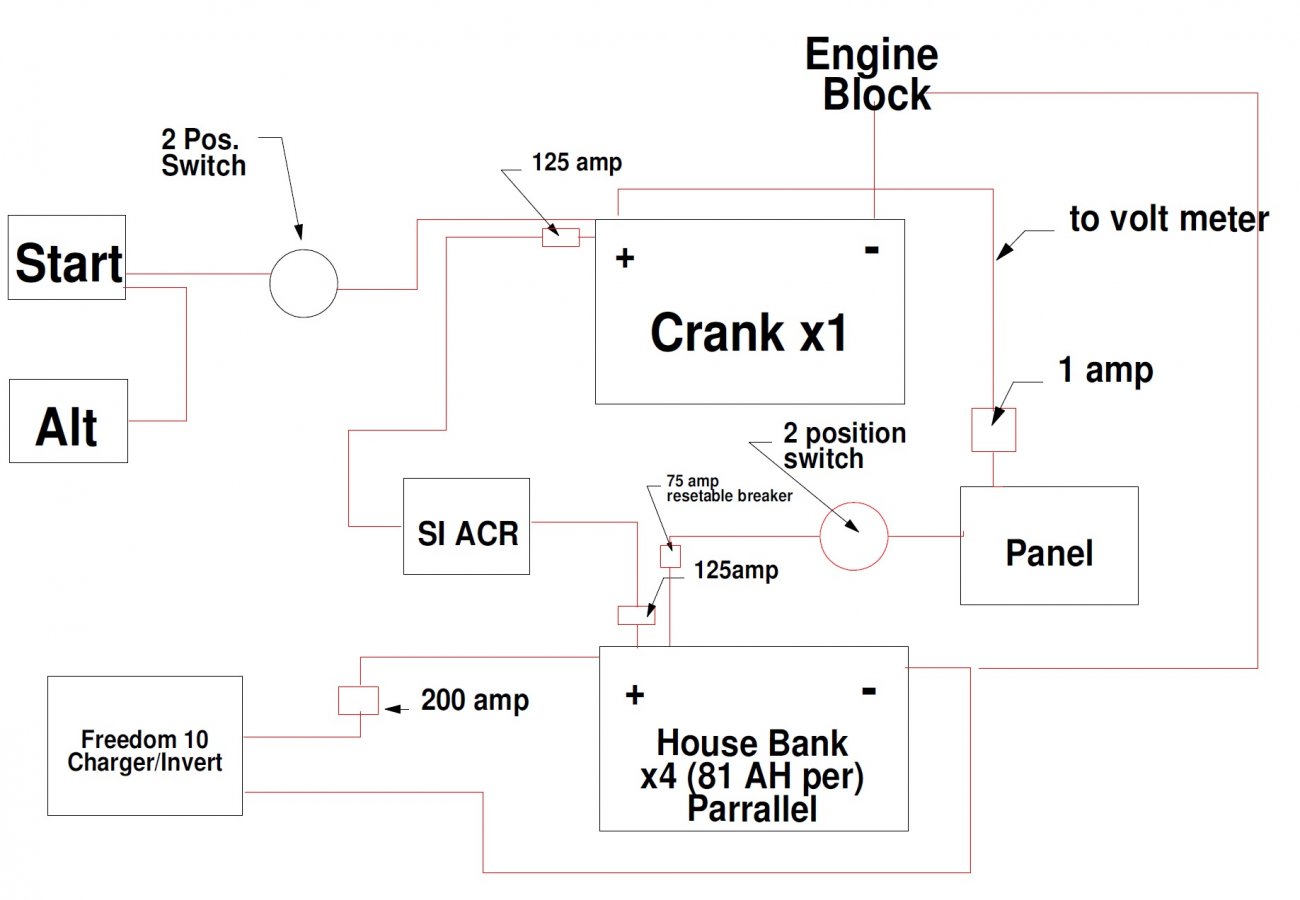
In preparation of installing solar to my boat, I have mapped out the main DC circuits to figure out where to install and evaluate any needs for change. I've been meaning to do this since its purchase last April and the project has motivated me to better learn the systems. Long story short I have a single crank battery and 4 house batteries in parallel. A Freedom 10 charger/inverter connected to the house bank. A Blue Seas SI ACR connecting the crank and house bank. The alternator hooked to the crank and the house bank feeding my Blue Seas panel which is two banks of 12 vlt breakers and a single bank of 120vlt, amp meter, 12 volt meter (with two bank positions) and a 120 volt meter. All positive battery posts have 125 amp fuses with the exception of the lead between the house bank and panel, it has a reset able 75 fuse.

I have drawn out the schematic below. From what I see and after researching the SI ACR, I need to move the alternator battery output off of the crank battery and to the house bank to it up a little. I am interested in additional input.

As for the solar circuit.....I'm thinking of adding it to the battery side of the 200 amp fuse for the charger. Thoughts?
boat wire.jpg
 

Attachments

Last edited:
Dec 28, 2015
1,945
Laser, Hunter H30 Cherubini Tacoma
Additional, I have seen a lot of discussion on externally regulated alternators in the marine forums. I'm not seeing anything that looks like mine is externally regulated. Can I assume it would be fine to move the battery output from the starter lug to the house bank? It is a Hitachi LR155-20, 55A
 
May 17, 2004
6,145
Beneteau Oceanis 37 Havre de Grace
That sounds like a remarkably sound design so far. I do agree that it would be better to have the alternator going to the house bank. Three other questions that come to mind are:

- What loads, if any, are connected directly to the house bank (eg bilge pumps), and are they individually fused for their wire sizes?
- Would you like any provision to start the engine from the house bank if the starter battery fails, or would you just use a jumper cable? It looks like you could add one wire connecting the outputs of the two 2 position switches, with its own switch, to be able to quickly divert between the banks. You might need to resize some fuses and wires to do that though.
-Is the cable to the starter appropriately fused at the battery? Your picture doesn't show that one.
 
Jan 11, 2014
13,992
Sabre 362 113 Fair Haven, NY
Basically the system looks pretty sound. A couple of suggestions.

You are correct to move the alt out put to the house bank, MaineSail's site MarineHowTo.com has articles on this.

As it is currently configured, if the start battery fails, you will not be able to start the diesel. Installing a Blue Seas Dual Circuit Plus switch will allow you start off the house batteries or run the house off the start battery. Check the Blue Seas site for installation, Maine Sail has also posted this several times in his Forum.

The stock internally regulated alternator is going to struggle to keep the batteries charged. An externally regulated larger capacity alternator will do a much better job, especially with the new refrigeration.

Consider installing Positive and Negative bus bars to keep the number of connections on the battery down. The negative bus bar is easy, Blue Seas makes them. There are a number of ways to build your own positive bus bar.
 

Sumner

.
Jan 31, 2009
5,254
Macgregor & Endeavour 26S and 37 Utah's Canyon Country
Agree with others about moving Alt. to House Bank.

Also I'd fuse the wiring to the solar appropriately, a 200 amp fuse is probably way too big for the wiring used and controller.

http://purplesagetradingpost.com/sumner/endeavour-electrical/electrical-index.html

I have separate main fuses for the house loads, the solar and the 110 to 12 volt 50 amp Sterling charger. After the main house load fuse there are fuse blocks for the individual runs, all sized to the wires on those runs. The short wires from the three main fuse blocks to the house battery post are protected by ...

... fuses on the battery post that are also two different sizes, again size for the loads on them.

I run the starter cable to a 1-2-Both-Off main switch so I can start off either the start battery, the house bank or both,

Sumner
===========================================================================
1300 miles to The Bahamas and Back in the Mac...
Endeavour 37 Mods...
MacGregor 26-S Mods...
Mac Trips to Utah, Idaho, Wyoming, Canada, Florida, Bahamas
 
Jan 11, 2014
13,992
Sabre 362 113 Fair Haven, NY
fuses on the post that are also two different sizes, again size for the loads on them.
Size to protect the wire, not the load. The wire should be sized to handle the load. Sometimes it is necessary to have multiple fuses/breakers on the same circuit.

On my boat I have one breaker (15 amp) that supplies power via a 10 gauge wire to a terminal strip that powers the electronics at the terminal strip each device has its own 2 or 5 amp fuse to protect the 18 gauge wire from the terminal strip to the device.
 

Sumner

.
Jan 31, 2009
5,254
Macgregor & Endeavour 26S and 37 Utah's Canyon Country
Size to protect the wire, not the load. The wire should be sized to handle the load. Sometimes it is necessary to have multiple fuses/breakers on the same circuit.
Should of clarified that a little better, thanks, that was what I was getting at. Our wires are sized for the loads and the fuses for the wires,

Sumner
===================================================================
1300 miles to The Bahamas and Back in the Mac...
Endeavour 37 Mods...
MacGregor 26-S Mods...
Mac Trips to Utah, Idaho, Wyoming, Canada, Florida, Bahamas
 
May 20, 2016
3,015
Catalina 36 MK1 94 Everett, WA
Without knowing wire sizes it’s hard to comment on fusing but I’ll give it a go

1) the 200A battery to charger is way to big. I would set this at 1.5x charger amps or wire capacity which ever is lower. Fuse close to battery.
2)) as others have said I’d add a disconnect between the start and disconnect to crank battery to the house. This allows house only to start, house + crank or crank only. See Maine Sails article on 1,2,both
3) look at adding a disconnect in the engine compartment for an Alternator disconnect
4) Alternator hooks to house - redo ACR wires to match, connect SI portion of the ACR
5) the 125A to the ACR seems high, depends on wire size but 80’s seem more appropriate - especially on the destination side.
6) fuse at crank battery for wire going to Alternator.


Of the fuses out there I like MBRF but ANL are a close second. You need both the amp rating and a very high fusable rating (1000+ Amp). Both these fuses meet that spec

For the house Circuit Breaker use a type 187

If you include wire size and distance we can do better analysis.
 
  • Like
Likes: Ward H
Dec 28, 2015
1,945
Laser, Hunter H30 Cherubini Tacoma
Without knowing wire sizes it’s hard to comment on fusing but I’ll give it a go

1) the 200A battery to charger is way to big. I would set this at 1.5x charger amps or wire capacity which ever is lower. Fuse close to battery.
2)) as others have said I’d add a disconnect between the start and disconnect to crank battery to the house. This allows house only to start, house + crank or crank only. See Maine Sails article on 1,2,both
3) look at adding a disconnect in the engine compartment for an Alternator disconnect
4) Alternator hooks to house - redo ACR wires to match, connect SI portion of the ACR
5) the 125A to the ACR seems high, depends on wire size but 80’s seem more appropriate - especially on the destination side.
6) fuse at crank battery for wire going to Alternator.


Of the fuses out there I like MBRF but ANL are a close second. You need both the amp rating and a very high fusable rating (1000+ Amp). Both these fuses meet that spec

For the house Circuit Breaker use a type 187

If you include wire size and distance we can do better analysis.
Good points. I'll get the wire sizes. Regarding the 200 amp fuse, the charger is a Freedom 10 with 1000watt inverter. The manual for it calls for that size fuse. Not to challenge your input just stating the manual. I'll do a little more digging on the info. I was able to map what I have out last night from 6pm-8pm using my trusty tracer. It wasn't much fun.
 
Dec 28, 2015
1,945
Laser, Hunter H30 Cherubini Tacoma
As you all have recommended, I have been reading up on all of MainSails posts and MarineHowTo.com website. I also have a marine electrical/mechanical manual I've been using.
 
Jan 11, 2014
13,992
Sabre 362 113 Fair Haven, NY
Good points. I'll get the wire sizes. Regarding the 200 amp fuse, the charger is a Freedom 10 with 1000watt inverter. The manual for it calls for that size fuse. Not to challenge your input just stating the manual. I'll do a little more digging on the info. I was able to map what I have out last night from 6pm-8pm using my trusty tracer. It wasn't much fun.
If it was just a charger, Les is correct, a 200 A fuse is way too large, however, when in the inverter 200 A sounds about right the cable should be pretty hefty.
 
Jan 11, 2014
13,992
Sabre 362 113 Fair Haven, NY
As you all have recommended, I have been reading up on all of MainSails posts and website. I also have a marine electrical/mechanical manual I've been using.
Charlie Wing''s book on DC wiring is very clear and straight forward. Covers the basics well. Calder's book is good, but can be a little dense.
 
May 20, 2016
3,015
Catalina 36 MK1 94 Everett, WA
Good points. I'll get the wire sizes. Regarding the 200 amp fuse, the charger is a Freedom 10 with 1000watt inverter. The manual for it calls for that size fuse. Not to challenge your input just stating the manual. I'll do a little more digging on the info. I was able to map what I have out last night from 6pm-8pm using my trusty tracer. It wasn't much fun.
No challenge. I missed it was an inverter. Still at full load your pulling ~105A (assuming 80% efficiency) so if it’s pulling more than 150 there is something big time wrong. Yes the wires may handle it but I also like to keep from melting down the load. Your boat your choice.

You also might want a 250-300A fuse at crank battery to starter. Missed that one. Not necessary per ABYC but mostly cause the big straight 6’s and V8 diesels had their way with the spec.
 
Feb 26, 2004
23,325
Catalina 34 224 Maple Bay, BC, Canada
  • Like
Likes: StargazerP303
Feb 6, 1998
11,759
Canadian Sailcraft 36T Casco Bay, ME
Long story short I have a single crank battery and 4 house batteries in parallel. A Freedom 10 charger/inverter connected to the house bank. A Blue Seas SI ACR connecting the crank and house bank. The alternator hooked to the crank .
If the alternator is connected to the start battery and the house is being charged via the ACR and alternator fed start battery this is incorrectly hooked up. The article below will help you understand why.
Making Sense of the ACR (LINK)

All positive battery posts have 125 amp fuses with the exception of the lead between the house bank and panel, it has a reset able 75 fuse.
If these are main protection fuses they are too small to start a motor or use any decent sized inverter. If either bank can be called upon, even in an emergency, to start the motor then you'll want a fuse of 250A at a minimum but preferably 300A.

I have drawn out the schematic below. From what I see and after researching the SI ACR, I need to move the alternator battery output off of the crank battery and to the house bank
You read that correctly..

As for the solar circuit.....I'm thinking of adding it to the battery side of the 200 amp fuse for the charger. Thoughts?
If you add it to the battery side of the fuse there is no fuse protection. The solar feed fuse should be sized to protect the solar feed wire

You're also lacking any way to cross connect / isolate a bad battery and run the vessel of the remaining bank. The Blue Sea 7622 ML-ACR may be a better choice as it can be used in auto or manual parallel mode. A bit less ideal than a proper switching configuration but better than no way to use the vessel if a bank suffers a failure.
 
  • Like
Likes: StargazerP303
Dec 28, 2015
1,945
Laser, Hunter H30 Cherubini Tacoma
Hunter Elect.jpg
Ok, with everyone's input and inquires I mapped out the system with more detail and included size and approx lengths. I just noticed a error the SI AR is a SI ACR.

A addition to the original is the added "Echo Charge" circuit I missed last time. This is a 15 amp max charge lead that follows the 3 phase charging steps of the primary charger that is meant for a secondary battery that is isolated. I'm thinking this is a problem with the ACR.
I need to review all of the input so please understand I'm not discounting it....That being said, I was out for a sail yesterday and paid attention to the SI ACR's combined LED light on the unit. With the engine off and the AC plugged in (charger on) the light is on, which I would expect. I unplugged the AC and let it sit for at least 10 minutes and the light stayed on. There was no loads on the DC circuits other than the refer which was about 1 amp. I turned on the inverter and turned on a DC load making the inverter turn on. The light went out and stayed off until I started the engine which then it turned on. The light not turning off after a couple minutes of the AC begin unplugged and not other charge current being supplied to either side of the ACR doesn't appear to be proper functions.
 

Attachments

Last edited:
May 20, 2016
3,015
Catalina 36 MK1 94 Everett, WA
Thanks for clarifications

  • 200 amp fuse at charger should be 7” to battery not at charger. You fusing the wire to the charger/inverter. Other direction is self limiting.
  • Alternator and charger to house not start
  • Hard to tell but should pull positive and negative from batteries at opposite ends of chain only. (Relocate house ground to engine to other battery)
  • Alternator output blown diodes if crank disconnected while running.
  • No way to crank from house only or house+crank
 
  • Like
Likes: Ward H