alternative charging options?

Jul 7, 2004
8,525
Hunter 30T Cheney, KS
Recently,, or over decades?
Recently that I've noticed. I just moved docks when I bought the Hunter a couple years years ago. When I had my Mac slipped on the cheap docks, it was never a problem or a concern that was ever discussed with the other sailors on the 'high end' docks.
 

jssailem

SBO Weather and Forecasting Forum Jim & John
Oct 22, 2014
24,454
CAL 35 Cruiser #21 moored EVERETT WA
It builds muscle... Lift with your legs, or find an 18 year old helper...
They could be in the range of 85-105 AHr. Using the suggested 10% guide a 30 AMP charger is in line. The 20 AMP works but takes a bit longer. The issue of your dock power being 20 AMP service is a limiting factor.

Is the only AC demand running the charger?

Sherlock Holmes would say "when you have eliminated the impossible, whatever remains, however improbable, must be the truth" or in this case the cause of your issue.
 
Jul 7, 2004
8,525
Hunter 30T Cheney, KS
Thanks again for taking the time to repost that response Main. If as you say, your bench Freedom works fine on a 5mA GFCI, and mine is stable on the yard 5mA GFCI, then would the problem point to the cumulative effect on the dock? And why do I seem to be the only boat affected nearby?
As I understand our setup, the pedestals on the dock are daisychained. Each one has 4 20 amp circuit breakers that each provide power to a dedicated GFCI.
Because it's working in the yard and intermittent in the slip, I'm still confused. Since my charger supply is wired to the same buss as my AC distribution panel then why does removing the line to the unit allow the boat AC distribution work without tripping? :confused:
 
Jul 7, 2004
8,525
Hunter 30T Cheney, KS
It builds muscle... Lift with your legs, or find an 18 year old helper...
They could be in the range of 85-105 AHr. Using the suggested 10% guide a 30 AMP charger is in line. The 20 AMP works but takes a bit longer. The issue of your dock power being 20 AMP service is a limiting factor.

Is the only AC demand running the charger?

Sherlock Holmes would say "when you have eliminated the impossible, whatever remains, however improbable, must be the truth" or in this case the cause of your issue.
LOL
My main AC draw in the slip is the A/C. Occasionally the water pressure pump, coffee pot etc. When the charger is going full charge, having the A/C come on will trip the shlre circuit breaker.
 
Feb 6, 1998
11,757
Canadian Sailcraft 36T Casco Bay, ME
Thanks again for taking the time to repost that response Main. If as you say, your bench Freedom works fine on a 5mA GFCI, and mine is stable on the yard 5mA GFCI, then would the problem point to the cumulative effect on the dock? And why do I seem to be the only boat affected nearby?
As I understand our setup, the pedestals on the dock are daisychained. Each one has 4 20 amp circuit breakers that each provide power to a dedicated GFCI.
Because it's working in the yard and intermittent in the slip, I'm still confused. Since my charger supply is wired to the same buss as my AC distribution panel then why does removing the line to the unit allow the boat AC distribution work without tripping? :confused:
You need to at least run the test I posted for you.

There can not be any AC White/NEUTRAL to AC Green/GROUNDING bond on-board the vessel when running on shore power.

This is what causes most GFI's to trip. As I mentioned a large number of inverters are incorrectly wired. The Freedom series were designed for both land and RV use. Many are improperly wired for marine use.

Beg borrow or steal an AC Leakage clamp meter (not the same as a standard clamp meter) to clamp the entire cord set or use a 120V AC Line Splitter to test AC Black/HOT, AC White/NEUTRAL and AC Green/GROUNDING.

Your marinas GFCI could also be failing/faulty and an Ideal Sure Test can easily tell you if it is tripping at spec.
 
Jul 7, 2004
8,525
Hunter 30T Cheney, KS
Boy, the electrical companies seem clueless when you ask about GFCI's that trip at different thresholds. "well we have 15 amp and 20 amp receptacles".
 
May 24, 2004
7,209
CC 30 South Florida
The kicker is, it works fine on the trailer in the yard with the same GFCI setup.
:(
What came first the chicken or the egg? Had a similar situation at a private dock. A licensed electrician came out and said the GFCI at the pedestal was redundant and was eliminated. It worked fine for the next six months and then the battery charger died. Did it die as result of the previous breaker tripping or was the tripping the results of a failing charger. We will never know as we replaced it and for the next ten years has been working fine. As best as I can surmise I think the charger may have had an intermittent fault that was causing the tripping. Don't recall why exactly the GFCI was deemed to be redundant but no problems there either. I think your decision to replace the old charger is a wise one as dealing with these problems is highly frustrating.
 
Jul 7, 2004
8,525
Hunter 30T Cheney, KS
Today I split the power to the charger and the main boat power system. Each are on a separate shore power cord. I'll see which pedestal GFCI trips now.
I can't find a class B 30ma GFCI anywhere!
 
Aug 22, 2017
1,609
Hunter 26.5 West Palm Beach
Main Sail,
Thank you for all the excellent information that you posted.

I share your frustration with the number of boats out there that are not ABYC compliant in their wiring. In addition to that, I am equally frustrated by the difficulties & expenses involved in gaining access to the ABYC standards & NPFA 303. If more people had easy access to this information, then more boats would probably have fewer electrical mistakes aboard. If you know of a good source for this information that is available to the public, please fill me in. I'm only finding my information in dribs & drabs. Most of what I do find is usually a few years out of date.

Thanks,
Jim
 
Feb 6, 1998
11,757
Canadian Sailcraft 36T Casco Bay, ME
In addition to that, I am equally frustrated by the difficulties & expenses involved in gaining access to the ABYC standards & NPFA 303.

Anyone can join the ABYC, and have access to the standards, but keep in mind that the standards are not written to be read by those not specifically trained to understand them. An individual membership is $185.00 per year and gives you access to every standard.

A better choice for a DIY is a book like Charlie Wings Boatowner's Illustrated Electrical Handbook..
 
  • Like
Likes: JimInPB
Aug 22, 2017
1,609
Hunter 26.5 West Palm Beach
Thank you Main Sail. Excellent information & advice as usual. For some reason, I thought that ABYC membership was more expensive that that. I was also previously unaware of that book.
 
Jul 7, 2004
8,525
Hunter 30T Cheney, KS
Still tripping my GFCI. I am taking Main's advice and searching for the leak. I found a leakage clamp tester from Reed Instruments could afford. I hope this works...


Pat

.
Jun 7, 2004
1,250
Oday 272LE Ninnescah Yacht Club, Wichita, Ks.
Here is a bit more confusion....we never have an issue on our boat...no need for a pig tail....we do have to use a pig-tail in the yard....Justin, A dock was re-wired approx. 7 years ago....maybe 8....In the yard, we do use a pig-tail because of the power source / pedestals installed in the yard....
 
Jul 7, 2004
8,525
Hunter 30T Cheney, KS
Here is a bit more confusion....we never have an issue on our boat...no need for a pig tail....we do have to use a pig-tail in the yard....Justin, A dock was re-wired approx. 7 years ago....maybe 8....In the yard, we do use a pig-tail because of the power source / pedestals installed in the yard....
Hi Pat. The 30amp power cord we got with the boat plugged in directly to the PO's twist-lock pedestal. Since our pedestals use 20amp "household" GFCI outlets, it had to be converted with a pigtail. With the trouble I've had since we brought her to the dock, I bought a new 10ga cable that plugs into the pedestal directly. So now I have to convert on the boat side. Regardless, it made no difference to my problem.
I'm getting this AC tester to see what/where the neutral to ground leak is.
It's very intermittent. I'm expecting there to be a leak just below the 5ma threshold that exceeds it intermittently and causes the GFCI to trip.
 
Last edited:
Jul 7, 2004
8,525
Hunter 30T Cheney, KS
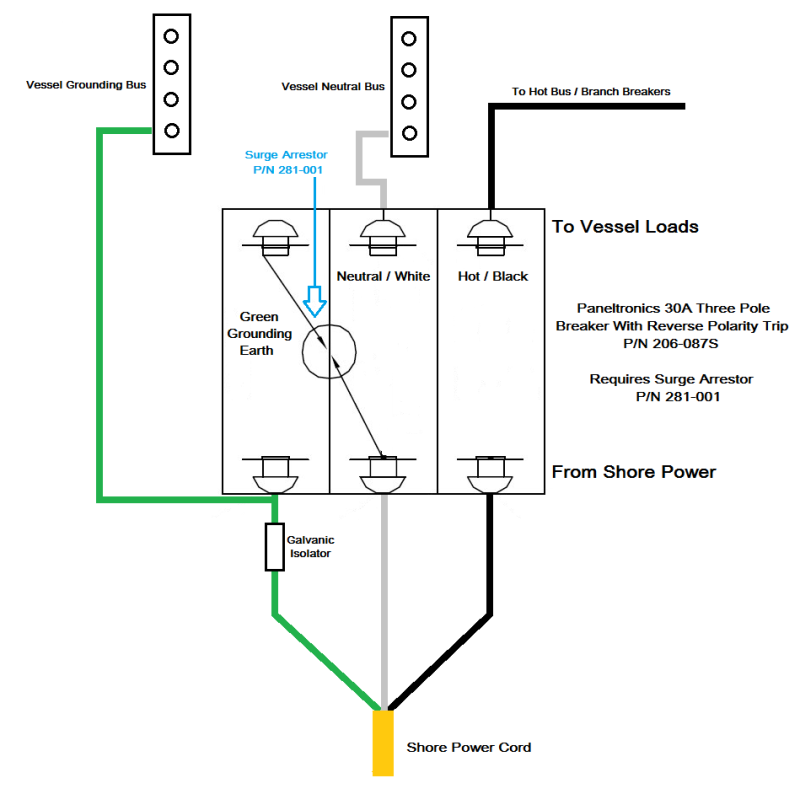
This maybe a Mainsail question. I wanted to sketch my AC Main power switch but maybe I can describe it well enough to ask what this discreet component is for:
It's a 3PST main switch/breaker. When engaged, one pole supplies power (black wire) to the load and is distributed to other switches. Okay. The second pole connects neutral (white) to the neutral buss. So far so good.
Here's the kicker: the ground (green) input wire is tied directly to the ground buss. Then there is a lead from the ground buss to the input side of the 3rd switch pole. Then the contact side of the earth switch pole is connected to the input side of the neutral line via a diode(?) of some sort where the white wire is connected . So when you engage the AC switch, neutral supply, neutral buss, and earth buss are all connected (indirectly?) through this component.
My electronics days are an ancient memory. Why would neutral and ground be tied together electronically, not mechanically? Is it a safety measure of some sort? If this component has failed, is this why my pedestal GFCI fails? What could this component be? A zener? It's hard to read installed, but I think is has "CG751..."
Does any of this make sense? I think I could take this component out of the system and everything would still work.
 
Last edited:
Feb 6, 1998
11,757
Canadian Sailcraft 36T Casco Bay, ME
This maybe a Mainsail question. I wanted to sketch my AC Main power switch but maybe I can describe it well enough to ask what this discreet component is for:
It's a 3PST main switch/breaker. When engaged, one pole supplies power (black wire) to the load and is distributed to other switches. Okay. The second pole connects neutral (white) to the neutral buss. So far so good.
Here's the kicker: the ground (green) input wire is tied directly to the ground buss. Then there is a lead from the ground buss to the input side of the 3rd switch pole. Then the contact side of the earth switch pole is connected to the input side of the neutral line via a diode(?) of some sort where the white wire is connected . So when you engage the AC switch, neutral supply, neutral buss, and earth buss are all connected (indirectly?) through this component.
My electronics days are an ancient memory. Why would neutral and ground be tied together electronically, not mechanically? Is it a safety measure of some sort? If this component has failed, is this why my pedestal GFCI fails? What could this component be? A zener? It's hard to read installed, but I think is has "CG751..."
Does any of this make sense? I think I could take this component out of the system and everything would still work.

These three pole reverse polarity trip breakers are very often miswired..

 
Jul 7, 2004
8,525
Hunter 30T Cheney, KS
You da' man MS! That shows exactly how mine is wired. Is it possible that the surge arrestor is going bad and tripping my GFCI? I am in the process of ordering a leakage clamp tester but still looking, hoping for something else being the culprit.
Could I disconnect that component for a while to see if the tripping stops?