Wire Jacketing Observations

Feb 6, 1998
11,760
Canadian Sailcraft 36T Casco Bay, ME
About a year ago, maybe more, I posted some photos of badly oxidized bare copper wire. My assertion at the time was that moisture had permeated the transparent jacket of the wire. I was told I was a nut, which is pretty true.;)


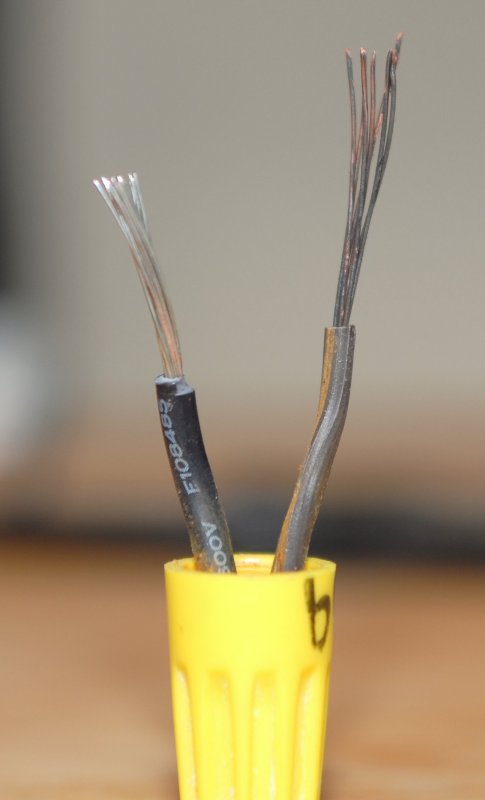
So this past week I began the long needed, complete re-wiring of our boat. In doing so I discovered more of this "trailer" type wire. Only this time it was in a factory original PVC wire chase glassed into the hull. There were two sets of four wire, trailer wire, used to power the mast. One of these four conductor wires was made of non-transparent PVC jacketed wire the other transparent perhaps vinyl jacketed wire. It seems CS used what ever trailer wire they could get or color coded the wire by jacket type for identification?

This is an interesting case study:

1- Both of these wires terminated at exactly the same location on either end.

2- Both of these wires were installed at the exact same time, 30 years ago.

3- Both were subjected to the exact same environmental conditions.

4- Both wired used the exact same factory open style crimp connectors.

5- Both wires had the same exact amount of visible oxidation at the crimp ends.

6- Neither of these wires showed any signs of ever being wet or any substantial corrosion on the crimps other than some oxidation.

7- One of the wires, the one shown below that is oxidized, had both ends sealed from the factory with electrical tape, as perhaps an extra that was not needed or being used. It still had an excellent seal of tape on both ends and showed no signs of any voids along the jacket under the tape.

8- I cut both sets of wires in the middle of their approx 18' length at roughly 9 feet then stripped all four wires on each one, eight in total.

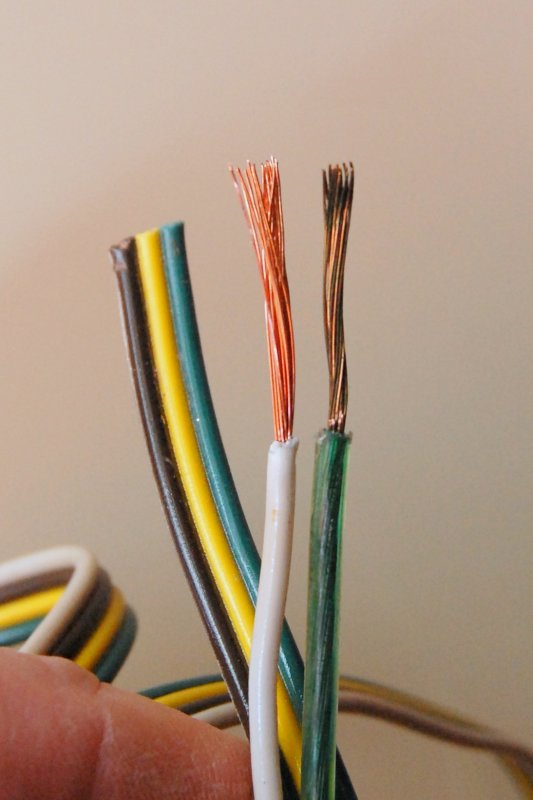
9- All four of the wires on the non-transparent jacketed (perhaps PVC?) wire were in absolute perfect, like new condition 9 feet in.

10- All four of the wires on the transparent jacketed wire (perhaps vinyl?) were badly oxidized at 9 feet and this included the one with the electrical tape, hermetically sealed ends.

11- For those counting that is four for four.


The only explanation I can honestly come up with is that some wires have very poor jacketing, that over time, 30 years in this case, possibly allow moisture to permeate the jacket?

I did have one wire, of the higher quality duplex type, that terminated at a plug in the anchor locker that had suffered severe moisture damage and the crimp literally fell off the wire when I touched it. The oxidation "creeped" up this wire about 18" over 30 years despite it having no drip loop. When I cut this wire in it's center, like the trailer wiring, both the + & - wires showed like new even when subjected to a failed plug seal on one end and 30 years of constant high moisture from being in an anchor locker.

My guess is the same as before that all wire jackets may not be created equal and some cheap wire might allow moisture to permeate the jacketing?

Wire on right is the clear jacketed stuff and the wire on the left is the solid jacketed type.
 

Ross

.
Jun 15, 2004
14,693
Islander/Wayfairer 30 sail number 25 Perryville,Md.
And they aren't tinned.
 
Oct 10, 2008
38
Ericson 34 Lk Champlain
OK, the wires lasted thirty years without a problem, and would likely last another thirty.

What's the point?

Why do you think that corrosion is from water, and not chemicals in the insulation. This corrosion should not be a problem as long as the crimp was properly made.

I would be more concerned with your nicking wires when you strip them.

This reminds me of the time several years ago when some scientists dissected two snapping turtles from Lk Ontario and found .5 ppm of dioxin in their flesh. I have always wondered if the .5 ppm of dioxin hurt the turtles more than dissecting them. ;)
 
Jan 27, 2008
3,092
ODay 35 Beaufort, NC
Maine, You need to seriously look at a chain saw project and then start building a wooden boat. I look forward to the day you launch your new wooden boat, raise the sail on the schooner and head out to the banks for some cod fishing. I thought all Main sailors were wooden boat enthusiasts? What's up with that?
 
Feb 6, 1998
11,760
Canadian Sailcraft 36T Casco Bay, ME
OK, the wires lasted thirty years without a problem, and would likely last another thirty.

What's the point?
As always the point is to open conversation to figure things out..

Why do you think that corrosion is from water, and not chemicals in the insulation. This corrosion should not be a problem as long as the crimp was properly made.
This is why I bring this up. That is a very plausable explanation I had not thought of. Do you know any more about this?

I would be more concerned with your nicking wires when you strip them.
Me too!
 
Oct 10, 2008
38
Ericson 34 Lk Champlain
Do you know any more about this?[/quote said:
No, other than that surface oxidation on the wire won't affect a properly made connection and won't affect the current carrying properties of the wire. No harm, no foul.

For example, you might notice overhead power line conductors. Generally only covered when required to avoid abrasion from trees. As a safety note: those wires are "covered", not "insulated". Don't grab that PVC covered wire laying in the road.
 
Feb 6, 1998
11,760
Canadian Sailcraft 36T Casco Bay, ME
No, other than that surface oxidation on the wire won't affect a properly made connection and won't affect the current carrying properties of the wire. No harm, no foul.
This is true until one needs to remove a crimp fitting that has suffered some corrosion. I have been on the receiving end of trying to make a decent connection with badly oxidized wire. Short of cleaning each strand with ScotchBrite cleaning this stuff off to make a good connection is not easy. I once even resorted to On/Off acid. Worked quite well but this was only a temporary fix as I know the acid was not a good idea, but it did clean the wire enough to get my friends Mako up and running again. I did have some decent luck once with Penetrox on oxidized wire but it was only a temporary fix so i can't speak to long term conductivity....

If the connection was made when the wire was clean it will still pass current fine but re-attaching to wire that looks like that will not always result in a a good electrical connection.
 

Johnb

.
Jan 22, 2008
1,505
Hunter 37-cutter Richmond CA
I wonder if the purity/quality of the original copper has any bearing on it's tendency to corrode.
 
Jan 27, 2008
3,092
ODay 35 Beaufort, NC
The nature of metals

When you go for a walk in a natural setting you don't see metals. In their natural state which is the lowest energy level for the material they are generally in the form of oxides. Miners dig this up in the form of ore and then blast furnaces are used to break the bonds, separate the impurities and recover the pure metal. This is then mixed with alloying elements to give it specific properties when cooled. In processed form metals are at an unnatural high energy state and are trying to go back to their lower energy condition. Thus metals will typically combine with free oxygen in the atmosphere immediately and form oxide layers. Depending on the metal and the alloying elements these oxides can have varying effects on the properties and will continue over time.
I too have seen corroded wires on a boat and after stripping back the wire for eight inches or so found the conductor completely corroded all the way up the length of wire inside the insulator. This too in a dry but high humidity location. I believed at that time the corrosion was progressing along the length, not really thinking about permeability of the insulator to moisture and oxygen. That is an interesting thought, how porous is the insulator on various wires? A simple experiment might be to dip a loop of wire in a vat of water for a period of time and the same wire immersed at one end for the same time, then compare the internal condition of the wire, if done at elevated temp it will shorten the test time. Otherwise high magnification inspection via a SEM might be required to physically observe the insulator characteristics. I have certainly seen wire with far less than 50% of its' thickness available to conduct and while still able to conduct the resistance increase and size versus amp load can make this a fire hazard as temperatures will increase along with resistance.
A lot of our boats are now in this 25 to 30 year old range and it is probably a good idea to take up the rewiring torch like Maine Sail the probel of course being time and money. The trade off of working on the boat versus having fun with the boat, though those can be synonyms.
The options seems to be buy a new boat versus maintain the old one and cost of a new boat loan versus the cost to maintain the old one and the value of your time.
 
Feb 26, 2004
23,360
Catalina 34 224 Maple Bay, BC, Canada
Why do a test?

Dave, I think you may have made a connection (!) between what MS is trying to say and the nay-sayers.

Corrosion wicking up the entire length of wire may not be so much "wicking up" but rather "wicking through' the insulation.

One of the things that brings many of us together on this forum is that we almost all have Good OLD Boats, notice the emphasis.

As MS noted, most boat factories didn't use tinned wire even if the material was available, until some time later.

It could very well be, regardless of the reason for the wire corrosion, that we all simply need to be reminded from time to time to check the wires on our boats.

My main engine ground, before I paralleled it with a new tinned wire, was OEM, 1986 and I KNOW it is not tinned. I check the connections, but I haven't stripped the wire all the way back.

The other thought is that many kinda immediately get drawn into the "salt water is corroding my wiring." That scares me. How many of us have boats that are so porous and wet INSIDE that the wiring is going to heck in a handbasket so quickly because of immersion in salt water? Sure, there's the salt water "environment," but few of us are splashing salt water on the wiring, including the insulation.

This is an issue that takes a long time to begin to appear and manifest itself.
 
Dec 25, 2008
1,580
catalina 310 Elk River
Yea, those dam chlorine ions they invade anything. I have a chemical fees pump that I use to chlorinate my well water. I have a hell of a time keeping it from leaking.
 

walt

.
Jun 1, 2007
3,550
Macgregor 26S Hobie TI Ridgway Colorado
Not related to crimping - but interesting that the resistance of Tin is about 6 times higher than copper - which is a fair amount higher. I wonder how much copper oxidation is required for pure copper wire to "degrade" to the "new" resistance of tin plated copper? Ie, is copper with some discoloration really any worse than the tin plated copper when its new?

I need to measure this someday to back this up but I also believe I saw that the ohms per foot of a particular gauge of tin plated copper was somewhat higher than pure copper.

No argument about using tin plated copper for marine applications, just an observation.
 
Dec 25, 2008
1,580
catalina 310 Elk River
I don't know, but I would think not very much. 10 gauge copper has ~1 ohm/1000ft, the plating for connectors and wire is so thin that it's resistance is effectively nil for the electrons passing through to get to the copper. If it were a 1000' of tin wire than yes it would be 6 ohms. Plating the wire has no effect on the internal resistance.
 
Oct 2, 2006
1,517
Jboat J24 commack
Well

The wire in my J24 mast (28 years old ) was BLACK as far as i cared to strip and would NOT pass ANY power when i rewired it.

In chasing down dead battery's i have found MANY bilge pump wires that DO leak current when in water
 
Nov 9, 2008
115
Pearson 323 Bayfield
Brittle wires

Interesting thread. It shows good thinking but, more importantly, it shows how little we know about what really happens to the wires in our boats.

I gutted and completely rewired my boat and, knowing little, followed the "rules" as put forth by Calder and Casey. I regret that I did not peel back insulation nor cut the wires in the middle to examine them.

However, I did observe 1) a lot of the ends of the wires to be very brittle. 2) None of the connections were covered with anything, all bare. 3) All were black or nearly so. 4) Some of the terminals that the wires connected to were obviously corroded.

An observation from the new wiring side was that it seems impossible to truly seal the ends of the wires with adhesive heat shrink as Jack Rabbit Marine told me I must do. The shrink wrap doesn't contract enough to cover the "hole" at the outer end of the connecter. Perhaps the adhesive melts around the end enough to seal out moisture?

I'll let you know in 30 years if my self-done wiring job is any better or worse than Maine Sails original was.

Geoff
 
Feb 26, 2004
23,360
Catalina 34 224 Maple Bay, BC, Canada
What's so hard

I can guarantee that all of the damn LAMP CORD that was used in our boat has turned black, black, black all the way through by now!:doh:
 
Feb 6, 1998
11,760
Canadian Sailcraft 36T Casco Bay, ME
I can guarantee that all of the damn LAMP CORD that was used in our boat has turned black, black, black all the way through by now!:doh:
Did someone say LAMP CORD?:D I found this interesting connection a while ago. Definite difference between tinned and not..
 
Feb 26, 2004
23,360
Catalina 34 224 Maple Bay, BC, Canada
Pssst: I didn't say lamp cord, Catalina Yachts did; that's how they wired my running rights through the ss tubing!
 
Jan 27, 2008
3,092
ODay 35 Beaufort, NC
Waterproof Process

I had the wonderful experience of proving out the process on an electrical product that had a requirement to be waterproof when immersed in 3 feet of water and to be able to be blasted with a 3000 PSI pressure washer for 5 minutes in each orientation (it was a cube so 6 orientations) and not leak at all. This was a nightmare. We found water would wick all along the length of wire inside the insulation and short (ground) out the component inside the potting compound. So I can attest that moisture will wick along the wire but I have no doubt that over time it will also permeate the insulation and attack it from that aspect as well. I think we call all rest easy however as the copper oxide should be recoverable back to pure copper with application of a bunch of energy to break the chemical bonds and retrieve the pure copper. Many people make money recycling electrical wiring, I know because they broke in and stripped all the wire out of the vacant factory next door to me. So make sure you leave all that black useless worn out wiring for the trash pickers.