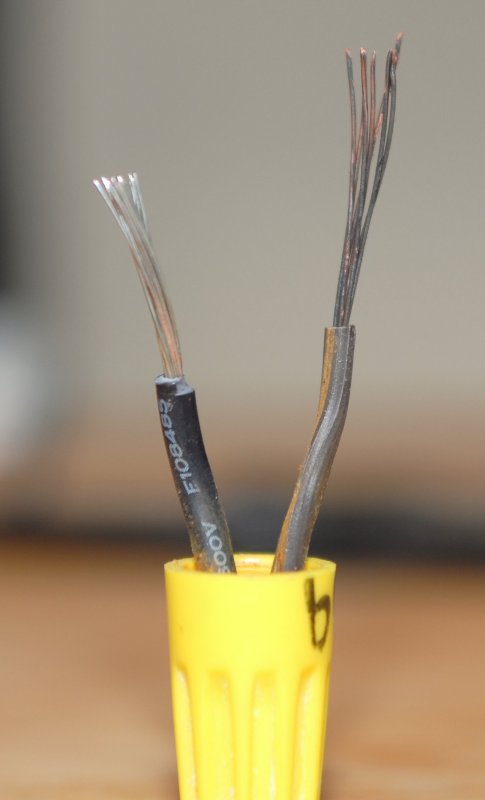
About a year ago, maybe more, I posted some photos of badly oxidized bare copper wire. My assertion at the time was that moisture had permeated the transparent jacket of the wire. I was told I was a nut, which is pretty true.
So this past week I began the long needed, complete re-wiring of our boat. In doing so I discovered more of this "trailer" type wire. Only this time it was in a factory original PVC wire chase glassed into the hull. There were two sets of four wire, trailer wire, used to power the mast. One of these four conductor wires was made of non-transparent PVC jacketed wire the other transparent perhaps vinyl jacketed wire. It seems CS used what ever trailer wire they could get or color coded the wire by jacket type for identification?
This is an interesting case study:
1- Both of these wires terminated at exactly the same location on either end.
2- Both of these wires were installed at the exact same time, 30 years ago.
3- Both were subjected to the exact same environmental conditions.
4- Both wired used the exact same factory open style crimp connectors.
5- Both wires had the same exact amount of visible oxidation at the crimp ends.
6- Neither of these wires showed any signs of ever being wet or any substantial corrosion on the crimps other than some oxidation.
7- One of the wires, the one shown below that is oxidized, had both ends sealed from the factory with electrical tape, as perhaps an extra that was not needed or being used. It still had an excellent seal of tape on both ends and showed no signs of any voids along the jacket under the tape.
8- I cut both sets of wires in the middle of their approx 18' length at roughly 9 feet then stripped all four wires on each one, eight in total.
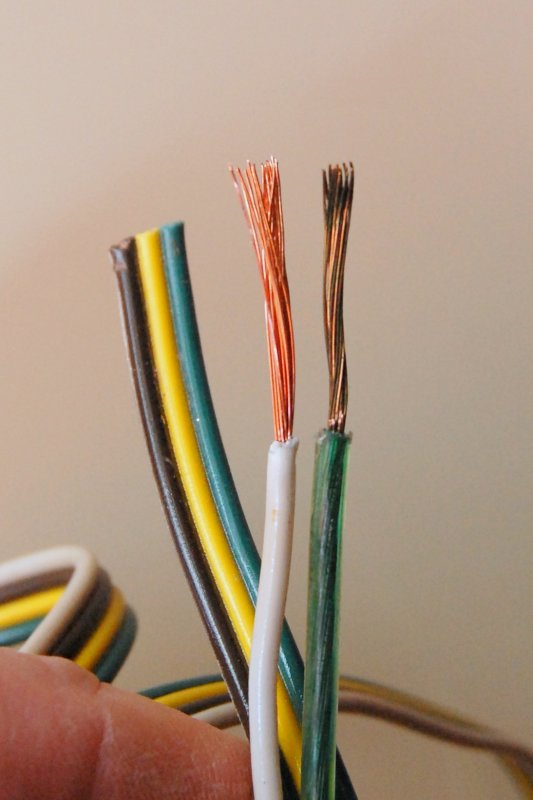
9- All four of the wires on the non-transparent jacketed (perhaps PVC?) wire were in absolute perfect, like new condition 9 feet in.
10- All four of the wires on the transparent jacketed wire (perhaps vinyl?) were badly oxidized at 9 feet and this included the one with the electrical tape, hermetically sealed ends.
11- For those counting that is four for four.
The only explanation I can honestly come up with is that some wires have very poor jacketing, that over time, 30 years in this case, possibly allow moisture to permeate the jacket?
I did have one wire, of the higher quality duplex type, that terminated at a plug in the anchor locker that had suffered severe moisture damage and the crimp literally fell off the wire when I touched it. The oxidation "creeped" up this wire about 18" over 30 years despite it having no drip loop. When I cut this wire in it's center, like the trailer wiring, both the + & - wires showed like new even when subjected to a failed plug seal on one end and 30 years of constant high moisture from being in an anchor locker.
My guess is the same as before that all wire jackets may not be created equal and some cheap wire might allow moisture to permeate the jacketing?
Wire on right is the clear jacketed stuff and the wire on the left is the solid jacketed type.
So this past week I began the long needed, complete re-wiring of our boat. In doing so I discovered more of this "trailer" type wire. Only this time it was in a factory original PVC wire chase glassed into the hull. There were two sets of four wire, trailer wire, used to power the mast. One of these four conductor wires was made of non-transparent PVC jacketed wire the other transparent perhaps vinyl jacketed wire. It seems CS used what ever trailer wire they could get or color coded the wire by jacket type for identification?
This is an interesting case study:
1- Both of these wires terminated at exactly the same location on either end.
2- Both of these wires were installed at the exact same time, 30 years ago.
3- Both were subjected to the exact same environmental conditions.
4- Both wired used the exact same factory open style crimp connectors.
5- Both wires had the same exact amount of visible oxidation at the crimp ends.
6- Neither of these wires showed any signs of ever being wet or any substantial corrosion on the crimps other than some oxidation.
7- One of the wires, the one shown below that is oxidized, had both ends sealed from the factory with electrical tape, as perhaps an extra that was not needed or being used. It still had an excellent seal of tape on both ends and showed no signs of any voids along the jacket under the tape.
8- I cut both sets of wires in the middle of their approx 18' length at roughly 9 feet then stripped all four wires on each one, eight in total.
9- All four of the wires on the non-transparent jacketed (perhaps PVC?) wire were in absolute perfect, like new condition 9 feet in.
10- All four of the wires on the transparent jacketed wire (perhaps vinyl?) were badly oxidized at 9 feet and this included the one with the electrical tape, hermetically sealed ends.
11- For those counting that is four for four.
The only explanation I can honestly come up with is that some wires have very poor jacketing, that over time, 30 years in this case, possibly allow moisture to permeate the jacket?
I did have one wire, of the higher quality duplex type, that terminated at a plug in the anchor locker that had suffered severe moisture damage and the crimp literally fell off the wire when I touched it. The oxidation "creeped" up this wire about 18" over 30 years despite it having no drip loop. When I cut this wire in it's center, like the trailer wiring, both the + & - wires showed like new even when subjected to a failed plug seal on one end and 30 years of constant high moisture from being in an anchor locker.
My guess is the same as before that all wire jackets may not be created equal and some cheap wire might allow moisture to permeate the jacketing?
Wire on right is the clear jacketed stuff and the wire on the left is the solid jacketed type.