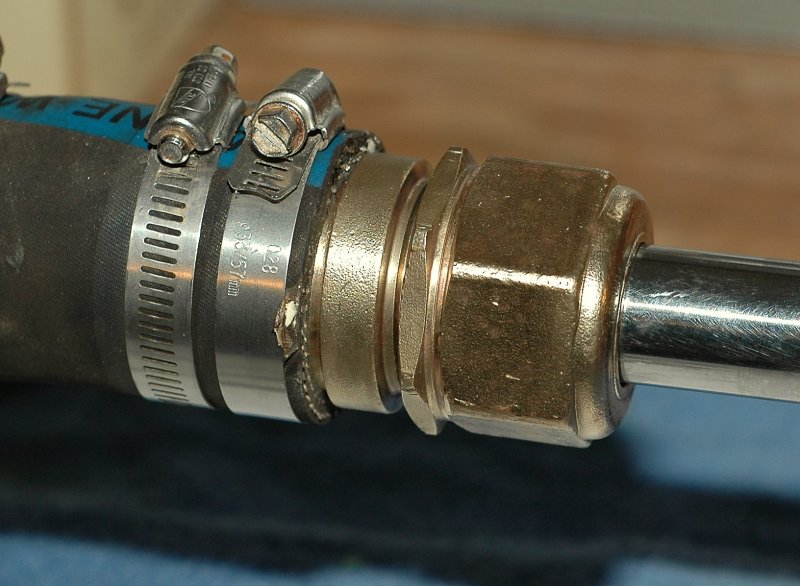
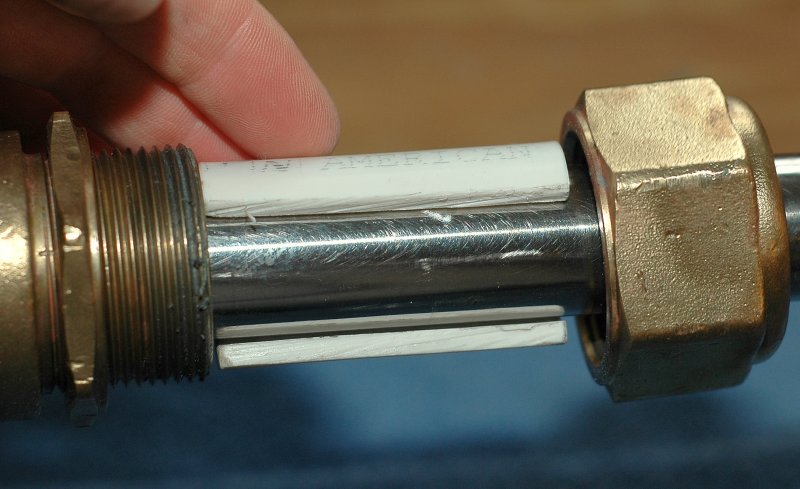
Standard stuffing box seal repacking?

Sep 28, 2025
131
Catalina C 30 MK1 1983 Stockton Lake Missouri
The photo below is a store bought line wrench.
The reason for using a flare nut wrench/line wrench on the stuffing box nut is because the open end wrench can deform the stuffing box nut because it is a kind of a flare nut.
I has had to be adjustable frequently for over five years.
1760420158800.jpeg

Hope for the best plan for the worst.
 
Last edited:
Sep 28, 2025
131
Catalina C 30 MK1 1983 Stockton Lake Missouri
Can I shorten or length the stuffing box hose to move the stuffing box packing to new spot on the prop shaft if it’s has wear of more than .05 inches? I have the original bronze prop shaft.

Hope for the best plan for the worst.
 
Jan 7, 2011
6,014
Oday 322 East Chicago, IN
Can I shorten or length the stuffing box hose to move the stuffing box packing to new spot on the prop shaft if it’s has wear of more than .05 inches? I have the original bronze prop shaft.

Hope for the best plan for the worst.
Yes, you can do that if you have room. You don’t want to go so short that the stuffing box is close to or touching the shaft log (the fiberglass tube the hose is mounted on. And you dont want it so long your stuffing box is no longer supported by the hose, and instead is riding on the shaft all of the time.

In the end, you should really inspect the shaft carefully. When I pulled mine out a few years ago, not only were there wear areas, but there were also circumferential cracks in the shaft.

That was enough for me to bite the bullet and get a new shaft, coupling, and eventually a Volvo shaft seal…


Greg
 

jssailem

SBO Weather and Forecasting Forum Jim & John
Oct 22, 2014
24,912
CAL 35 Cruiser #21 moored EVERETT WA
:plus:. I am with Greg. It is possible.

Yet such action may leave you open to unforeseen risks.
Here are some images of what I saw on my 49-year-old shaft when I started to change the stuffing box flax. I had the engine out of the boat for a rebuild. I could thoroughly inspect the shaft. (Not easy when the engine is in place.)

Just a minor pitting condition.
The shaft looks shiny. It is 1 and 3/8 inches thick.
1763139105725.jpeg

I sail in open water, miles from safe harbors, occasionally.

This is what I discovered when I moved the shaft and exposed more of the area that was in the stuffing box.
1763139157393.jpeg


I was not about to put my boat at risk of a lost prop and shaft.

I installed a new shaft and replaced the stuffing box with a dripless shaft seal.

It is your boat and you use it in your waters. Let that guide you as to what is best for your situation.
 
  • Like
Likes: Tally Ho
Sep 28, 2025
131
Catalina C 30 MK1 1983 Stockton Lake Missouri
Thanks for the information it is always welcome.
I haven’t inspected the shaft other than the section between the stuffing box and the transmission, that looks fine no discoloration from heat, but I will know more when I repack the stuffing box.
I sail on a 25,000 acre inland lake and run the engine 5 minutes out and back. Same slip same lake for 42 years as the two owners before me and they didn’t use it much.
1763173340695.jpeg
 
Last edited:

jssailem

SBO Weather and Forecasting Forum Jim & John
Oct 22, 2014
24,912
CAL 35 Cruiser #21 moored EVERETT WA
I’m going to throw this out there, sounds like you real don’t need an engine. It is convenient. You really could sail in and out.
Your boat your waters dictate what is necessary.
 
Sep 28, 2025
131
Catalina C 30 MK1 1983 Stockton Lake Missouri
Yes, and under favorable, conditions, I could sailing in and out or just into the dock
I think that Mr. Hardiman has summed up the dilemma of docking a 30 foot sailboat under sail in the statement that he coined about how a sailboat works.
(There is no "lift"...there is only "drag" in the direction you want to go.)
 
Last edited:
  • Like
Likes: jssailem
Sep 28, 2025
131
Catalina C 30 MK1 1983 Stockton Lake Missouri
I re packed my stuffing box this spring and it is working great. The hose/log was in great shape so I did it with the boat in the water. Here was a tutorial of instructions that helped me the most.
I may have got this site from somewhere here if so thanks and thanks marinehowto.
 
Last edited:
  • Like
Likes: jssailem
Mar 6, 2008
1,531
Catalina 1999 C36 MKII #1787 Coyote Point Marina, CA.
I replace the stuffing exactly the way that Alan describes in post #8 and with Gore. The last time I replaced it it lasted 7 years. It did not need to be replaced, I replaced the stuffing only because I had the boat out of the water.
There is only one thing I do in addition to replacing the stuffing. I put ample amount of lanocoat inside the nut just before I put the nut on. The lanocoat warms up and loosens up and let's a small amount of water to get through and just moisten the outside of the nut where the shaft protruds when spinning.
When stopped the lanocoat cools and makes a waterproof seal around the shaft so there is no dripping while at rest.
The nut needs to be hand tight plus 1/4 of a turn.
 
Sep 28, 2025
131
Catalina C 30 MK1 1983 Stockton Lake Missouri
Joe White,
Alan's post was great and eased my anxiety about doing the stuffing box packing with the boat in the water as well as a great how to do set of instructions.
Hope for the best and plan for the worst.
.
Here is something that Marinehowto add to my installation with an Older bronze shafts.
GFO, GTU & Ultra-X Warning
WARNING: While I do like the performance of graphite impregnated packing materials such as Duramax Ultra-X, Gore GFO or Western Pacific Tradings GTU they can be potentially dangerous to underwater metals. I have used it on my own vessel but inspect the Aqualoy 22 prop shaft yearly.
“RC, Why the warning then.?”
It’s all about corrosion. Graphite is the most noble element on the galvanic scale.. As such anything in the drive train becomes anodic or sacrifices itself to the packing. Older bronze shafts, really more of a brass because they had high zinc content, can be damaged by these new high tech graphite impregnatedpacking materials.
The damage shown in this photo happened in one season and with intact prop shaft anodes. The shaft was in perfectly fine condition when packed, and a year later this is what it looked like.
The packing used on this shaft was Gore GFO a graphite impregnated packing. If you have a bronze shaft please use extreme caution with graphite impregnated packing materials.
I don’t tend to see these issues with Aqualoy 22 shafting but I have seen it with bronze and lower grades of stainless. Please use these packing materials carefully. If you choose them please do check on the shaft periodically.
Also, please be aware that after you install a graphite impregnated packing you will see some accelerated anode erosion rates. No dire need to be alarmed at this but do keep up with them and check them more often until you are familiar with the new erosion rate..
Here is where the ABYC Standards come down on graphite packing:
Begin Quote:
ABYC P-6:
“6.7.4 Graphite impregnated packing material shall not be usedbecause of the possibility of galvanic incompatibility with the shaft material.”

End Quote:
I suspect what we are seeing in this photo is exactly the “galvanic incompatibility” the ABYC warns against.
We now know where the ABYC stands on graphite packing but what about the largest prop shaft manufacturer in the United States, and possibly the world, Western Branch Metals?
Begin Quote:
Western Branch Metals:
“Do not use graphite packing in the stuffing box. Instead, use a packing material that causes the least abrasion after the lubricant wears away. The use of graphite-impregnated packing is not recommended because of the possibility of galvanic corrosion of the shaft material.”

End Quote:
Now we have not only the ABYC but one of the largest prop shafting manufacturers on the planet both saying exactly the same thing. Do not use graphite packing’s. As they say your boat, your choice.
With all that said there are still many happy boaters who have had decentresults with these graphite packing’s. Please remember however that they should not be treated as a set it and forget it packing. If using these graphite impregnated packing materials I would strongly suggest checking the shaft at least yearly.


The Home Made Packing Insertion Tool
Many folks have asked me how I insert the packing rings into the female nut. Well, like anything dealing with boating, it’s not always easy but can be done with a little Yankee ingenuity.

The Home Made Packing Insertion Tool
Many folks have asked me how I insert the packing rings into the female nut. Well, like anything dealing with boating, it’s not always easy but can be done with a little Yankee ingenuity.
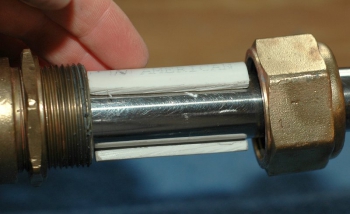
I decided that in order to keep my ring joints staggered, and to get them properly seated, I needed a new tool. I wanted a tool that was to be perfectly parallel with the prop shaft when inserting and seating the flax but that did not involve twisting the nut or threading it onto the male end..
You need to seat the packing without causing any twisting and there were no commercially available tools to do this, so I made one. Using a screw driver will not give you the correct angle to seat the flax properly and could potentially mess up the joints or put twists in the flax rings. Seating the packing with no twists is important.
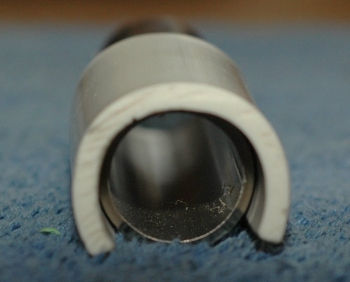
31MyHomeMadeFlaxInsertionTool


32FlaxToolOnShaft
 
Last edited: