I have a yanmar 2QM15 that does a slow grind now when i try to start it even though my battery is fully charged. I changed the cables to my battery switch because they were old and needed it anyway but the problem persists... My question is how can i determine if it is a bad starter or solenoid or a bad cable between the engine and the switch? Is there ways to use a multimeter to see which of these components is bad before i spend a lot of money on parts? The connections dont look corroded pn the Battery switch to starter cable so im not sure where to start. Please Help. Thank you very much all i appreciate any tips on troubleshooting this problem.

Slow grind when starting..Starter or Solenoid or Current????
- Thread starter GJensen
- Start date
- Status
- Not open for further replies.

You need to perform a loaded voltage drop test between the battery and starter, all circuits positive and negative. Average loss is .25 volts per connection. Typical solenoids actually have 2 internal and 2 external connections and can read a normal loss of 1 volt. Do a google search on meter procedures to perform drop tests, ohm meters are useless for diagnosing your problem.

Re: Slow grind when starting..Starter or Solenoid or Current
Have you considered that it may be the OTHER end of the wiring? The ground. Check the ground connection from your batteries to the engine. This, many times, is the culprit.
Have you considered that it may be the OTHER end of the wiring? The ground. Check the ground connection from your batteries to the engine. This, many times, is the culprit.

In electrical troubleshooting as in most all else, start with what is easy and cheap and work your way to the more difficult areas!
In your case start with wiring issues:
1- look at all connections, are they clean, tight and greased.
2- Perform a load test on the battery: though full charged it might no longer have power.
3- Take off starter, disassemble look for parts which could be burnt, look at the brushes (these are really graphite blocks that transmit the power to the starter motor).
Since your engine is turning over albeit slowly, the solenoid shouldn't be the culprit.
I used to have a 3QM30 and when similar trouble occured it was invariably the fuse holder near the battery that had worked it's way loose... I had started by disassembling the starter, greasing etc first... It's better to do it the other way!
Pierre
In your case start with wiring issues:
1- look at all connections, are they clean, tight and greased.
2- Perform a load test on the battery: though full charged it might no longer have power.
3- Take off starter, disassemble look for parts which could be burnt, look at the brushes (these are really graphite blocks that transmit the power to the starter motor).
Since your engine is turning over albeit slowly, the solenoid shouldn't be the culprit.
I used to have a 3QM30 and when similar trouble occured it was invariably the fuse holder near the battery that had worked it's way loose... I had started by disassembling the starter, greasing etc first... It's better to do it the other way!
Pierre

Re: Slow grind when starting..Starter or Solenoid or Current
From my experience, the starter needs a "freshening up". Not always, but generally a dragging starter is just that. With a good battery, and good wires with clean connections at all ends, there's your problem. And like Stu said, the ground is sometimes subject. It's a very simple circuit, with a minimal of possibilities..
From my experience, the starter needs a "freshening up". Not always, but generally a dragging starter is just that. With a good battery, and good wires with clean connections at all ends, there's your problem. And like Stu said, the ground is sometimes subject. It's a very simple circuit, with a minimal of possibilities..

Re: Slow grind when starting..Starter or Solenoid or Current
yup.. cheap and easy first.. after that, if the problem hasn't disappeared, the starter brushes and a clean-up would probably be in order. Take it out and if you aren't comfortable with brush and commutator work, take it to a good automotive/truck/tractor starter shop and have them re-build it for you.. Good Luck with it.
(I thnk Roger Long posted some pictures of his 2QM starter .. Its brushes were very worn)
yup.. cheap and easy first.. after that, if the problem hasn't disappeared, the starter brushes and a clean-up would probably be in order. Take it out and if you aren't comfortable with brush and commutator work, take it to a good automotive/truck/tractor starter shop and have them re-build it for you.. Good Luck with it.
(I thnk Roger Long posted some pictures of his 2QM starter .. Its brushes were very worn)
Re: Slow grind when starting..Starter or Solenoid or Current
thank you very much everyone for these excellent tips. I will find ground to engine first and then check all my connections again... what is the grease used to seal these connections please?
thank you very much everyone for these excellent tips. I will find ground to engine first and then check all my connections again... what is the grease used to seal these connections please?
Re: Slow grind when starting..Starter or Solenoid or Current
Generally a dielectric grease. It's common stuff. I like to use a fully synthetic teflon grease, made by Superlube. I don't know if it can technically be called dielectric grease, but it's close, and does the same thing..
Generally a dielectric grease. It's common stuff. I like to use a fully synthetic teflon grease, made by Superlube. I don't know if it can technically be called dielectric grease, but it's close, and does the same thing..
Re: Slow grind when starting..Starter or Solenoid or Current
How do you know the battery is still good. Can you monitor the batt voltage as someone cranks?
But for sure connections coming and going.
How do you know the battery is still good. Can you monitor the batt voltage as someone cranks?
But for sure connections coming and going.
Chris, let's be clear that grease should only be used after the fittings are made and clean. Right?Generally a dielectric grease. It's common stuff. I like to use a fully synthetic teflon grease, made by Superlube. I don't know if it can technically be called dielectric grease, but it's close, and does the same thing..

Re: Slow grind when starting..Starter or Solenoid or Current
you can get dielectric grease at any auto parts store, comes in a small squeeze tube. Typically used on light bulbs to prevent corrosion. Probably a good idea to use it on mast lights and running lights that live in a bad environment. You can also get a spray that is used on battery terminals to stop corrosion. As Stu noted you connect your cables then spray the terminals to reduce exposure to the environment. No reason that spray wouldn't work on other connections like your engine ground that I can think of.
you can get dielectric grease at any auto parts store, comes in a small squeeze tube. Typically used on light bulbs to prevent corrosion. Probably a good idea to use it on mast lights and running lights that live in a bad environment. You can also get a spray that is used on battery terminals to stop corrosion. As Stu noted you connect your cables then spray the terminals to reduce exposure to the environment. No reason that spray wouldn't work on other connections like your engine ground that I can think of.

Re: Slow grind when starting..Starter or Solenoid or Current
GJ,
The guys gave you good advice on troubleshooting and in what order.
I recently had a starter problem and the fix was somewhat of a surprise.
My engine was starting slowly. Upon checking the system, I discovered that the starter showed water damage from a previous spray/leak in the hose connection on my muffler.
I had the starter rebuilt and before mounting it, I closely looked at the starter mounting base on the engine and it was covered with a mixture of rust & salt water dried film.
I cleaned the mounting base REAL well, and it took some time as I didn't want the deposits to fall into the engine's flywheel housing. Remember, the ground is bolted here & I believe the compromised surface for grounding was the other problem. Had I just bolted the starter without cleaning first, it might still be harder to start.
Remember, it doesn't take much to screw up 12 volt systems.
When done, I started the engine, and it didn't turn a few revolutions before turning over, but immediatley as with a new car. It felt good. Remember, it's only two bolts to remove & inspect.
CR
GJ,
The guys gave you good advice on troubleshooting and in what order.
I recently had a starter problem and the fix was somewhat of a surprise.
My engine was starting slowly. Upon checking the system, I discovered that the starter showed water damage from a previous spray/leak in the hose connection on my muffler.
I had the starter rebuilt and before mounting it, I closely looked at the starter mounting base on the engine and it was covered with a mixture of rust & salt water dried film.
I cleaned the mounting base REAL well, and it took some time as I didn't want the deposits to fall into the engine's flywheel housing. Remember, the ground is bolted here & I believe the compromised surface for grounding was the other problem. Had I just bolted the starter without cleaning first, it might still be harder to start.
Remember, it doesn't take much to screw up 12 volt systems.
When done, I started the engine, and it didn't turn a few revolutions before turning over, but immediatley as with a new car. It felt good. Remember, it's only two bolts to remove & inspect.
CR
Stu, to the best of MY understanding, the grease can be applied before you make the connection. I stand to be corrected here by the electrical engineers, but like said before, I've seen it ALL globbed up in light bases for the obvious corrosion limiting properties. I myself use it commonly on battery terminals in vehicles, heavy machinery, boats, etc. Years later, the terminal will look like the day I put it together.
If I had to make an offhand guess here, I would say it has to do with oxygen/element exposures, thereby preventing corrosion.
I learned this trick many years ago when I had some "dealings" with the U-Haul Co. Smart people. They went to mounds of trouble to prevent minor mishaps on many different levels. They would take pieces of burlap about 2" X 4" and cut a hole close to one end large enough to go over a battery stud/terminal. Slathered in dielectric grease. After the connection was made, the remaining flap was folded back over the entire terminal, and the grease would hold it there. It was kind of an icky mess, but the results were, it was VERY rare to have to remedy a terminal. I still do this today with the aforementioned results. And I use teflon grease too by the way. It's a LOT less nastier than marine grease, and I'm thinking that it shares some of the same dielectric properties. I have never once been let down by this stuff.
If I had to make an offhand guess here, I would say it has to do with oxygen/element exposures, thereby preventing corrosion.
I learned this trick many years ago when I had some "dealings" with the U-Haul Co. Smart people. They went to mounds of trouble to prevent minor mishaps on many different levels. They would take pieces of burlap about 2" X 4" and cut a hole close to one end large enough to go over a battery stud/terminal. Slathered in dielectric grease. After the connection was made, the remaining flap was folded back over the entire terminal, and the grease would hold it there. It was kind of an icky mess, but the results were, it was VERY rare to have to remedy a terminal. I still do this today with the aforementioned results. And I use teflon grease too by the way. It's a LOT less nastier than marine grease, and I'm thinking that it shares some of the same dielectric properties. I have never once been let down by this stuff.

I use a few products for anti-corrosives on terminals. One of the best is NO-OX-ID:
This can be purchased from Sailors Solutions (image Sailors Solutions)
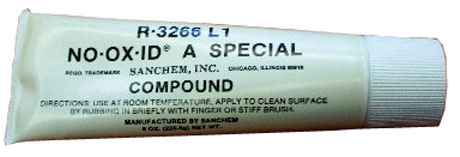
NO-OX-ID is an electrically conductive grease not a "dielectric" which, by nature, blocks or inhibits electrical contact. I use this where the starter case meets the engine block and alternator and battery connections and terminal strips etc. etc... It prevents rust from forming and provides a clean electrically conductive path for the case ground.
I also try to connect the engine neg directly to the mounting ear of the starter case. This yields a direct path back to the battery without the need to pass hundreds of amps of current through a rusty engine. This product kicked butt in the recent Practical Sailor testing. I have known how well it worked since well before then and was the one who recommended that Nick Sailors Solutions begin stocking it.
I also use:
Superlube AntiCorrosive GEL (image fishingtackle.com)

This is a GREAT product for battery terminals. It has no silicone in it and therefore does not make everything a slimy mess. Really all you need for battery terminals is Vaseline but I prefer this....
This can be purchased from Sailors Solutions (image Sailors Solutions)
NO-OX-ID is an electrically conductive grease not a "dielectric" which, by nature, blocks or inhibits electrical contact. I use this where the starter case meets the engine block and alternator and battery connections and terminal strips etc. etc... It prevents rust from forming and provides a clean electrically conductive path for the case ground.
I also try to connect the engine neg directly to the mounting ear of the starter case. This yields a direct path back to the battery without the need to pass hundreds of amps of current through a rusty engine. This product kicked butt in the recent Practical Sailor testing. I have known how well it worked since well before then and was the one who recommended that Nick Sailors Solutions begin stocking it.
I also use:
Superlube AntiCorrosive GEL (image fishingtackle.com)
This is a GREAT product for battery terminals. It has no silicone in it and therefore does not make everything a slimy mess. Really all you need for battery terminals is Vaseline but I prefer this....
I WILL have to look into the no-ox-id. Maintenance preventers are near and dear to my heart.
About anything Superlube makes gets a "two thumbs up" from me. Edson advises, and sells it for their pedestals, and I've just got a sneaky feeling that they settle for nothing less than the best. I had been using it for years, so it was just a little affirmation that a company like that recommends it.
From the short bit of uses and what-not listed on the containers would sell me..
About anything Superlube makes gets a "two thumbs up" from me. Edson advises, and sells it for their pedestals, and I've just got a sneaky feeling that they settle for nothing less than the best. I had been using it for years, so it was just a little affirmation that a company like that recommends it.
From the short bit of uses and what-not listed on the containers would sell me..
Both times I have had starter problems just like you described, it has been the battery. The battery was getting a surface charge and reading good. But put it on a big load like starting a diesel and in a few seconds it was down to ten volts. After a short rest the surface charge reappeared and the battery tested good. This was on a two year old battery. A new battery solved the problem both times. I vote for monitoring the battery voltage while you crank.How do you know the battery is still good. Can you monitor the batt voltage as someone cranks?
But for sure connections coming and going.
Thanks,
Ray
Re: Slow grind when starting..Starter or Solenoid or Current
thanks again guys... I have to sheepishly admit that i think it was a bad battery. IT was showing a surface charge but i spent 25 bucks at harbor freight for a load tester and realized my battery was bad even though it was fairly new... I got a new battery and the starter didnt grind. Thanks again for all tips and i am still going to go through and clean and grease my ground connections and anything i can get to on the control panel so that it will last longer. Thanks for everyones help... Its a 31yr old sailboat so im always learning something new trying to keep her running.
thanks again guys... I have to sheepishly admit that i think it was a bad battery. IT was showing a surface charge but i spent 25 bucks at harbor freight for a load tester and realized my battery was bad even though it was fairly new... I got a new battery and the starter didnt grind. Thanks again for all tips and i am still going to go through and clean and grease my ground connections and anything i can get to on the control panel so that it will last longer. Thanks for everyones help... Its a 31yr old sailboat so im always learning something new trying to keep her running.
- Status
- Not open for further replies.