Singlehanding a Capri

Jul 17, 2013
50
859
Hi folks, I know a lot of you guys singlehand your Capri 22s. This is my third season now and I've only ever sailed the boat with crew. I am still a pretty novice skipper; most of my experience is in light to moderate conditions. That said, I feel pretty comfortable these days. Love sailing her - you all know what I mean. Sometimes I have had trouble getting crew and I find myself sitting on the dock dreaming of taking the boat out on my own. Still a little nervous about it though. Any tips?

Cheers,
Charlie
 
May 23, 2007
1,306
Catalina Capri 22 Albany, Oregon
Start small. Just sail with the main if you want, and don't mess with the jib until you're comfortable.

Cross sheet your jib/genoa sheets when you're single handing so you can work the sheets from the high side.
 

HERSH

.
Nov 21, 2012
520
Catalina Capri 22 http://www.chelseayacht.org
If there is any chance of inclement weather, put a jib/genoa down-haul on. That way, should the weather get nasty, you can pull the headsail down without going forward.

Hershey
 
Jul 11, 2013
21
559
I second the other comments above. Coming into the dock is probably the hardest part, depending on where/how you dock but even that with a little practice becomes no big deal. Single biggest thing - don't fall off. Life jacket on at all times even if you don't plan or think you'll go forward. That's my rule for single-handing anyway. I added cam cleats aft of the primary winches which helps me quickly handle the jib sheets - but that was really optional, not something I think is/was required. I think it's pretty great boat to single hand.
 

HERSH

.
Nov 21, 2012
520
Catalina Capri 22 http://www.chelseayacht.org
Life jacket. My policy is I wear a life jacket when single handling the boat, or if my "crew" is not capable of handling the boat should I fall overboard.

Another good idea is to tell a friend what time you expect to be back.

Docking: have everything prepared before you start to dock. Fenders positioned, lines attached to bow and stern, and a boat hook readily available --- ( NOT down in your cabin!)

Hersh
 
Jul 18, 2013
44
22
Study cover to cover, then implement as appropriate.

http://www.sfbaysss.org/tipsbook/
146 pages of ...

Thoughts, Tips, Techniques and Tactics for Singlehanded Sailing
Andrew Evans on Foolish Muse
fwd by Bruce Schwab

You'll learn a tonne about your boat while doing it (Chapter 3).
First though you'll learn a tonne about yourself (Chapter 2).

Have a blast!
 
Jul 22, 2013
75
Catalina Capri 22 Mk II Salem Harbor
Ahoy Cap't Charlie,
When you say "sitting on the dock" does that imply Amaryllys (interesting name and I hoped I got it right) is tied to the dock with you, that is, a slip vs on a mooring ? If so, I can empathize with your plight. I'm not very comfortable docking my capri solo yet I sail solo fifty and sixty days a season (from a mooring). Only at season's end do I motor up the Danvers river and dock my boat in preparation for hauling out. OTOH, if it's solo sailing you're considering, well, that's cake.
From my mooring, I make a rough guess as to wind strength (not speed as the number is really just a reflection of strength). If I can hear the wind whistling in the rigging, I'll start with a reefed main. Otherwise, it's full hoist and walking the mooring pennant back to the tiller (sort of gives me a running start with instant steerage), and off I go. With the stock CDI roller furling (for me it's reefing too) jib, I can roll out as much as I want from aft of the traveler. The furling line goes thru a cabin top mounted spin lock so that I can release and secure the line from the helm with an upward/downward tug. Self-tailing winches make for fast fast lines (hoho). Coming about/jibing is a bit of a rodeo yet manageable. I'll sheet in the main and while sitting windward, I'll loop the active (lee side) jib sheet off the winch's self-tailing teeth then loop the sheet twice off the winch (that's the rodeo part) as the bow passes thru the eye of the wind. Then it's just pulling in the new active sheet, securing it in the self-tailing teeth.
I do wear a self-inflating life jacket and have learned to keep the cockpit's floor clear forward of the traveler so that any quick trips forward to adjust the main (outhaul, Cunningham, ect.) are without incident. Anything I think I'll need (sun block, cooler, pee pail, sweatshirt, et al) I keep with me, aft of the traveler.
As others have said, sailing with only the main may a good place to start. Getting on a mooring makes the whole proposition of going and coming back easy.
Wooster w/o a crew
 

HERSH

.
Nov 21, 2012
520
Catalina Capri 22 http://www.chelseayacht.org
Ahh yes;

My comments were assuming you keep your boat as a slip.

Now If you keep you boat on a mooring like I do, I have a few suggestions. Mine is on a mooring.

Depending on how tight your mooring area is packed whether you sail off your mooring or motor off the mooring will be a decision made at the time you are ready to go. I have to snake my way through about 5-6 rows of moored boats to get to clear water, so conditions would have to be ideal for me to sail off.

Assuming I am going to motor off, 1) Make sure the cockpit and cabin deck are free of stuff that you could trip over.2) Start the motor, 3) hank on the headsail, but not hoist. 3) Raise the mainsail and put plenty of slack in the mainsheet. ( remove pigtail if you have one connecting boom to rear stay.) 4) Go forward and attach the pickup buoy, cut her free and scamper back to the motor.

5) After getting out to a clear sailing area, cut and raise the motor. 6) Raise the headsail.

Returning to a mooring:

Make sure the eyes on your mooring line are large enough to easily be put over the cleats, but small enough to not come off easily.
You do not want to fight getting the eye over a cleat when you return, especially if the wind is blowing hard.

I always motor into my mooring. 1) I drop my headsail when in clear water and tie it down. 2) Start my motor 3) Head into the wind an drop the main and let it sit on the deck. 4) Motor in, taking notice to how the other boats on moorings are headed and approach from the same direction. 5)I approach the mooring so when I am at my pickup, I ideally am doing 0 kts. ( Motor in neutral, but running in case you "miss" the pickup). Scamper forward and grab pickup and quickly get one mooring line eye over a chock.

6) Now you can take your time furling the sails, attaching the mooring lines securely, and closing up your boat.

Hershey
 
Jul 13, 2011
102
Capri 22 MK1 659 Canandaigua Lake
Ditto to all the great comments above, especially the life jacket rules. Sometimes I trail a 100' piece of pretty heavy polypropylene with a big stopper-knot on the end so if I do fall over with the helm tied off, I have a fair chance of catching the boat before it sails away.

Naturally, money solves all problems: self-tailing winches are great, but not necessary, Winchers work pretty well; a way to secure the helm to dash around and secure a sheet or something like that is a necessity; an electronic auto-helm would be awesome and rising fast on my Xmas list. Jib furling is really handy and my wife's favorite thing about the boat. Reef early and often. Be conservative and protect against the down-side.

When picking up the mooring under sail I furl the jib, reach toward a spot a few boat-lengths downwind of the pickup buoy and then shoot up wind and pick it up. If you're coming in too fast, push the boom over to back the main and slow down. If you're short, bear off and try again. If you have a 20' dock line tied at the bow, you can slip the end of it through the mooring bridle and relax without leaving the safety of the cockpit. Walk the line forward and put the bridle on the mooring cleats at your leisure.
 
May 3, 2008
252
Catalina Capri 22 Half Moon Bay
I solo sail quite a bit...
I put a small cheek block and a cam cleat on the top of my tiller.
I then have a small (3mm ?) line that runs from from port pushpit to starboard pushpit.
The line just lays loose over the tiller until needed... then I just round the block and cleat it.
It does, however, depend on there being some weather-helm to keep the tension.
...or if it's really light, I attach a small bungee on the other side!
Works great!

This shows the red line cleated on a port tack...


This short video shows me solo sailing in light conditions...
Tacking, using the tiller-minder and cross-sheeting the genoa...
Solo Sailing Bella Barchetta

 
Jul 2, 2013
53
232
I just bought and installer a Tiller Clutch this past week. I had the tiller tamer, and thought it was too cumbersome so I never really used it much. I'm really liking this one though. You flip the switch down to clamp on the line and hold the tiller in place. Click it up, and it moves free and easily. When I'm not using it, I uncleat the line and bungee it to the tiller to keep it out of the way.
 

Attachments

Jan 22, 2008
507
Catalina 310 278 Lyndeborough NH
The Tiller Clutch looks interesting. My wife complains about the tension I leave with the Tiller Tamer. The adjustment is somewhat cumbersome especially since I mounted it under the tiller - rotational motion is anti intuitive.

I purchased the tiller controller from Catalina Direct but did not install it. I will have to look at the design again this fall.
 
Sep 30, 2011
9
I Like all the previous comments especially the ones about a life jacket. One thing I may add is some kind of tiller tamer. When learning the dance required to perform a decent looking tack or gybe, the tiller can get away and you can over steer. I picked up a piece of bulk bungee chord and fastened a loop in the center. Then I use two jam cleats near my rear stanchions to hang on to the ends. The jam cleats allow me to adjust tension as needed. The beauty of bungee is this allows me to steer as much as I like, but when I lose my grip on the tiller it is pretty much self centering. Once I complete my tack and get situated, I usually slip the loop off of the end of the tiller and let the bungee snap back near the stern, out of the way. I don't leave it there all the time because if something should happened to me I want the boat to round up into irons.
Enjoy yourself.
 
Jul 22, 2013
75
Catalina Capri 22 Mk II Salem Harbor
Welcome aboard Cap't Cradabau,
I do the tacking/jibe dance like a simian, with my hands and feet. I often steer w/a leg leaving my hands free for jib work.
Solo sailing is a particular thing , maybe an essential thing. Alone with the boat's gliding rhythm rocking in the wind and waves, sailing becomes transcendent.
Sailing in ethereal realm,
Wooster
 

Kunzig

.
Jul 3, 2013
88
1013
Nice photos Mathew,
Makes for an easy "try" and see if it works for you... kinda thing.

Also like the suction trash? container under the tiller.

We should All take photos of our cockpits so we can see all the gizmos that folks have come up with.
 
Jul 13, 2011
102
Capri 22 MK1 659 Canandaigua Lake
If the wind is light enough to sheet by hand, I lead the jib sheet tails back through the spinnaker sheet/guy turning blocks on the pushpits and drop them into the clam cleats back there. This is particularly handy when sailing with a crowd of non-sailing types who tend to be sitting on the jib sheets and sort of in the way. I can stay back behind the traveler and run the boat from there while they sip chardonnay and enjoy the ride. When sailing alone, I move forward and cross-sheet.
 

Curt

.
Jun 6, 2010
92
Catalina Capri 22 518 Buffalo
Hey Rightbrainer,

Great minds must think alike.

I was out the other day in a moderate breeze all alone and loving life. I was froward and sailing with the genny sheets crossed, every time I tacked they became a tangled mess. I was pondering ( I do a lot of pondering when solo)for a solution and thought about adding old style spring blocks to the tracks and eliminate having to run a sheet around the leewaard winch. If I bypass the leeward winch the sheet binds in the installed roller block. Later while lazing against the padded swim ladder I thought why not run the sheets around the winch and then through the Spinnaker turning block and use the cam cleat. Works like a charm. Even in higher wind the low side is not far away at the stern.

On the tiller control topic, I use either my tiller extension with the handle stuck in a small deck mounted receiver I made or a redneck tiller tender. The redneck version is simply a length of old line run from one stern cleat, wrapped three times around the tiller and then to the opposite cleat. To hold the tiller in position simply slide the wraps forward and they snug up and hold firm. To regain the tiller slide the wraps aft.

Cheers,
Curt
 
Apr 3, 2014
18
299
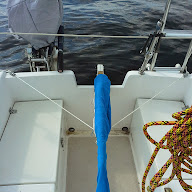
One of the reasons I was very happy when a Capri 22 fell into my hands was that it is one of the most ideal boats for single-handing. The previous owner also helped to make this even easier through the addition of a keeper over the hatch:


I'd also suggest a professional school to teach the basics. Barb and I went to Sail Solomons (http://sailsi.com/) in Solomons, MD and came back much more relaxed about what we'd gotten ourselves into. Sail Solomons teaches on the Capri 22 (Mistral and Maestro) so, even though there are differences from boat to boat, it was close enough for us to equate it to what would become our own experience.

My girlfriend, Barbara, and I love to sail together, but work schedules prevent our being able to do that as often as we'd like. If we didn't single-hand, the poor thing would spend most of its life a Dock Queen - looking pretty, but never going anywhere.

So, one day, a few weeks after our schooling, I just did it.

After all, backing out of our slip on the outboard is really no more involved than backing a small outboard driven power boat. You might be thinking, "Uh, what about the boat drifting away while you're on the dock handling lines, there, smart guy?"

No problem. Buy a premade line of about 10 feet +/- a couple with a loop on one end. Make sure your slip has a midship cleat. If it doesn't, ask the owner to install one, or get permission to install one yourself.* Ours had three - aft, amidships and bow. Clear your spring lines, then loop the loopy end on the dock cleat, and run the line to your port winch, tighten the boat right to the dock using the winch, and jam cleat the line. This will hold the boat fast to the dock while you now clear the forward and aft lines.

*We haven't had to experiment with it yet, but, in the permanent absence of a midship cleat on the dock, you supposedly can accomplish the same thing by putting the loopy end on your aft port cleat, running the line up to and around the forward dock cleat, and then back to the winch. In fact, I might experiment with it this summer (2014) since releasing that arrangement is liable to be easier. Oh, and this will obviously require a MUCH longer line.

Then, if you haven't done so already, start your engine and keep it in neutral.

Move forward, and in one smooth motion remove the line from the jam cleat (which should instantly create slack on the line), lift it off the dock cleat (which should only be about 2 feet in front of you - an easy arm reach - and slide back to the motor and commence your backing evolution. All done!

Now, I should mention that, as far as the sail is concerned, before any of the above COMPLETELY prep the sail for raising. Take off the cover, the tiedowns, make sure the slugs are all in, etc. Once you're out on the water you want raising the main halyard (in the picture I provided it is the right-most cam cleat on the keeper) to be accomplished in one smooth easy motion.

Next, you'll motor out and put her into the wind.

Raising the mainsail does require the use of both hands so steerage is an issue. Our boat came with a rudder tie-off which, while not the greatest such tool, is good for keeping the boat on course during the limited time mainsail ops are in progress.


Once your rudder is under control, loosen the mainsheet, detach the topping lift, grab the main halyard, raise the sail, jam cleat and regular cleat the halyard once raised and return to the motor, turn it off and raise it to its stowage position and then heave your carcass to the appropriate side of the boat for rudder duties.

While this roughly one minute of excitement is passing, the boat will definitely have begun veering off course. Relax. You're in control now. Get her back where you want her. Once you're good and steady, determine which side your jib needs to deploy on (this only works with a roller furler jib, by the way) and haul that jib line out, jam or cam cleat it and you are now officially running on mainsail and jib. Sit back, break out a tall one, and relax (at least until your first tack).

Tacking is no problem either. Don't sweat the jib. Do your tack or jibe and then, after you're stable on course, move the jib to the appropriate side (which the wind will quite helpfully do for you).

Hope all that helps, even though I know you posted this months ago.