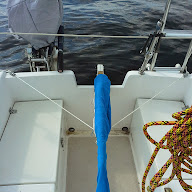
One of the reasons I was very happy when a Capri 22 fell into my hands was that it is one of the most ideal boats for single-handing. The previous owner also helped to make this even easier through the addition of a keeper over the hatch:
I'd also suggest a professional school to teach the basics. Barb and I went to Sail Solomons (
http://sailsi.com/) in Solomons, MD and came back much more relaxed about what we'd gotten ourselves into. Sail Solomons teaches on the Capri 22 (Mistral and Maestro) so, even though there are differences from boat to boat, it was close enough for us to equate it to what would become our own experience.
My girlfriend, Barbara, and I love to sail together, but work schedules prevent our being able to do that as often as we'd like. If we didn't single-hand, the poor thing would spend most of its life a Dock Queen - looking pretty, but never going anywhere.
So, one day, a few weeks after our schooling, I just did it.
After all, backing out of our slip on the outboard is really no more involved than backing a small outboard driven power boat. You might be thinking, "Uh, what about the boat drifting away while you're on the dock handling lines, there, smart guy?"
No problem. Buy a premade line of about 10 feet +/- a couple with a loop on one end. Make sure your slip has a midship cleat. If it doesn't, ask the owner to install one, or get permission to install one yourself.
* Ours had three - aft, amidships and bow. Clear your spring lines, then loop the loopy end on the dock cleat, and run the line to your port winch, tighten the boat right to the dock using the winch, and jam cleat the line. This will hold the boat fast to the dock while you now clear the forward and aft lines.
*We haven't had to experiment with it yet, but, in the permanent absence of a midship cleat on the dock, you supposedly can accomplish the same thing by putting the loopy end on your aft port cleat, running the line up to and around the forward dock cleat, and then back to the winch. In fact, I might experiment with it this summer (2014) since releasing that arrangement is liable to be easier. Oh, and this will obviously require a MUCH longer line.
Then, if you haven't done so already, start your engine and keep it in neutral.
Move forward, and in one smooth motion remove the line from the jam cleat (which should instantly create slack on the line), lift it off the dock cleat (which should only be about 2 feet in front of you - an easy arm reach - and slide back to the motor and commence your backing evolution. All done!
Now, I should mention that, as far as the sail is concerned, before any of the above COMPLETELY prep the sail for raising. Take off the cover, the tiedowns, make sure the slugs are all in, etc. Once you're out on the water you want raising the main halyard (in the picture I provided it is the right-most cam cleat on the keeper) to be accomplished in one smooth easy motion.
Next, you'll motor out and put her into the wind.
Raising the mainsail does require the use of both hands so steerage is an issue. Our boat came with a rudder tie-off which, while not the greatest such tool, is good for keeping the boat on course during the limited time mainsail ops are in progress.
Once your rudder is under control, loosen the mainsheet, detach the topping lift, grab the main halyard, raise the sail, jam cleat and regular cleat the halyard once raised and return to the motor, turn it off and raise it to its stowage position and then heave your carcass to the appropriate side of the boat for rudder duties.
While this roughly one minute of excitement is passing, the boat will definitely have begun veering off course. Relax. You're in control now. Get her back where you want her. Once you're good and steady, determine which side your jib needs to deploy on (this only works with a roller furler jib, by the way) and haul that jib line out, jam or cam cleat it and you are now officially running on mainsail and jib. Sit back, break out a tall one, and relax (at least until your first tack).
Tacking is no problem either. Don't sweat the jib. Do your tack or jibe and then, after you're stable on course, move the jib to the appropriate side (which the wind will quite helpfully do for you).
Hope all that helps, even though I know you posted this months ago.