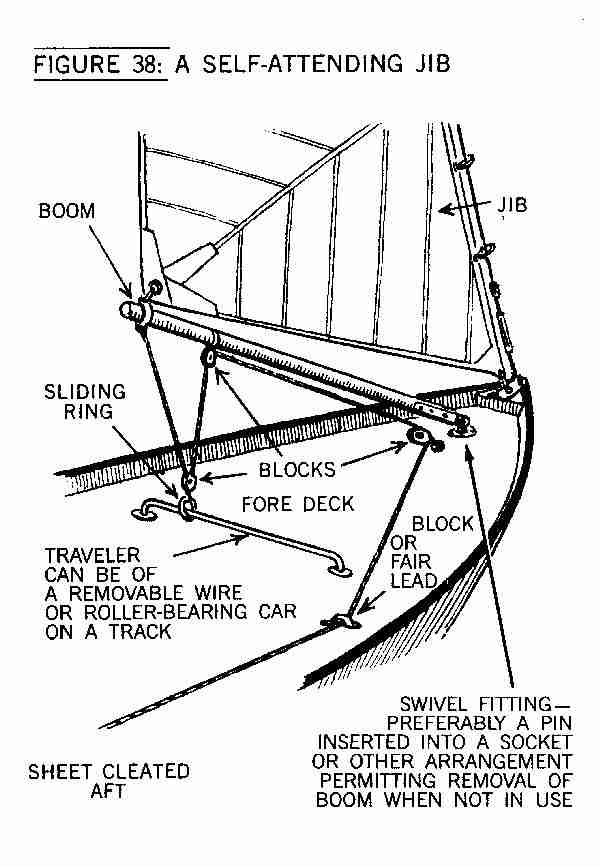
I would strongly recommend that you re-consider the Hoyt-Boom or a home-made equivalent as that is about the ONLY method that will give proper/decent control to a self tacking jib. The hoyt-boom removes all the 'faults' of every-other & ever conceived self-tacking jib control .... through ALL time & EVER attempted method of jib control when using a single sheet. In comparison, ANY other present and historical method will result in horrendous control and worse-than-BAD sail shape.
In essence, the Hoyt Boom's MAIN attribute is to the hold the clew DOWN (and out) and, importantly, at ALL angles of the clew from the center line of the boat ... and thus does double duty of a vang AND outhaul simultaneously ... and best of all only requires 1 control line, a jib sheet, to operate when sailing. With single line control on a Hoyt-Boom or equiv.... you now have the exact same control requirements as does the MAINSAIL: .... boom - holds the clew/outhaul 'tight'; vang - holds the boom down; traveller - allows the sail to be moved from the centerline WITHOUT HAVING THE CLEW RAISE UP INTO THE AIR !!!!!! A hoyt-boom, for a jib, is absolute 'perfection' & ease ... all rolled into one.
ALL of the 'clap-trap' methods of single sheet jib control result in one and only ONE POSSIBLE sailing angle where the jib is closely set properly (usually only 'sets' properly when beating/pointing) ... when you ease the sheet, the clew moves 'outboard and forward' AND 'LIFTS' - all resulting in a sail that has the head of the sail 'flogging', the foot 'overtrimmed' (too close to the centerline) and ONLY a very thin section of mid panel 'working' !!!!! When the sheet is eased, as for when reaching or running, the sail will be GROSSLY OVER-TWISTED, air flow totally separated and no longer 'attached' to the upper panels, AND the lower panels have the WIND usually on the WRONG side at the bottom panels ---- a useless 'set'. The Hoyt-boom (or 'equivalent' such as a 'wishbone', etc.) prevents all this.
A further advantage of the HOYT-BOOM, etc. is that when 'eased' off the centerline the HoytBoom, because its connected (to the deck) about 10% cord length of the sail BACK from the tack of the jib will automatically ADD or INCREASE the amount of draft in the sail - especially good for sailing 'downwind'.
There are many 'historical predecessors' of the Hoyt-boom; take a look at (do websearch) the Chesapeake Bay Sailing 'Log Canoes', etc. ... for single line control - they use essentially a 'pole' that runs from the 'LP' point of the luff and along the 'LP line' of the jib (or any other sail) and back to the clew + a VANG that holds the pole DOWN to prevent the clew from 'rising'. Look at the 'mizzen' on the attached pic of a 'sailing log canoe' ---- that 'boom' you see on the mizzen is an 'LP pole' which can also be used on a jib - to make it self tacking (you wont need the also shown 'vertical clew pole' on a Mac). The Hoyt-boom method increases the efficiency and ease of even the "LP pole".