self-tending jib on Macgregor 25

Status
Not open for further replies.

pupluv

.
Nov 11, 2007
90
- - wilmington, ca
Has anyone successfully installed a form of self-tending jib on a Macgregor 25 or similar-sized boat? Obviously the Hoyt Jib Boom would be ideal but it's too expensive and too large.

I know about different forms a self-tender can take, what I'm looking for is actual experience and installation help.

Thanks in advance!
 
Jul 29, 2010
1,392
Macgregor 76 V-25 #928 Lake Mead, Nevada
Has anyone successfully installed a form of self-tending jib on a Macgregor 25 or similar-sized boat? Obviously the Hoyt Jib Boom would be ideal but it's too expensive and too large.

I know about different forms a self-tender can take, what I'm looking for is actual experience and installation help.

Thanks in advance!
Contact Bluewater Yachts in Seattle @ 1-800-688-8626. They specialize in MacGregor stuff and might have just what you're looking for. Fair winds and Full Sails...
 

caguy

.
Sep 22, 2006
4,004
Catalina, Luger C-27, Adventure 30 Marina del Rey
There is a pretty neat setup on a Mac 25 here at MDR mastup. He put it together with couple of cheek blocks and a block on the mast. I'll take pictures and get measurements for you tomorrow.
 
Aug 4, 2009
204
Oday 25 Olympia
Has anyone successfully installed a form of self-tending jib on a Macgregor 25 or similar-sized boat? Obviously the Hoyt Jib Boom would be ideal but it's too expensive and too large.

I know about different forms a self-tender can take, what I'm looking for is actual experience and installation help.

Thanks in advance!
Based upon our experience with a partially furled jib, this is what we would do. Purchase a used 80 to 90% jib or equivalent and sheet it to the mast, stretching the foot tight. Locate the sheeting point high enough on the mast to result in a leach twist equal to about 1/2 of your spreader length. This is particularily effective beating to weather in a bit of a breeze with a reef in the main. All you have to do is steer.

Geohan
 

Joe

.
Jun 1, 2004
8,308
Catalina 27 Mission Bay, San Diego
re: quoted from Columbia 26 mkII owner's manual.http://www.columbia26mk2.com/cman3.htm

"The simplest, and more common on smaller boats, has the club boom lashed directly to the foot of the jib. A becket block is mounted in the middle while blocks are placed at the base of the forward stanchions. The jib sheet is then rove from the becket block to the port stanchion block, back through the becket block to the starboard stanchion, and aft to the starboard cockpit winch."
 

caguy

.
Sep 22, 2006
4,004
Catalina, Luger C-27, Adventure 30 Marina del Rey
Here are the pictures of his setup. I assume the jib clew attaches to the traveling block. I'm not sure about the two lines going up the mast. It looks like an attempt at a double purchase but I'm not sure he accomplished this.
Hope the pictures help.
 

Attachments

kenn

.
Apr 18, 2009
1,271
CL Sandpiper 565 Toronto
Based upon our experience with a partially furled jib, this is what we would do. Purchase a used 80 to 90% jib or equivalent and sheet it to the mast, stretching the foot tight. Locate the sheeting point high enough on the mast to result in a leach twist equal to about 1/2 of your spreader length. This is particularily effective beating to weather in a bit of a breeze with a reef in the main. All you have to do is steer.
I have no direct experience yet but we're considering doing the same, and what you've proposed sounds very workable. The pictures from caguy also make sense to me - I think the vertical stuff is to provide control of the jib clew's height.

The only thing I'd add to either setup is a mini-boom whose only purpose is to hold the jib clew out on a run. That might be too fussy to be worthwhile...
 

RichH

.
Feb 14, 2005
4,773
Tayana 37 cutter; I20/M20 SCOWS Worton Creek, MD
I would strongly recommend that you re-consider the Hoyt-Boom or a home-made equivalent as that is about the ONLY method that will give proper/decent control to a self tacking jib. The hoyt-boom removes all the 'faults' of every-other & ever conceived self-tacking jib control .... through ALL time & EVER attempted method of jib control when using a single sheet. In comparison, ANY other present and historical method will result in horrendous control and worse-than-BAD sail shape.
In essence, the Hoyt Boom's MAIN attribute is to the hold the clew DOWN (and out) and, importantly, at ALL angles of the clew from the center line of the boat ... and thus does double duty of a vang AND outhaul simultaneously ... and best of all only requires 1 control line, a jib sheet, to operate when sailing. With single line control on a Hoyt-Boom or equiv.... you now have the exact same control requirements as does the MAINSAIL: .... boom - holds the clew/outhaul 'tight'; vang - holds the boom down; traveller - allows the sail to be moved from the centerline WITHOUT HAVING THE CLEW RAISE UP INTO THE AIR !!!!!! A hoyt-boom, for a jib, is absolute 'perfection' & ease ... all rolled into one.

ALL of the 'clap-trap' methods of single sheet jib control result in one and only ONE POSSIBLE sailing angle where the jib is closely set properly (usually only 'sets' properly when beating/pointing) ... when you ease the sheet, the clew moves 'outboard and forward' AND 'LIFTS' - all resulting in a sail that has the head of the sail 'flogging', the foot 'overtrimmed' (too close to the centerline) and ONLY a very thin section of mid panel 'working' !!!!! When the sheet is eased, as for when reaching or running, the sail will be GROSSLY OVER-TWISTED, air flow totally separated and no longer 'attached' to the upper panels, AND the lower panels have the WIND usually on the WRONG side at the bottom panels ---- a useless 'set'. The Hoyt-boom (or 'equivalent' such as a 'wishbone', etc.) prevents all this.

A further advantage of the HOYT-BOOM, etc. is that when 'eased' off the centerline the HoytBoom, because its connected (to the deck) about 10% cord length of the sail BACK from the tack of the jib will automatically ADD or INCREASE the amount of draft in the sail - especially good for sailing 'downwind'.

There are many 'historical predecessors' of the Hoyt-boom; take a look at (do websearch) the Chesapeake Bay Sailing 'Log Canoes', etc. ... for single line control - they use essentially a 'pole' that runs from the 'LP' point of the luff and along the 'LP line' of the jib (or any other sail) and back to the clew + a VANG that holds the pole DOWN to prevent the clew from 'rising'. Look at the 'mizzen' on the attached pic of a 'sailing log canoe' ---- that 'boom' you see on the mizzen is an 'LP pole' which can also be used on a jib - to make it self tacking (you wont need the also shown 'vertical clew pole' on a Mac). The Hoyt-boom method increases the efficiency and ease of even the "LP pole".
 

Attachments

Joe

.
Jun 1, 2004
8,308
Catalina 27 Mission Bay, San Diego
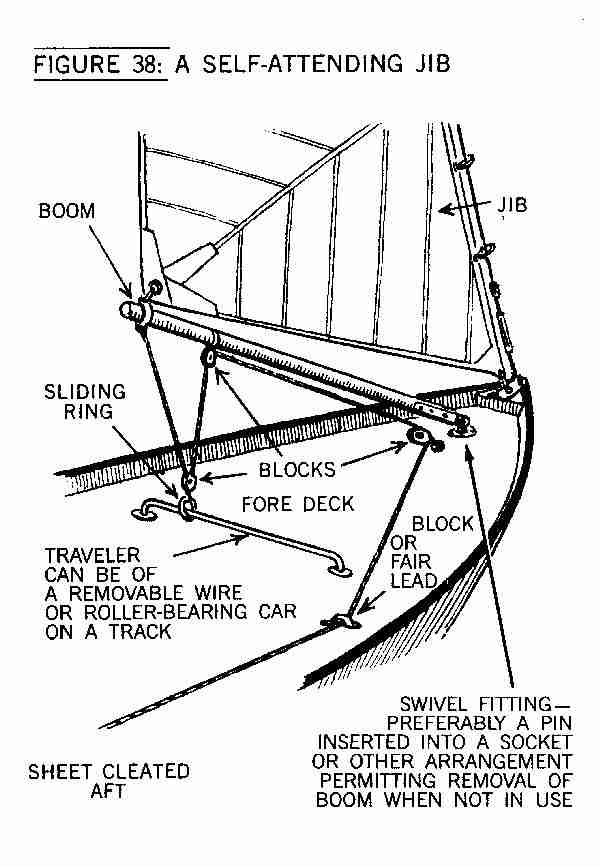
Here's a diagram that's easy to understand, but a bit more involved than my previous suggestion.... you could add an outhaul to the jib boom if you wanted additional sail trim options... run it forward to the swivel then back to cockpit.
 

RichH

.
Feb 14, 2005
4,773
Tayana 37 cutter; I20/M20 SCOWS Worton Creek, MD
Joe,

- that clubfoot/clew is going to 'raise' when the sheet is eased and when the clubfoot is well away from the centerline. I used to have such a rig for a staysail -- better than 'blocks' but not very 'adequate' to prevent undue 'twist'.

If you use such, its much better make the sheet attachments at mid-boom (but that doubles the sheet loads) and move the 'traveller' way forward ... under mid-boom. OR you have to add a separate 'vang' for the clubfoot and that adds 'complexity'.

The Hoyt-boom eliminates all these 'problems' because it cannot 'raise'.
 
Status
Not open for further replies.