Impeller problems

Status
Not open for further replies.
Jan 22, 2008
880
Fed up w/ personal attacks I'm done with SBO
Mates,

Have you ever had a problem with replacement impellers? Specifically, the replacements, for whatever reason, don't pump water as efficiently as the old ones. I'm talking so inefficient that it affects the engine operating temperature.
 
Dec 2, 1999
15,184
Hunter Vision-36 Rio Vista, CA.
What engine do you have?

Are you purchasing OEM impellers or other "after market" brands. How do you know that the impeller is not working as efficiently? If it is because you are still over heating you may have something stuck in your heat exchanger, raw water intake or mixing elbow clogging up.
 
Sep 25, 2008
544
Bristol 43.3 Perth Amboy
broken vanes

I've had the experience with the broken vanes lodging in the heat exchanger.
 
Jan 22, 2008
880
Fed up w/ personal attacks I'm done with SBO
Full disclosure:
I'm not having a problem. Over on the Moyer site there has been a recent discussion about new impellers that aren't as wide as the old ones they're replacing. The result is water leaks internally between the face of the vanes and the cover plate. Without that seal the water doesn't pump or at a very reduced rate. One member measured the difference between new and old and there was a dramatic difference.

After much discussion a theory emerged that the internal pump cavity wears significantly over time and the impeller in place swells to match the cavity depth, accounting for the difference in width between new and old.
So far, I'm not buying it. I suggested that if this were true we would have heard of it long ago and to my knowledge we haven't. Further, why would only the pump cavity wear and not the cover plate? A knowledgeable member posted back that it happens all the time, as far back as he can remember.

This member is a sharp guy and his posts are highly regarded but since I've never heard of the problem before - and I've been in boats for around 40 years including about 10 years in the industry - I thought I'd ask if it really is a common problem. If it is, that's good information. If it isn't, that's good information too.

I'm not on a campaign to be right here. I'd really like to know.
 
Sep 25, 2008
7,668
Alden 50 Sarasota, Florida
Neil
That is an old problem when water pumps used to be made of soft steel and the impeller blades were formed with metallic inserts rather than contemporary metals and molded neoprene or rubber blades. Some old myths die slowly. I guess there is some truth in what the person you quoted said albeit not relevant today.


Missing vane parts from a long overdue impeller change is likely the problem.
 
Jan 22, 2008
880
Fed up w/ personal attacks I'm done with SBO
Steve,
Interesting link.

Don,
We're talking something different than vane breakage, familiar with that. I found a picture taken by the guy who did the measurements. He mislabeled the dimensions but the pic tells the story. The short one is new.

Also, we're dealing with relatively current pumps, either bronze or brass bodies (I'm not sure which, whatever has been commonly used over the past few decades).
 

Attachments

Dec 2, 1999
15,184
Hunter Vision-36 Rio Vista, CA.
I would question the brand of impeller. They could have been mis-labeled or someone screwed up the specs.

We had a similar problem with Yanmar impellers several years ago with the vulcanization of the rubber to the hub. These were Yanmar OEM parts, not aftermarket. It can happen to anyone.
 
Jan 22, 2008
880
Fed up w/ personal attacks I'm done with SBO
MoyerMarine.com is a site specific to Atomic 4 engines. It's an outstanding resource. Thanks to the information, advice and parts available there, many of us have smooth running, reliable engines that are well over 30 years old.

The way this issue surfaced was a member bought a replacement impeller from Moyer and his engine temps rose significantly. He found the difference in height between the new and old impellers and started asking questions. Many of us measured our impellers and pump cavities and found measurements all over the place suggesting we weren't dealing with tight manufacturing tolerances or a perhaps a wear issue. We're divided into two camps right now, the internal wear camp and the poor dimensional control camp (for the new impellers). Oberborfer, the pump manufacturer, seems to be in the internal wear camp.

I'm struggling with the fact that, in my experience, this hasn't been a problem until recently. Why was there no issue for 4+ decades until now? My reason for inquiring on this forum was to hopefully pull in a much wider survey size rather than rely on only my personal experience. It will be interesting to see if ANYBODY has experienced this.
 
Nov 6, 2006
10,195
Hunter 34 Mandeville Louisiana
Even OEM is not a guarantee.. I remember a couple of folks on this site who had trouble with brand new OEM Yanmar impellers.. It was reported that the hub would get loose from the rubber very quickly (less than an hour of run time) and then it would pump no more. Lesson here is compare the new part to the old part before installation. The critical parameters on a new impeller are the vane length and the width. If the hub is larger with the same diameter vanes, it will pump less at same RPM. Looks like in the posted case here, the width is clearly the problem..
 
Dec 1, 1999
2,391
Hunter 28.5 Chesapeake Bay
I know that both Globe (blue) and Yanmar OEM water pump impellers have had their problems with loose hubs in the past. I used to check my impeller by just bending the vanes and seeing if any cracks were starting at their base. But now I also hold the vanes and see if the hub is losing its grip. It is also possible for the cam in the water pump housing to wear down just tiny bit (due to sand or grit entering the raw water intake system) and that would cause the pump to be less "efficient."
 
Feb 6, 1998
11,756
Canadian Sailcraft 36T Casco Bay, ME
Wear and impeller size issues are neither out of the question however the situation above is almost certainly the result of an improperly packaged, manufactured or shipped impeller.

Pump wear is and can DEFINITELY be a real issue. It can be different depending upon geographic waters as suspended particles can vary and can be more or less aggressive in some areas when compared to others.

Our boat has over 3k engine hours and is on her second pump and almost ready for a third due to body wear. With a new pump she'll prime nearly instantaneously and with a worn pump it can take up to 20 seconds or more if she loses prime.

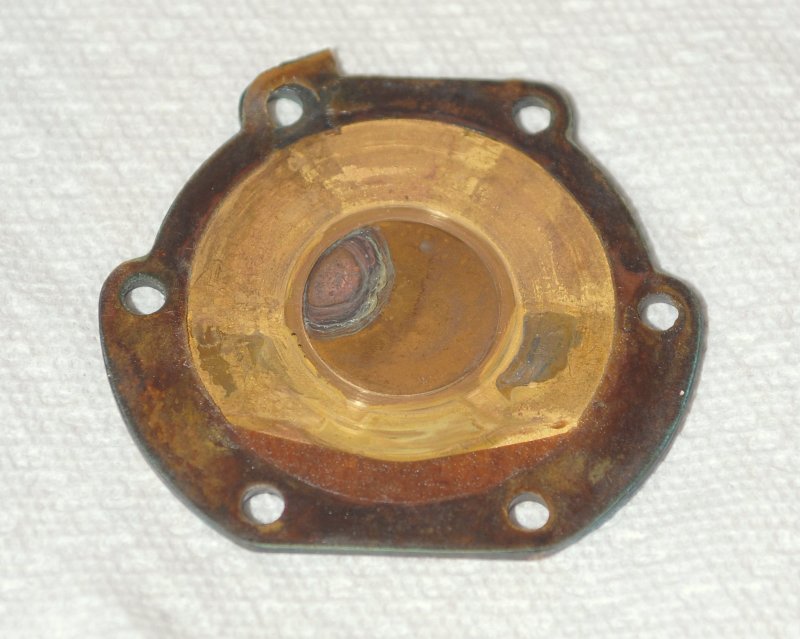
This is a worn cover plate note the defined "ridge" in the center around the hub:


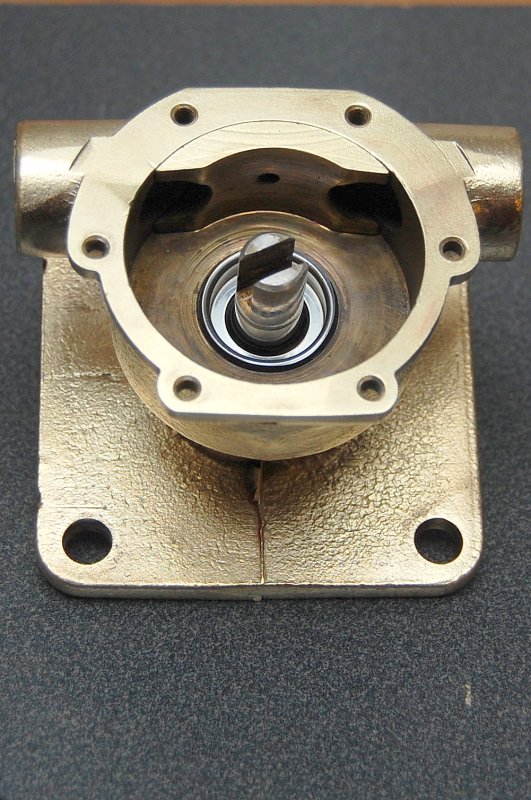
Below is a worn pump body. Note the scores close to the bearing. This is likely from a piece of grit that got sucked into the pump and jammed between the impeller and the pump body. The worst wear I see is always the thickness between the cover plate and the back of the pump body not so much in the diameter. I have yet to come across a pump so worn that a vane did not have a slight bend in it from contact with the pump wall or enough contact friction to become an issue.

When installing a new impeller seat it hard into the body and be sure that it sticks just a touch above the edges of the pump or exactly even so that the cover plate will compress it ever so slightly or that the impeller will have contact with it. If the impeller is not mating with both the rear of the pump body and the cover plate it will not perform the way it should.
 
Oct 2, 2006
1,517
Jboat J24 commack
The A4 is on at least its 3rd modern pump housing counting the moyer unit i have

The A4 design has evolved from a tiny weep hole to a huge slot to make it harder for a BAD pump seal to push water into the oil supply
 
Status
Not open for further replies.