Brand new sailor and Hunter 23.5 owner here. Just wanted to take a minute to introduce myself and tell everyone I'm excited to find a resource. I have a 1993 for about a month and have been going through the manual for the boat and the outboard to try and learn as much as possible about it. It's in great shape (as far as I can tell) and wanting to get it in the water and make sure everything works as it should. Any beginners advice, I would gladly accept! Thanks for everything! I'm still learning how to search the forum to try to find answers to my questions, but until then... thanks for having me!

Hello to all!
- Thread starter wvpackmule
- Start date

Welcome to the forum and congratulations on your first post! 
You will find some resources for your new-to-you boat here:
You will find some resources for your new-to-you boat here:


Where will you sail it? And will you be dry sailing it (Sailing off a trailer)?
Beginner's tips: Rig it up in your driveway before going to the launch ramp. Watch out for overhead electric lines where you practice rigging it and, believe it or not, at the launch ramp. Do not pull on a loose halyard, or any line, until you completely understand what the other end is attached to. I did this on my first launch - it made a rough day. Start early in the day when there's less wind - everything is easier. Sail upwind first - it's easier to sail downwind to the ramp or marina.
Beginner's tips: Rig it up in your driveway before going to the launch ramp. Watch out for overhead electric lines where you practice rigging it and, believe it or not, at the launch ramp. Do not pull on a loose halyard, or any line, until you completely understand what the other end is attached to. I did this on my first launch - it made a rough day. Start early in the day when there's less wind - everything is easier. Sail upwind first - it's easier to sail downwind to the ramp or marina.

Congrats on the new (to you) boat. A friend of mine had one that we sailed all over Lake Pontchartrain and the Mississippi gulf islands .. It is a fine boat.. Welcome aboard.
Thanks so much!Welcome to the forum and congratulations on your first post!
You will find some resources for your new-to-you boat here:
Thanks so much! My first launch will be in Beech Fork lake to make sure everything seems to work well. Unfortunately, my driveway has power lines right over them but I'm trailering it to my father in laws in the morning for the inaugural mast raise. He doesn't have a power line in sight. Noted on the halyards and great tips. I doubt I'll launch it as I don't have any sailing experience yet and without an outboard, I'd still like to get a handle on the wind and tacking.Where will you sail it? And will you be dry sailing it (Sailing off a trailer)?
Beginner's tips: Rig it up in your driveway before going to the launch ramp. Watch out for overhead electric lines where you practice rigging it and, believe it or not, at the launch ramp. Do not pull on a loose halyard, or any line, until you completely understand what the other end is attached to. I did this on my first launch - it made a rough day. Start early in the day when there's less wind - everything is easier. Sail upwind first - it's easier to sail downwind to the ramp or marina.
That's a great point! I'm excited to see if it floats first. The bilge pump is missing so I'll have to get one, unless I want to join the bucket brigade.After you launch… and the ballast tank fills…Don’t forget to close the ballast tank before you hoist the sails.
That does bring up a question. Favtory suggests the bilge is located port side just forward of the cooler, however I traced the bilge line and they had it running aft and it ended beside two thru hull mounts for transducers. Where would the hunter typically collect water? Should I mount it in the factory spot or mount it under the aft berth where the line seems like it ran to?You really should have a method of de-watering. Bigger is better.

jssailem
SBO Weather and Forecasting Forum Jim & John
- Oct 22, 2014
- 24,833
Your concern with the bilge is complicated. Other owners have faced it.
Here is an SBO link from 2010. The owners are discussing how to install a bilge hose loop for the boat.
Here is an interesting review from Practical Sailor.
hunter-23-5
You might find the attached personal manual, created by an owner, helpful. "McDonnell Hunter 23.5 Manual"
Looking at the boat in profile, I drew a line set about the lowest point on the boat hull. The rationale is that water will seek the lowest point in the boat. This is usually where a bilge pump would be located. On your boat, the water ballast tanks and the shallow hull draft complicate this.
It appears to me that incidental water will find its way into your boat. It will move about the shallow bottom of the hull. Here are some ideas on how you might deal with it.
Incidental water (leaks, rain, wash-down) does not stay neatly in one sump (bilge). It tends to collect:
Practical access points owners use:
Here is an SBO link from 2010. The owners are discussing how to install a bilge hose loop for the boat.
H23.5: water enters bilge pump through-hull and runs into bilge through the pump
In my recent thread "H23.5 centerboard/compression post leak", Mike (soling42) suggested water can enter the bilge pump outlet/through-hull when heeled over far enough. Sure enough, this is indeed the cause of what I hope is my third and last leak. I've attached pictures. There are only a few...
forums.sailboatowners.com
Here is an interesting review from Practical Sailor.
hunter-23-5
You might find the attached personal manual, created by an owner, helpful. "McDonnell Hunter 23.5 Manual"
Looking at the boat in profile, I drew a line set about the lowest point on the boat hull. The rationale is that water will seek the lowest point in the boat. This is usually where a bilge pump would be located. On your boat, the water ballast tanks and the shallow hull draft complicate this.
It appears to me that incidental water will find its way into your boat. It will move about the shallow bottom of the hull. Here are some ideas on how you might deal with it.
Incidental water (leaks, rain, wash-down) does not stay neatly in one sump (bilge). It tends to collect:
- Under the cabin sole, around the centerboard trunk and ballast tank
- In the spaces under the settees
- In the aft berth under the cockpit
Practical access points owners use:
- Flip-up lid / bottom companionway step — ballast fill/drain valve and vent
- Cover plate at the base of the mast compression post — centerboard mechanism
- Under-settee and aft-berth hatches — stray-water collection spots
Attachments
-
1.2 MB Views: 83


The bilge on my H26 was where you descibe yours on the 240. In the 6 years I sailed that boat (and I sailed her hard) I don't think I ever got water on my bilge pump. I did have to sponge a little off of the cabin sole from time-to-time. I would leave it where it is and think of it as a "sh*t is hitting the fan" sort of bilge pump and not your daily drain sort of pump.That does bring up a question. Favtory suggests the bilge is located port side just forward of the cooler, however I traced the bilge line and they had it running aft and it ended beside two thru hull mounts for transducers. Where would the hunter typically collect water? Should I mount it in the factory spot or mount it under the aft berth where the line seems like it ran to?
Your concern with the bilge is complicated. Other owners have faced it.
Here is an SBO link from 2010. The owners are discussing how to install a bilge hose loop for the boat.
H23.5: water enters bilge pump through-hull and runs into bilge through the pump
In my recent thread "H23.5 centerboard/compression post leak", Mike (soling42) suggested water can enter the bilge pump outlet/through-hull when heeled over far enough. Sure enough, this is indeed the cause of what I hope is my third and last leak. I've attached pictures. There are only a few...forums.sailboatowners.com
Here is an interesting review from Practical Sailor.
hunter-23-5
You might find the attached personal manual, created by an owner, helpful. "McDonnell Hunter 23.5 Manual"
Looking at the boat in profile, I drew a line set about the lowest point on the boat hull. The rationale is that water will seek the lowest point in the boat. This is usually where a bilge pump would be located. On your boat, the water ballast tanks and the shallow hull draft complicate this.
It appears to me that incidental water will find its way into your boat. It will move about the shallow bottom of the hull. Here are some ideas on how you might deal with it.
Incidental water (leaks, rain, wash-down) does not stay neatly in one sump (bilge). It tends to collect:
Limber holes in the structure let some of that water migrate toward the center, but owners frequently note there is no single deep, well-defined sump (bilge), the way a conventional keelboat has. The factory automatic bilge pump sits in this central area; its discharge through-hull is on the hull side and is relatively low, which is why heeling can let water run back through the pump. (The SBO link above discussed this issue.)
- Under the cabin sole, around the centerboard trunk and ballast tank
- In the spaces under the settees
- In the aft berth under the cockpit
Practical access points owners use:
Because the hull is shallow and the ballast tank occupies most of the lowest volume, stray water will sit in several shallow pockets rather than one obvious well. Many owners add extra pumps or just sponge those pockets after a rain.
- Flip-up lid / bottom companionway step — ballast fill/drain valve and vent
- Cover plate at the base of the mast compression post — centerboard mechanism
- Under-settee and aft-berth hatches — stray-water collection spots
Thanks so much for all of that information. It gives me a logical way to approach it. I told my wife yesterday I'm stripping the interior down for the first sail (taking all the cushions and access panels out to keep an eye on how everything does) so I can see where it all goes. I'm a bigger guy and haven't been able to crawl into the aftmost part of the aft berth to look over the transom. It looks like there's a decent cavity back there but will need to crawl back there and check it out.
When you crawl into a tight space have your cell phone handy. Sometimes crawling out doesn’t go as well as crawling in.
Hahaha I’m a great screamer.When you crawl into a tight space have your cell phone handy. Sometimes crawling out doesn’t go as well as crawling in.
jssailem
SBO Weather and Forecasting Forum Jim & John
- Oct 22, 2014
- 24,833
What leads you to believe that you were short changed?
Not all boats are designed or fitted with topping lifts. I don’t know if one was OME on the Hunter 23.5. It can be added if desired.
Not all boats are designed or fitted with topping lifts. I don’t know if one was OME on the Hunter 23.5. It can be added if desired.
If you have the B & R rig (and you probably do) then the topping lift is strung like this...
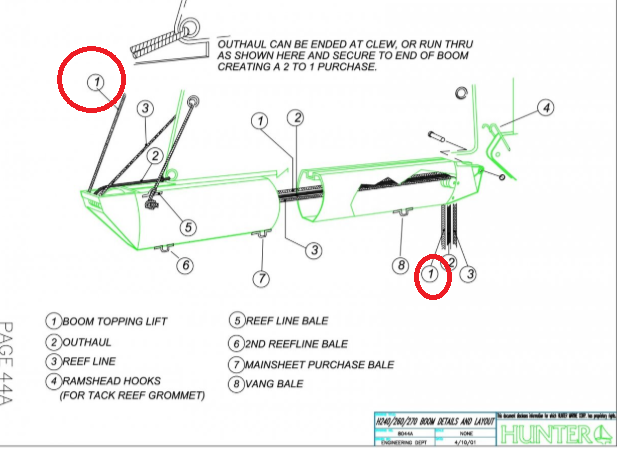
When i try to attach pictures, it says they are too large. I have an outhaul line and a reef line, that's all. However, I have (what I would call) a topping line that's tied to the masthead and the tag end hands free but it's long enough that I can tie a bowline in it just to support the mast, but only a temporary fashion. No shackle on the end of that line and no line running through the boom where the topping lift should run. Seeing pictures of lazy jacks, my boat does not have those. 
Am I correct in that no bocks/pulleys are used within the boom for the topping lift? I think I came across a video once that either the reef line or outhaul line runs around blocks within the boom housing?If you have the B & R rig (and you probably do) then the topping lift is strung like this...
View attachment 239654