Engine running hot - help/advice needed please

Status
Not open for further replies.
Dec 9, 2008
426
1980 Hunter 30 "Denali" Seaford, VA
Hello,

I noticed that my engine seems to be running hot all of the sudden. I have a 2QM15 fresh water cooled that also goes through my hot water heater. It's hard to tell what temp it is running, it's over easily 200F and maybe close to 220F but under 240 F. I don't get an alarm.

As background, I just bought the boat and my to do list is being worked on but there are some engine things that haven't been done yet. I read through two Nigel Calder books today but they didn't really seem to point me in the right direction, or at least the silver bullet wasn't identified.

I replaced the impeller on the raw water side today since the PO didn't know when it was last replaced, the old one was a little worn but not that bad and doesn't seem to be the culprit. It needed replacing anyway so no big deal.

The oil level is good, but I haven't done an oil change yet, I think I will do this next, though I don't suspect this will be the problem, but it's needed anyway.

That leaves me with the fresh water cooling side. I have not seen any leakage anywhere. I removed the freshwater cap (radiator cap thingy) and fluid came out but I suspect only due to being below the reservoir. I had to stop at this point because it was getting dark and I was getting tired, but now can't stop thinking about it.

I am almost sure that there is some issue in the fresh water side. How do I know if it is working properly other than temp gauge? I am sure that I need to replace the coolant in the engine, so I plan on that tomorrow too. When I empty it, I am considering taking each hose off one at a time to look for failure/cloggage. Is there something I should run through the system before refilling it will coolant mixture? Is there any way to know where the failure is without any leakage? I do think that the system is moving the coolant, but at a very slow rate because a lack of true overheating where I get an alarm. After the hoses, there are the cooling coils, there doesn't seem to be a way to inspect these for proper flow to determine if they are the problem. I am not in any position to replace this engine if it gets ruined and if it did our season which has started out so well, might come to a complete stop.

So, please let me know if you are "in the know" on this topic if my troubleshooting methods going forward sound logical and whether I am missing anything. I have left out thermostat because I believe that the fail open, I might be wrong though. My thoughts are that there is some sort of corrosion that happened inside the fresh water side, enough to cause a clog where a hose was bending or something and it's reducing the flow substantially, but not to the point that I get an alarm.

We've used the boat more in the last couple of weeks then it's been used in several years by the PO and when we first purchased it, at idle, the temp guage would only read around 110 F or something low like that. It is, I guess, possible that the current reading is the normal operating temp and that since the boat wasn't used, the thermostat wasn't working right, but is now and that's why it was always running cool but that seems unlikely and the current temps seem high to me.

Agian, I appreciate your insight here!

Jon
 
Jun 13, 2005
559
Irwin Barefoot 37 CC Sloop Port Orchard WA
If you have looked at the impeller I would look next at the mixing elbow where the hot salt water mixes with the exhaust. The OEM elbows are normally made from cast iron and rust quickly and easily, obstructing the flow of salt water at it's exit.

To check it correctly you will have to remove it. I don't know about your engine but Yanmar sometimes uses a pipe union between the manifold and the elbow. The union has a right handed thread on one end and a left handed thread on the other, so you will have to look carefully to determine the direction to turn it to loosen it.

Have fun

Joe S
 

RichH

.
Feb 14, 2005
4,773
Tayana 37 cutter; I20/M20 SCOWS Worton Creek, MD
The freshwater side of an engine, other than reduced heat transfer in the exchanger - on the raw side, rarely yields problems.

First, check the raw water side for output volumetric flow ... at the outlet at the stern of the boat. Take a bucket and stopwatch, run the engine @ ~2000 rpm and measure the output flow. A 2QM should give approx. 3 gallons per minute.

If LESS than 3 gallons per minute (GPM), then you have either a restriction somewhere in the raw water circuit OR worn water pump - either a worn cam shoe ... or worn side (access) plate that is bypassing flow. Rarely but sometimes the exhaust manifold (cooled by the raw water circuit) will start to 'fall apart' internally due to the formation of 'slab rust' - but youll see this in reduced output flow IF all the other components are intact, etc. as a last step in the check process.
Summary:
1. worn raw pump
2. restriction
2a. slab rust in exhaust manifold
2b. fouled inlet strainer.

If close to 3 GPM, then check the condition of the heat exchanger for fouling. If Hx is fouled, then its time to use a commercial boiler descaling compound (avoid 'acids' such as muriatic, etc.) such as Rydlyme, etc. in the Hx AND the exhaust manifold (plus water injection nozzle to the wet muffler) -- www. Rydlyme.com
Note: if Heat exchanger and/or exhaust manifold rapidly re-fouls after cleaning, then consider to replace engine thermostat with one that opens full at a lower temperature - change from 180 to 135 deg. F full open.

IF the cooling system is found to be clear/clean, (has to be evaluated/remedied first) THEN evaluate for a blockage (carbonate/soot) in the water injection nozzle of the wet muffler. If the water Injection nozzle is partly blocked then the cylinders will run at excessive back-pressure. Symptom: engine will not reach FULL operating RPM AND engine runs 'hot' ... kinda like 'hot constipation'. :)

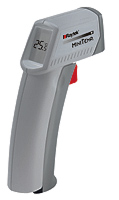
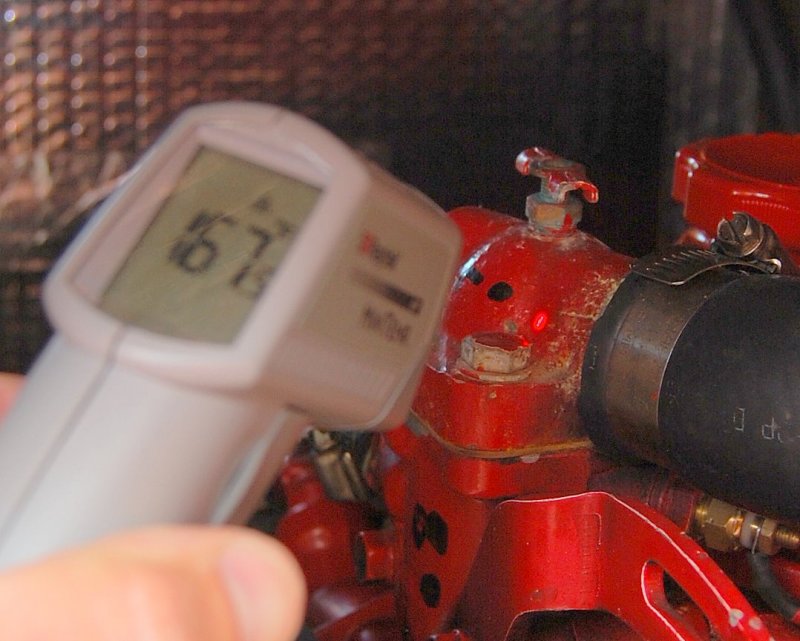
Its good practice to use an infrared thermometer (pyrometer) in evaluating cooling problems on a engine. Just evaluate the engines cooling system from 'back-to-front' looking for the radical difference in temperature. Best is to thermally PROFILE the engine when the engine is running well, then its VERY easy to find any trouble with an IR thermometer ( IR pyrometer). example: http://www.amazon.com/IRT0421-Non-C...ref=sr_1_1?ie=UTF8&s=hi&qid=1244698368&sr=8-1

IF then injection nozzle is clear then evaluate the injectors. Just send them out to an 'injector shop' - located in most 'population centers'. A too-lean engine will run HOT (the normal excess fuel in the injection helps to cool the combustion chambers ... called 'overfueling' - but can lead to 'sooting' of the injection elbow.)

hope this helps.
 
Aug 19, 2004
239
Hunter 35 Vancouver, BC
Mixing Elbow?

If you have looked at the impeller I would look next at the mixing elbow where the hot salt water mixes with the exhaust. The OEM elbows are normally made from cast iron and rust quickly and easily, obstructing the flow of salt water at it's exit.
The attached picture shows the discharge side of a brand new mixing elbow. You can see the junction where the hot sea water meets the exhaust gas. This is the location where all sorts of gunk eventually builds up and creates a blockage. Depending upon usage, the elbow normally requires attention every five years or so.

Boaters on limited budgets may try to clean out this debris, but this could be a false economy. Depending upon the ease of access to this area, removing the elbow can be much more challenging than, say, changing a water pump impeller. Once the whole elbow assembly is out of the boat, there is still a large nut that needs to be undone to split the unit into its two parts. This nut is often "frozen" and even the professionals sometimes struggle to free it.

I prefer to install a new elbow rather than take the chance of an engine failure at sea. Some after market mixing elbows are available for significantly less money than the Yanmar OEM unit.
 

Attachments

Jun 26, 2007
106
Freedom F39 Lyttelton New Zealand
Does the 2QM have a thermostat on the FW side. Could it be as simple as a stuck thermostat? Thermostats are always closed when cold and open with heat. If it is stuck closed ......
 
Dec 19, 2006
5,832
Hunter 36 Punta Gorda
Lots to Check

Sounds like every one is giving you lots of advice and if you have tools and are handy should be able to correct problem,but do one thing at a time don't go crazy taking every thing apart try one thing or one area and than check and see if that is the problem.
I would check water circulation of water cooling the engine,I am far from expert but if the mixing elbo is clogged most times can be cleaned out it will also give the the engine not smooth running and lots of black smoke out the exhaust when pushing under power,but sounds like could be any thing with the cooling system,check the flow out the raw water pump and all hoses maybe bypass the water and take out of the system but the heat exchanger could be clogged up,there two thermostats in a fresh water system,lots to check and good luck with getting it going.
 
Feb 6, 1998
11,760
Canadian Sailcraft 36T Casco Bay, ME
So many variables

Rich and the others have given some great advice so far. This is generally how I trouble shoot over heat issues..

#1 Check engine intake thru-hull/seacock. Clean if necessary. If you know you have good flow jump to #8.

#2 Check and clean hose from intake seacock to strainer and any elbows that may be in this path. Large (very large) zip ties work well for this.

#3 Be certain that the inner wall / membrane of the coolant hose, on the suction side of the system (before the raw water pump), is not collapsing under suction. This can often happen with older "wound" hose and even some multi-layer standard hoses.

#4 Remove strainer basket and snake both inlet and outlet ports.

#5 Remove hose from strainer to water pump and check/clean

#6 Remove and check or replace impeller and also check the old one for broken vanes. If vanes are broken you NEED to find the pieces.

#7 Test run engine make sure you have good water flow and at the proper flow rate. If you are still over heating move on.

#8 Using an infrared thermometer (you can't effectively trouble shoot a cooling system without knowing actual temps) measure the temperature at the sending unit, on the thermostat housing, and compare that reading with your temp gauge. Also, measure the temperature differential between the inlet and outlet sides of the HX and write down the differential. If the gauge and infrared are close it very well could be the thermostat. You can remove and test the stat in a pot of water using the infrared to confirm opening temp and re-install but stats are cheap so I would not advise this. Go new.


#9 Make sure "sealed" side of the system is not air bound and use the air purge valve to check for any trapped air. If it is low be sure to top off with the same type/brand antifreeze and to purge any trapped air.

#10 If still overheating check the temperature of exhaust elbow (on the engine side) and about 6-8 inches from the exhaust elbow on outlet side for a large temp differential. If you have a large temp differential you have a blockage at the exhaust elbow. Fix this before moving on and re-check engine.

#11 If exhaust elbow checks out open up the heat exchanger and look for "gunk" if junk, corrosion, pieces or crap are present remove the HX and bring it to a radiator shop for an acid bath cleaning or do a DIY cleaning with Rydlime as mentioned above.

#12 Re-install HX and check engine.

#13 If still overheating check for flow and then if it seems restricted purge and clean the "sealed" anti-freeze system side with Rydlime. Be sure to do a purge flush with water before re-filling with antifreeze. It's possible the journals and pathways are loaded with rust, gunk and corrosion and you have a partial blockage.


When the engine is finally fixed and running well use your new infrared thermometer to record the following numbers in a notebook after a thorough warm up and sufficient run time. This will save LOTS of time when you have a cooling system issue in the future..

HX Temp differential between inlet and outlet sides.
T-Stat housing temp
Exhaust elbow - both sides (pre-water and post water injection)
Exhaust hose temp
Various points of the cooling system

It's best to mark every one of your infrared thermometers "laser" measuring spots with a Sharpie marker so you can repeat these numbers and readings accurately by always measuring the same exact location.

Engine Temp Monitoring & Over Heating Baseline Assessment (LINK)


Sorry the above link won't help now but it can help in the future after you have fixed this problem.

 
Dec 19, 2006
5,832
Hunter 36 Punta Gorda
Lots to Check

Sounds like every one is giving you lots of advice and if you have tools and are handy should be able to correct problem,but do one thing at a time don't go crazy taking every thing apart try one thing or one area and than check and see if that is the problem.
I would check water circulation of water cooling the engine,I am far from expert but if the mixing elbo is clogged most times can be cleaned out it will also give the the engine not smooth running and lots of black smoke out the exhaust when pushing under power,but sounds like could be any thing with the cooling system,check the flow out the raw water pump and all hoses maybe bypass the water and take out of the system but the heat exchanger could be clogged up,there two thermostats in a fresh water system,lots to check and good luck with getting it going.
 
May 11, 2005
3,431
Seidelman S37 Slidell, La.
Something else to check

Maybe the unusual only happens to me, but here is what was causing my engine to run on the hot side last week. (Yanmar 3gm) After checking the impeller, which had been recently replaced, I was checking the raw water intake, and found an air leak on the raw water strainer. What was happening was the impeller was trying to pump raw water into the engine, and was getting air instead. A fairly simple fix, once the problem was found. Easiest way to check is to see if the raw water line at the pump will siphon. If it won't, there is a leak or obstruction. Let us know what you find.
 
Dec 9, 2008
426
1980 Hunter 30 "Denali" Seaford, VA
Wow, lots of great advice, thanks! I think I'm going to go over these things a couple of times today to really get them to sink in. I can see that water coming out of the boat and it seems like a good flow rate. It's pretty close to the waterline so I'll see if I can figure out a way to measure it.

I have a maintenance manual that covers a bunch of the yanmar engines, but it doesn't go into great details particularly on the QM series. I also have Nigel Calders diesel engine book as well as the other book that goes over electrical and mechanical boat systems.

If my flow is good, the mixing elbow sounds like it could be a culprit. I noticed two things that I didn't mention. Yesterday I noticed a little "slick" (for lack of a better term, it was not oily) of what looked like carbon deposits on the water coming out of the exhaust. Also, I noticed when motoring the other day that the engine doesn't like to hold higher RPM which could mean excessive backpressure??? Both could mean the mixing elbow? Thes are more questions than anything because I am not really overly familiar with these engines.

Thanks again!
 
Dec 9, 2008
426
1980 Hunter 30 "Denali" Seaford, VA
Maybe the unusual only happens to me, but here is what was causing my engine to run on the hot side last week. (Yanmar 3gm) After checking the impeller, which had been recently replaced, I was checking the raw water intake, and found an air leak on the raw water strainer. What was happening was the impeller was trying to pump raw water into the engine, and was getting air instead. A fairly simple fix, once the problem was found. Easiest way to check is to see if the raw water line at the pump will siphon. If it won't, there is a leak or obstruction. Let us know what you find.
If I have water coming out the exhaust I must have a siphon right?

If I am unable to measure the amount of water coming out, couldn't I take a 5 gallon bucket and fill it with 3 gallons of water and see how long it take for it to be emptied? Measure the input rather than the output? Just disconnect the hose at the seacock and put the hose in the bucket?
 
Dec 9, 2008
426
1980 Hunter 30 "Denali" Seaford, VA
I just looked up the mixing elbow, $186. If that is the problem, I will either have to wait or try to clean and repair the existing one.
 
Feb 26, 2004
23,353
Catalina 34 224 Maple Bay, BC, Canada
I noticed two things that I didn't mention. Yesterday I noticed a little "slick" (for lack of a better term, it was not oily) of what looked like carbon deposits on the water coming out of the exhaust. Also, I noticed when motoring the other day that the engine doesn't like to hold higher RPM which could mean excessive backpressure??? Both could mean the mixing elbow?
1. You'll always have a slick, think of what the exhaust represents.

2. Not necessarily. Your connection between the throttle and the engine could be loose, usually at the binnacle end.

I recommend dealing with the engine end first, #2 is most likely a whole 'nother issue altogether of friction on the throttle cable.
 
May 11, 2005
3,431
Seidelman S37 Slidell, La.
Water output

I don't see why measuring the input instead of the output wouldn't work. But as to the siphon, the air leak on my strainer was not large enough to cause a total loss of water intake, but sucked enough air that water intake was reduced. My strainer is a Groco, with a glass body, and looked to have had the top and bottom sealed up with plumbers putty at some time in the past. I really got lucky, and found that the gasket for my big Wix fuel filters was the exact same size for the top gasket. Keep us posted on what you find.
 

RichH

.
Feb 14, 2005
4,773
Tayana 37 cutter; I20/M20 SCOWS Worton Creek, MD
snip

If my flow is good, the mixing elbow sounds like it could be a culprit. I noticed two things that I didn't mention. Yesterday I noticed a little "slick" (for lack of a better term, it was not oily) of what looked like carbon deposits on the water coming out of the exhaust. Also, I noticed when motoring the other day that the engine doesn't like to hold higher RPM which could mean excessive backpressure??? Both could mean the mixing elbow? Thes are more questions than anything because I am not really overly familiar with these engines.
Carbon emissions can be caused by many things:
1. fouled injection elbow
2. COLD cylinder walls .... carbon emission dont matter unless the engine is WARM
3. injector or injection pump problems

Backpressure. Yes if the injection elbow is fouled you will get soot AND high engine temps.
But its always better to check the engine in a logical sequence ... check the output flow rate of raw cooling water first. Take a bucket, push it down into the water and catch the outlet flow while using a stopwatch ... dont guess.

FWIW - engine sooting in the exhaust header and water injection nozzle (formation of 'coke', actually) can be attributed primarily to old contaminated fuel. Diesel fuel is fairly stable, but once it starts to decompose by oxidation or by the action of fungi, etc. which forms 'resins', ... these degraded fragments dont 'burn' very well in the combustion chambers and the unburned fragments then 'condense' and adhere to the downstream components. Once adhering and subject to the high exhaust temperatures they then are 'reduced' to elemental carbon deposits (coke). Moral: if your tank is grossly contaminated with fungi (the black shit thats adhering to the tank walls), CLEAN out the TANK (to avoid sudden/future 'filter problems'), then never long term store (keeping the tank always 'topped-off') the fuel, keep on board only the amount of fuel that you will need plus some reserve, buy your fuel from a 'high turnover' source (such as one that caters to 'watermen) or 'jug it in from a high volume truckstop'.
Consider to regularly use a 'stabilizer + biocide'; but, start with a CLEAN tank... as if you put a biocide into a fouled tank you will have more problems than you can deal with when those 'resins break loose'.

:)
 

AXEL

.
Mar 12, 2008
359
Catalina C30 MKIII WEST ISLIP, NY
FYI, the mixing elbow can be a MAJOR pin in the butt to remove. It took me 5 days last fall. Here are a couple of quick checks;

Check the condition of the antifreeze. Make sure it's green. I had a problem several years ago where I sprung a leak in the heat exchanger which caused sea water and antifreeze to mix in the block. It will cool but not as efficient as all antifreeze.

Speaking of heat exchanger. Take the end caps off it and check for obstructions. Beaware once you remove the end caps you'll probably need new gaskets.

You probably should remove and replace the sea water thermostat. If it's not opening all the way this would be a (big) problem.
 
Dec 9, 2008
426
1980 Hunter 30 "Denali" Seaford, VA
Thanks Stu - good points, I am definately planning on keeping on track with the overheating problem first.

Nice and easy, yeah I'll check out those hose connections and I suppose I should check out the strainer too, it looks to be glass or clear plastice with two wing nuts on top I think. I probably won't get into the water till friday or saturday to look at the strainer on the thru-hull to look for anything slwoing the intake
 

John

.
Jun 3, 2006
803
Catalina 36mkII Alameda CA
My engine tended to run hot about a year ago. Knowing that the previous owner did little or no maintenance, I figured that the most likely was that the first place where the raw (salt) water entered would be the problem - in other words the heat excahnger. I removed it, boiled it out with Rydlime, and put it back on. I also changed the thermostat just in case. That solved the problem.

As for infrared thermometers: There's one you can buy online for ten or twenty dollars. It doesn't have the bells and whistles, but it suited my purpose perfectly.
 
Dec 9, 2008
426
1980 Hunter 30 "Denali" Seaford, VA
last night after work I did just a few things:

cleaned out the raw water stainer - didn't help
removed and tested the thermostat, seems operational
ran engine without thermostat installed - didn't help

today I will be getting in the water, first I will check the thru hull strainer under the boat and then test it

I will also try to measure the amount of raw water coming out the exhaust. Previously I thought I might do this from inside the boat testing how much water is drawn in instead of going out, but that does not determine if there is a problem at the thru hull.

after that, I haven't decided if I will check the mixing elbow or the heat exchanger. I don't know where to find Rydlyme other than order through Torresen, I would like to be able to find something locally. I was thinking perhaps of removing the the heatX and trying to backflush it with water and see if anything comes out and then soaking it in vinegar over night or something, any thoughts on this?

Thanks for the help, and I'll let you know how it progresses.
 
Aug 19, 2004
239
Hunter 35 Vancouver, BC
Testing Cooling Water Flow Rate

I will also try to measure the amount of raw water coming out the exhaust. Previously I thought I might do this from inside the boat testing how much water is drawn in instead of going out, but that does not determine if there is a problem at the thru hull.
Here's another option to trying to measure the volume of water coming out of the exhaust - which sounds a bit tricky to me.

Remove the hose that takes water from the heat exchanger to the mixing elbow and briefly run the engine. I have been told that the water jet from this hose should be strong enough to squirt several feet horizontally. When I had a cooling problem due to an upstream constriction, this flow was no better than a strong dribble from a slightly open tap and could barely manage to jump 3-4" horizontally. This flow limitation meant that my 3GM30 would not run at over 2,200 rpm without overheating. Of course this does not tell you anything about the condition of the mixing elbow, but it will prove/disprove the ability of the rest of the cooling system to move sufficient water. The chances of a constriction problem occuring downstream of the mixing elbow are minimal.
 
Status
Not open for further replies.