Correct fusing?

May 17, 2004
6,145
Beneteau Oceanis 37 Havre de Grace
How would you do that? Are you saying you'd use a 3A circuit breaker on the panel, and have nothing but this device powered from that circuit? I don't think I've ever seen a 3A CB (I've seen 25A, then 10A, 15A, 20A, and so on). Plus, how do you know it will have the time-blow characteristics of the fuse?
I think the OP said he's got fuses in his panel, not breakers, and also that there is nothing else on that branch.

Good point about the time-blow characteristic. If the original in-line fits directly into the existing holder at the panel then he could use the exact original fuse. Otherwise yes the new one should be selected to match. It should be possible to find out the specs - the vendor of the chartplotter would need to make those available in case the inline fuse ever blew.
 
  • Like
Likes: jviss

jviss

.
Feb 5, 2004
7,090
Tartan 3800 20 Westport, MA
@Davidasailor26 , thanks, you are a very reasonable person.

My view is that one should leave the breaker or fuse that's spec'd for the circuit, and keep the inline fuse that the device manufacturer supplied. The inline fuse can always be found right at the device.

I'm not sure there's a standard for this practice, though.
 
May 20, 2016
3,015
Catalina 36 MK1 94 Everett, WA
I put my fuses in a ATC holder behind the panel. My electronics panel switch powers 5+ ATC fuses using bridging blocks. Fuses in one place (actually my 24x7 device fueses are down by the house batteries). ATC fuses are easier to read Amperage than the darn glass fuses. If you get fancy fuse holders or expensive ATC fuses they have a LED to indicate the blown fuse.

The 3A fuse for my chart plotter hasn’t been moved yet, and it’s under a huge access panel in a crowded space it would take 20 minutes to access - way too much time on a dark and stormy night.

If I really need an ultra-fast or slow blow, I’ll put them in the same place.
 
May 20, 2016
3,015
Catalina 36 MK1 94 Everett, WA
A fuse is often an integral part of a reverse polarity protection scheme. Icom uses this, for example. A reverse polarity protection diode inside conducts when reverse polarity is applied, but relies on the external fuse to open in this case. Without the fuse, the radio is dead.

So, no, you are wrong saying "a fuse will never protect from reverse polarity."
Nope the diode is the only component there that protects from reverse bias - and if a device is hooked up backward that has a fuse and a diode the fuse will never blow or come into play because no current can flow thru the diode
 
Apr 8, 2010
2,237
Ericson Yachts Olson 34 28400 Portland OR
One reason that many manufacturers put a fuse in their positive wire near their device is that they want to protect the device and canNOT predict that the end user will properly fuse that circuit at the panel or anywhere else. :(
Smaller chart plotters are often installed by owners with wiring led direct to an ugly clump of wires on their battery terminals rather than going thru a panel.

If you have a real breaker (or fuse) panel and do run all of your loads to it, you are doing it right and providing good circuit protection.
A secondary problem that those little "hidden" fuse holders cause is that they often contain a glass-tube fuse in a holder that allows corrosion to sneak in over time, until increased resistance leads to an open circuit... and then the problem in the wiring ("device stops working") takes time and/or paid labor to find and fix.
 
  • Like
Likes: JimInPB
May 17, 2004
6,145
Beneteau Oceanis 37 Havre de Grace
Nope the diode is the only component there that protects from reverse bias - and if a device is hooked up backward that has a fuse and a diode the fuse will never blow or come into play because no current can flow thru the diode
Disagree. Look again at the example circuit I linked to. The diode is connected from the black like to the red. If the wires are hooked up correctly no current flows through it. If they're hooked up backwards then current flows through the diode, shorting it, and blowing the fuse to prevent any further damage.
 
Aug 22, 2017
1,609
Hunter 26.5 West Palm Beach
Everything the OP really needed to know was in the first two responses.

As post #2 said, a 3 amp fuse at the panel, before the #14 wire, will give you all the protection you need, as long as there are no other devices on the circuit. The size of fuse that is listed in wire charts is the maximum. There is no minimum.

Post #3 gave you a link to an ABYC standards based chart http://assets.bluesea.com/files/resources/reference/20010.pdf that tells you how much to upgrade the wire size for longer wire runs. Going 10 feet away from the feed counts as 20 feet in the chart, because you have 10 feet of wire going out (maybe red) & another 10 feet coming back (probably black). According to that chart, assuming a 3 amp load, you use the 5 amp column. For “critical equipment” #14 wire can be used for up to 20 feet. For non-critical equipment, it can be used for up to 65 feet. The difference is the amount of voltage drop that will be seen. In the real world, you can go a little longer because the chart lists 5 amps in that column & you are actually using less. Also, just because you are fused at 3 amps, does not mean that you are actually pulling close to three amps. You may draw a lot less. I have a Garmin unit that came with a 3 amp fuse installed. It draws less than 1 amp. If you only draw 1 amp in the real world, then you can go a lot further than the chart lists for a 5 amp load.

I will add that that, when you go to crimp the #22 wire, you may want to strip back about an inch of insulation, then fold the copper over a few times to fatten it up so that it will fit in the crimp a little more snug. Trying to get a good connection with a single thickness of #22 in a red crimp is something I have not had much luck with.

Your owners manual may list a range of fuse sizes & types that are acceptable. If not, then I would stay with the size & type of fuse that was originally provided.
 
Last edited:
  • Like
Likes: plenny7
Aug 22, 2017
1,609
Hunter 26.5 West Palm Beach
... I don't think I've ever seen a 3A CB (I've seen 25A, then 10A, 15A, 20A, and so on). Plus, how do you know it will have the time-blow characteristics of the fuse?
Panel mount circuit breakers come in many different amperage sizes & a few different trip curves. The number of different trip curves that are available from different types of fuses is much greater.

Below is an example of a 3 amp breaker. Other types also exist.

http://download.siliconexpert.com/p...575459132232772797eng_ds_1308242_w28_1215.pdf
 
Last edited:
Aug 22, 2017
1,609
Hunter 26.5 West Palm Beach
A fuse is often an integral part of a reverse polarity protection scheme. Icom uses this, for example. A reverse polarity protection diode inside conducts when reverse polarity is applied, but relies on the external fuse to open in this case. Without the fuse, the radio is dead.

So, no, you are wrong saying "a fuse will never protect from reverse polarity."
At the risk of posting too much mumbo-jumbo, I am going to try to clarify this a little better for people who don't have an electronics background.

Diodes are like check valves for electricity. They let current flow in one direction & not the other. There are two ways I know of that a diode can be used to protect equipment from reverse polarity One does not require the use of a fuse. The other does.

The first way is to have the diode in series with the load. In this case, the diode is installed in the direction that it does conduct current, with the negative side of the power connected to the bar side of the diode, not the triangle side (mnemonic - drunken electrons go into the bar). The disadvantage to this method is that you will normally see a 0.7vdc drop across the diode, so the device being powered gets 0.7vdc less than the source provides. When your house bank is low, this may cause a problem.

The other way is to have the diode installed in parallel with the power feed, in the direction that does not conduct current when the device is wired correctly. This is the method that has been discussed already. In this case, there is no voltage loss, but the diode can only protect the device if an upstream breaker or fuse will blow before damage is done to the device. The over current protection component may need to have a fast trip curve that only an electronic fuse or a one-time fuse can provide. Breakers may or may not trip fast enough. In this case, the current capacity of the diode needs to be larger than the current rating of the fuse. Since you have no way of knowing what size diode is in the device, using a larger than original fuse, or different trip curve fuse, means that you are taking a risk.

A fuse by itself, will not protect from reverse polarity, but it can be a necessary part of a system of components that does protect from reverse polarity & changing the type of fuse can disable that protection.
 
Last edited:

jviss

.
Feb 5, 2004
7,090
Tartan 3800 20 Westport, MA
Nope the diode is the only component there that protects from reverse bias - and if a device is hooked up backward that has a fuse and a diode the fuse will never blow or come into play because no current can flow thru the diode
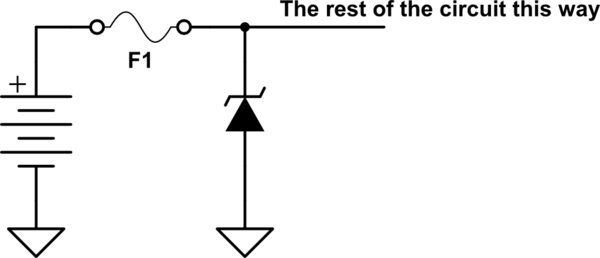
I'm afraid that's not how it works, Les. This is how a diode is used to protect equipment from reverse polarity:


The circuit shows normal operation, the protection diode reverse-biased, not conducting, and the unit's supply current flowing through the fuse.

Now if you reverse the polarity of the power supply, the battery in the circuit above, the diode will conduct, and a large current will flow, blowing the protection fuse. Since the fuse is outside the equipment, typically, it is easy to replace once the fault is corrected. If you eliminate the fuse, the diode will quickly burn out and fail open-circuited, at which point the equipment will be damaged by the reverse polarity supply.
 
May 20, 2016
3,015
Catalina 36 MK1 94 Everett, WA
@jviss yes here the fuse is protecting from reverse voltage. But wouldn’t that same fuse do the same job if relocated somewhere accessible??
 

jviss

.
Feb 5, 2004
7,090
Tartan 3800 20 Westport, MA
But wouldn’t that same fuse do the same job if relocated somewhere accessible??
Yes, it would. I happen to think that keeping the fuse in the harness that is usually supplied by the manufacturer makes some sense, but I can also see that putting it in a more conveniently accessible place makes sense, too.

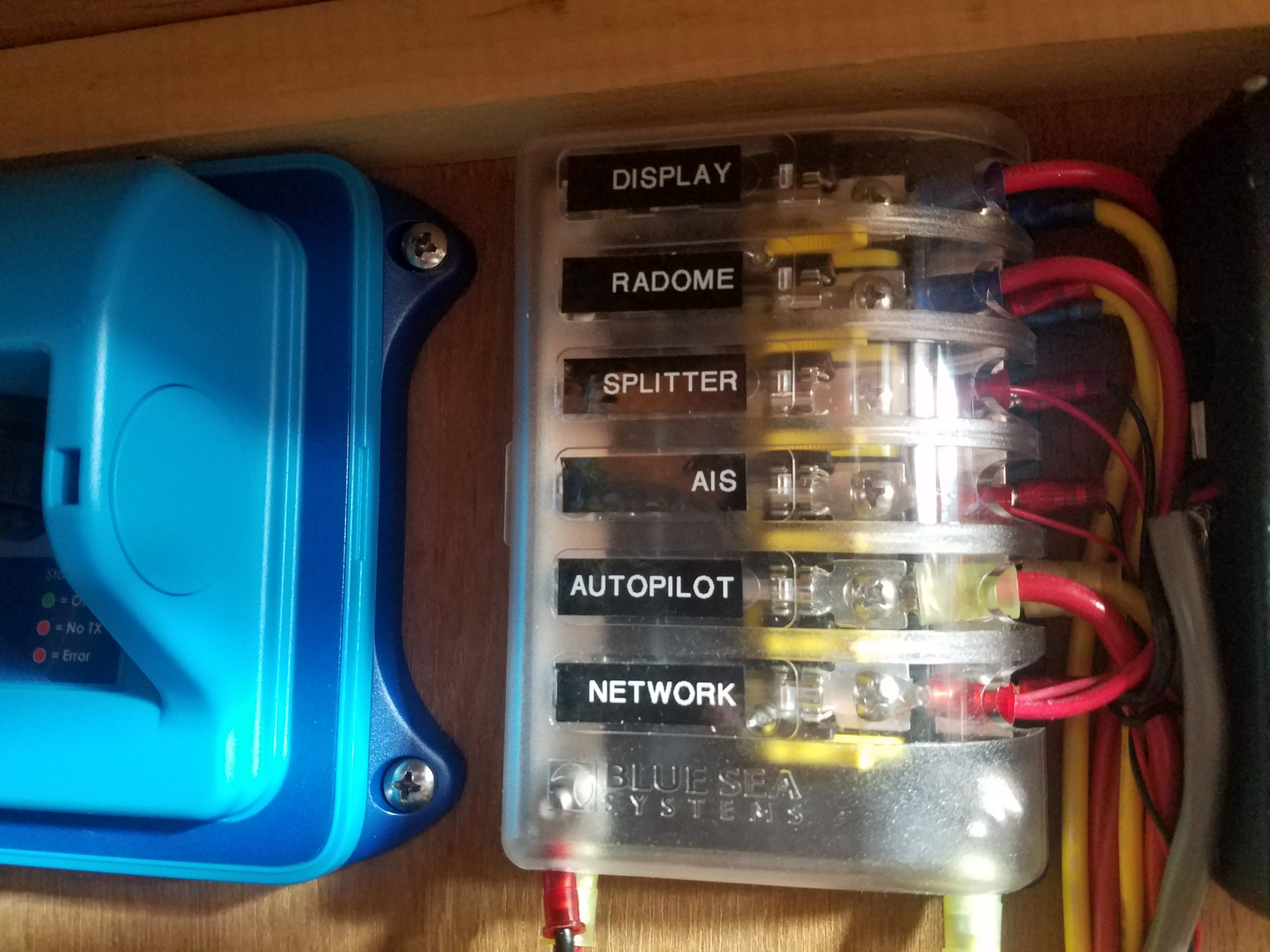
I like your ATC fuse block idea. My boat has the device fuses grouped similarly, but with the old, glass AGC fuses; this serves also to feed all of the electronic navigation devices from one breaker on the main panel.

(BTW, I haven't completely figured out all of the wiring on this boat yet, so I can't say why there are multiple wires on the load side of many of these fuses. I have to create a schematic at some point, and make sure I have the correct device protection fuses.)
 

jssailem

SBO Weather and Forecasting Forum Jim & John
Oct 22, 2014
24,518
CAL 35 Cruiser #21 moored EVERETT WA
That is one of the better exchanges of ideas @jviss among two electronic engineers. Nice write up @JimInPB .

Jviss.. I see you have the Vesper AIS. How do you like it? Are you using the gateway wifi function to provide Nmea2000 data to multiple displays?
 

jviss

.
Feb 5, 2004
7,090
Tartan 3800 20 Westport, MA
I see you have the Vesper AIS. How do you like it?
I like it! It came with the boat. I'm not currently using the WiFi feature for data; there are three WiFi networks on this boat! The default I will use is the Simrad WiFi-1 hub.
 
May 17, 2004
6,145
Beneteau Oceanis 37 Havre de Grace
The default I will use is the Simrad WiFi-1 hub.
Sorry for the thread drift but I'll be interested to know how that works for you. I have one but it's kind of unstable. It seems to stop accepting wifi connections a couple times a week. I have a bit of an unusual configuration where I have a raspberry pi doing all the DHCP and the wifi-1 acting as a pure access point, so maybe the issues are associated with that; I just don't know.
 

jssailem

SBO Weather and Forecasting Forum Jim & John
Oct 22, 2014
24,518
CAL 35 Cruiser #21 moored EVERETT WA
raspberry pi doing all the DHCP and the wifi-1 acting as a pure access point, so maybe the issues are associated
That is a real possibility. Sometimes it is better to set the connection rather than let the system choose the connection (DHCP).
 

CarlN

.
Jan 4, 2009
603
Ketch 55 Bristol, RI
First, remember that the perfect is the enemy of the good. I expect that a 10 amp fuse will blow long before a 22 gauge wire catches fire. It's rated at 7 amps. Most shorts are dead shorts that blow even a fuse that is way too big. And you are absolutely right that putting fuses (or even junctions) in a ceiling panel is asking for trouble.

But if you want to be fastidious, the best solution would be to run the bigger gauge wire all the way to the pedestal and move the manufacturer's fuse very close to the back of the unit where it is easy to find.

Finally, I believe most if not all modern marine electronic equipment is also protected from reverse polarity inside the unit.
 
Jan 4, 2013
294
Catalina 270 Rochester, NY
3 amp fuse at panel perfectly fine as long it's the only device on the circuit.
The one thing not discussed is slow blow vs fast blow. I would guess they gave you a fast blow fuse. You would use a slow blow fuse for a motor.

Retired Control Engineer