Tracing parasitic loads..
I have seen a lot of questions over the years about parasitic battery loads, current draw on your battery even when everything appears to be turned off. Here's a quickie on how I isolate and find them.
In order to trace ghost or parasitic loads you'll need the proper tool. You'll want a multi-meter that will read DC amps / millivolts out to the thousandths or the hundredths.
These meters can be had very cheaply these days and while the cheapies might not be the most accurate you are only looking to eliminate or make the current draw disappear on the meters screen.
If you find you have a parasitic load you can easily track it down by disconnecting load wires from the back of the panel , one by one while monitoring the meter, or anywhere a load pulls off the circuit down stream/current of the meter.
To test for this you simply insert the meter between the positive post of the battery and the positive battery cable. Please only do this with everything turned OFF!!! I can't stress this enough. ALL loads must be turned off including the battery switch before inserting your multimeter.
The fuses in multimeters, for reading milliamp DC current, are usually a 2 amp fuse MAX. Do not blow this fuse or the meter will no longer work. Fixing it will most likely require you to disassemble the meter to change the circuit board mounted fuse.
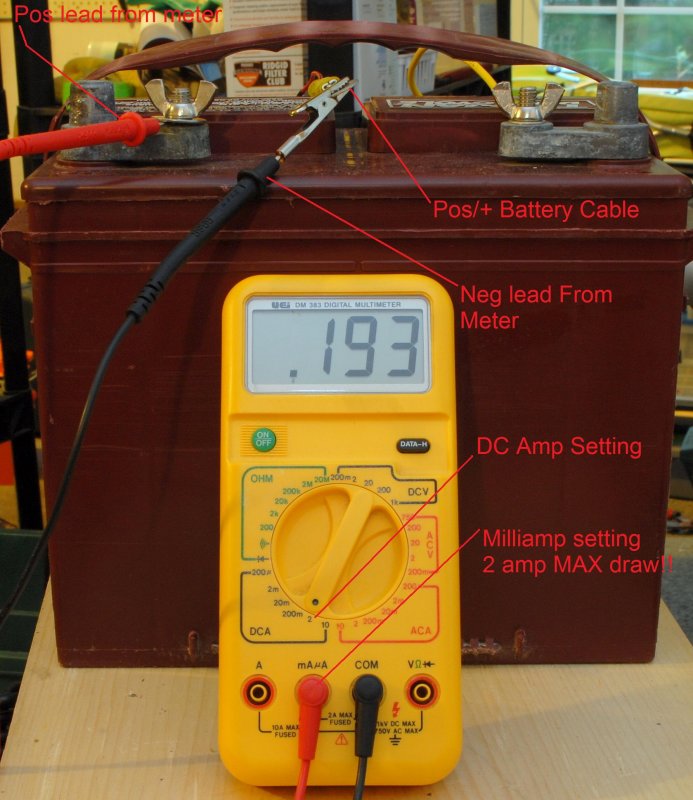
Once you've connected the positive lead from the multi-meter to the positive battery post, and the negative wire from the meter to the battery cable, set your meter to read milliamps and plug your cables into the appropriate sockets on the meter.
Once you flip on the meter it will either read .000, meaning you have no parasitic load, or a current flow such as the one pictured below.
Please note that I set this up in my garage and used a Sensibulb as my current draw hence the teeny tiny wire I labeled "battery cable". Your battery cable would be considerably larger..
Of course, like anything, there are more ways than this to achieve the same outcome but I find this to be the easiest and one of the fastest. A clamp meter that does DC amps/millivolt would actually be easier but they tend to hunt beyond .01 and can be tough to zero out beyond .1. I chose not to use my clamp meter for this because I know most sailors don't own a DC clamp meter..




 because If you blew the 10 amp fuse you have a big draw


