

Before winter came on strong I removed all the teak & holly ply from my cabin sole to make repairs and refinish. For the past 6 seasons I've looked at the glossy finish and always thought it was good enough to leave alone. But I've never been completely satisfied with the small areas of water stains that darkened the veneer underneath the varnish. In particular, the small area in the v-berth had the worst of it. So I pulled out a panel and the damaged laminate I found underneath the veneer convinced me to remove all the flooring. I wasn't sure if the damaged panel indicated that I could repair the damage that I find or if I would need to replace all of it. I could not believe how much grime accumulates around the edges of the floor pan that you can't see until the laminate is removed!
After removing all the flooring, I determined that it was possible to repair all the damaged areas because the teak & holly veneer was in relatively good shape (for a 27 year-old floor) and the damage to the laminate underside was repairable. And, I was certainly glad that I did it this winter because I think that it would have been relatively soon that the flooring may have been beyond repair. Basically, I glued and clamped the small areas of damage and then sealed the underside and edges with white epoxy undercoat paint. That part of the project was tedious but easily accomplished.
I thought that removing the varnish was going to be extremely difficult and I was very uncertain about the results until I got into it. With a heat gun and very sharp wood chisel, I found that scraping the varnish off was very satisfying. At first, I was afraid of overheating the varnish and burning the wood. I soon found that small areas of about 4" x 6" could easily be heated until the varnish bubbles and the chisel scraped all of it off cleanly. I did notice that the varnish came off more easily over the teak, but it adhered a bit more strongly to the holly strips. I had to be more careful with the holly.
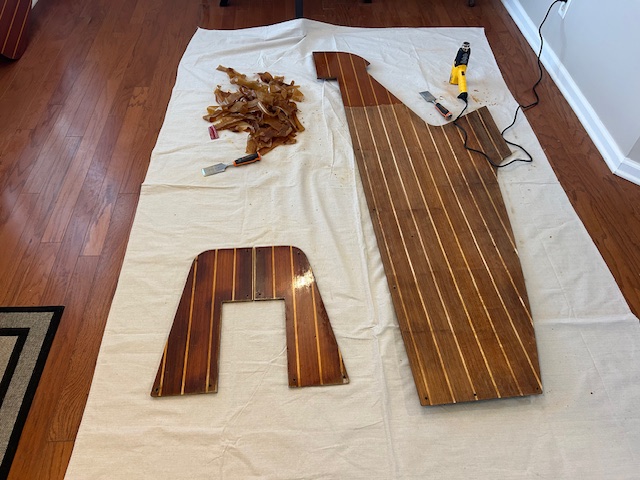
This shows the main flooring with most of the varnish removed and the v-berth panels before removing varnish. The water stains are more visible at the middle seam and around the edges where water penetrates and is trapped in the floor pan. The pile of varnish strips shows how it comes off with the chisel.
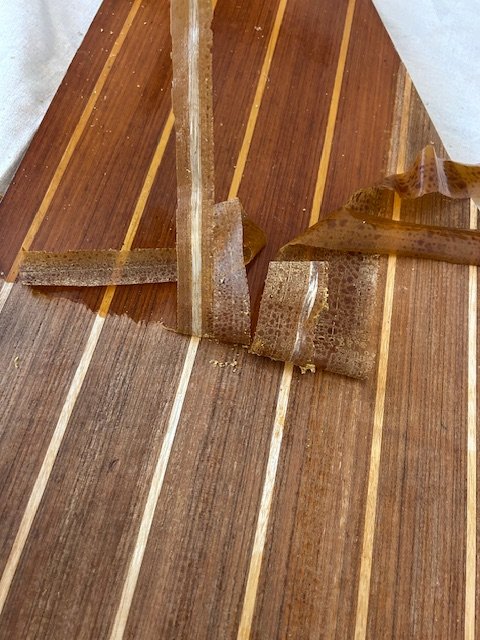
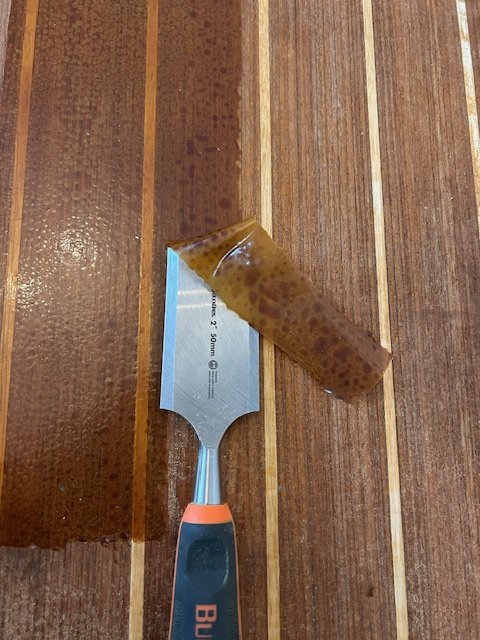
This shows how the varnish bubbles & how easily the chisel separates the varnish from the wood.
Next post, I'll show the flooring with all varnish removed.
After removing all the flooring, I determined that it was possible to repair all the damaged areas because the teak & holly veneer was in relatively good shape (for a 27 year-old floor) and the damage to the laminate underside was repairable. And, I was certainly glad that I did it this winter because I think that it would have been relatively soon that the flooring may have been beyond repair. Basically, I glued and clamped the small areas of damage and then sealed the underside and edges with white epoxy undercoat paint. That part of the project was tedious but easily accomplished.
I thought that removing the varnish was going to be extremely difficult and I was very uncertain about the results until I got into it. With a heat gun and very sharp wood chisel, I found that scraping the varnish off was very satisfying. At first, I was afraid of overheating the varnish and burning the wood. I soon found that small areas of about 4" x 6" could easily be heated until the varnish bubbles and the chisel scraped all of it off cleanly. I did notice that the varnish came off more easily over the teak, but it adhered a bit more strongly to the holly strips. I had to be more careful with the holly.
This shows the main flooring with most of the varnish removed and the v-berth panels before removing varnish. The water stains are more visible at the middle seam and around the edges where water penetrates and is trapped in the floor pan. The pile of varnish strips shows how it comes off with the chisel.
This shows how the varnish bubbles & how easily the chisel separates the varnish from the wood.
Next post, I'll show the flooring with all varnish removed.


 " .
" .


