Cabin sole repair - teak & holly ply

Oct 26, 2008
6,432
Catalina 320 Barnegat, NJ
Before winter came on strong I removed all the teak & holly ply from my cabin sole to make repairs and refinish. For the past 6 seasons I've looked at the glossy finish and always thought it was good enough to leave alone. But I've never been completely satisfied with the small areas of water stains that darkened the veneer underneath the varnish. In particular, the small area in the v-berth had the worst of it. So I pulled out a panel and the damaged laminate I found underneath the veneer convinced me to remove all the flooring. I wasn't sure if the damaged panel indicated that I could repair the damage that I find or if I would need to replace all of it. I could not believe how much grime accumulates around the edges of the floor pan that you can't see until the laminate is removed!

After removing all the flooring, I determined that it was possible to repair all the damaged areas because the teak & holly veneer was in relatively good shape (for a 27 year-old floor) and the damage to the laminate underside was repairable. And, I was certainly glad that I did it this winter because I think that it would have been relatively soon that the flooring may have been beyond repair. Basically, I glued and clamped the small areas of damage and then sealed the underside and edges with white epoxy undercoat paint. That part of the project was tedious but easily accomplished.

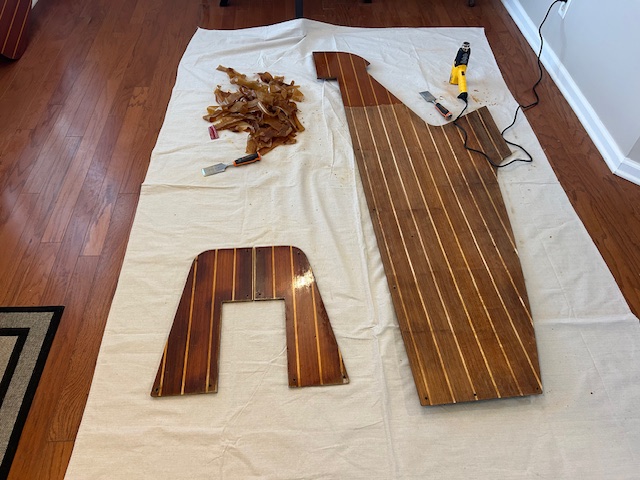
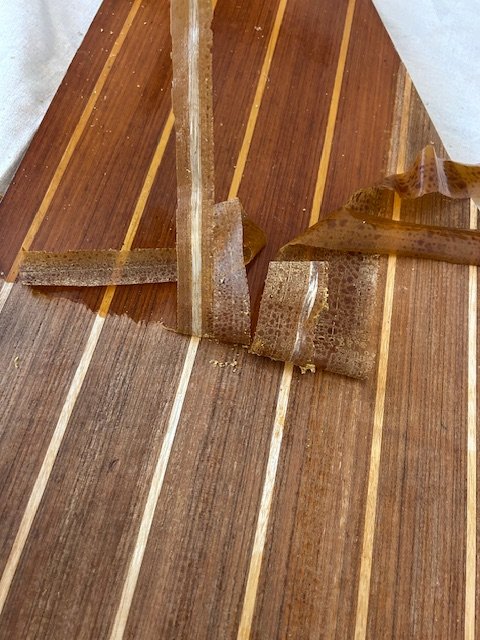
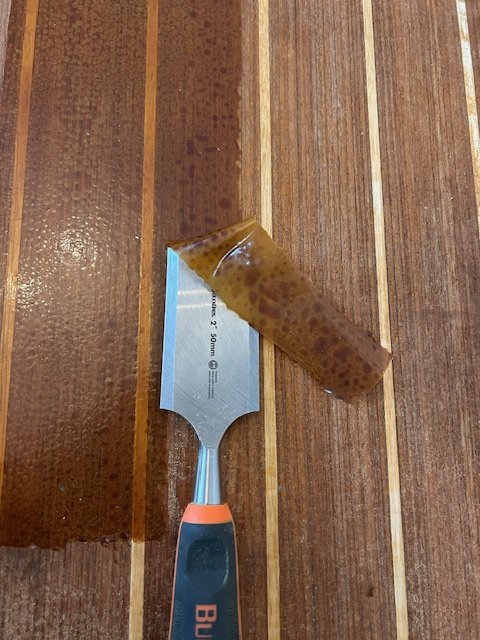
I thought that removing the varnish was going to be extremely difficult and I was very uncertain about the results until I got into it. With a heat gun and very sharp wood chisel, I found that scraping the varnish off was very satisfying. At first, I was afraid of overheating the varnish and burning the wood. I soon found that small areas of about 4" x 6" could easily be heated until the varnish bubbles and the chisel scraped all of it off cleanly. I did notice that the varnish came off more easily over the teak, but it adhered a bit more strongly to the holly strips. I had to be more careful with the holly.
IMG_4773.jpeg

This shows the main flooring with most of the varnish removed and the v-berth panels before removing varnish. The water stains are more visible at the middle seam and around the edges where water penetrates and is trapped in the floor pan. The pile of varnish strips shows how it comes off with the chisel.
IMG_4772.jpeg


IMG_4771.jpeg

This shows how the varnish bubbles & how easily the chisel separates the varnish from the wood.

Next post, I'll show the flooring with all varnish removed.
 
Oct 26, 2008
6,432
Catalina 320 Barnegat, NJ
IMG_4792.jpeg
IMG_4793.jpeg


One reason I did not want to replace the flooring was because the thickness of the flooring is just about 3/8" while the bilge covers are all 3/4". The bilge covers are all in good shape and I did not want to replace them just to match new flooring around the perimeter.

These photos follow light sanding and cleaning with acetone, which really highlights the pigment differences due to staining. My next step is to treat the entire surface with oxalic acid to bleach the veneer to a more even appearance. I'm going to do this today.

I plan to finish with 3 coats of clear epoxy followed by 3 coats of 1-part varnish (gloss). I am buying products from Total Boat. The theory is that the epoxy protects and builds up so that up to 12 coats of varnish is unnecessary. Any thoughts about that? I've heard that varnish over epoxy can be tricky and maybe not very satisfactory. I also fear that putting epoxy down eliminates any possibility of re-finishing in the future. But I figure there isn't any chance of that in my lifetime anyway.
 
Jan 11, 2014
13,952
Sabre 362 113 Fair Haven, NY
If you make sure all the amine blush is washed off and the epoxy surface is sanded, applying varnish should not be an issue. The bigger question is why go to the expense of using epoxy? I don't think it will give you much if any benefit.

Twelve coats of varnish would be overkill. Five or six would do fine. I've been using TotalBoat's Halcyon varnish, it seems pretty tough and wears well. It is a water based finish with very low VOCs and a very quick drying time. 4-5 coats can be applied in one day. I'm sure Sue would appreciate her home not smelling like varnish and mineral spirits while you complete this job.
 

jssailem

SBO Weather and Forecasting Forum Jim & John
Oct 22, 2014
24,455
CAL 35 Cruiser #21 moored EVERETT WA
I would get a small amount and try some tests. TB will say it works. Testing will see if it is satisfactory to you.

Testing is a minimal expense to avoid a long-term "Damn, why did that not work?:facepalm:" .
 
  • Like
Likes: Scott T-Bird
Jan 4, 2006
7,579
Hunter 310 West Vancouver, B.C.
I've heard that varnish over epoxy can be tricky and maybe not very satisfactory.
I can only speak for System Three, Silver Tip Epoxy when applying varnish over epoxy. I let it set for about a month in a warm area before varnishing. I sanded the surface of the epoxy with#220 just because it had a mirror finish and I needed a rougher surface for grip. Not a trace of a problem in either application or waiting for varnish to dry.

1772124344729.jpeg


If I had the opportunity to do my floor today with what I know now, I would apply a fine FG cloth with the first layer of epoxy and then two more coats of epoxy. That's how I did the stairs and they are now ~15 years old and still look like new. NOTE FG cloth in epoxy becomes 100% invisible. Unlike cloth in resin.

1772124472154.jpeg


No cloth on the seats but they still look good after many years.
 
May 17, 2004
6,113
Beneteau Oceanis 37 Havre de Grace
I plan to finish with 3 coats of clear epoxy followed by 3 coats of 1-part varnish (gloss). I am buying products from Total Boat. The theory is that the epoxy protects and builds up so that up to 12 coats of varnish is unnecessary. Any thoughts about that? I've heard that varnish over epoxy can be tricky and maybe not very satisfactory. I also fear that putting epoxy down eliminates any possibility of re-finishing in the future. But I figure there isn't any chance of that in my lifetime anyway.
We did varnish over epoxy on a teak cockpit table a few years ago. It worked out just fine and has held up well. We used West Systems clear hardener, and I think Epifanes varnish over that. The only part that needed special care was avoiding air bubbles in the epoxy.
1772125267973.jpeg
 
Jan 4, 2006
7,579
Hunter 310 West Vancouver, B.C.
The bigger question is why go to the expense of using epoxy? I don't think it will give you much if any benefit.
Meh ............... I don't know if I can entirely agree with that :confused: .

I've found my steps are wearing like cast iron with the FG cloth and epoxy uinder the varnish. No signs of wear after many years of use and abuse. All the varnish needs is a non porous, rock hard underlay and it seems to wear forever. And of course no dents every time a crewer drop his/her false teeth on the floor.
 
  • Ha
Likes: jssailem
Jan 11, 2014
13,952
Sabre 362 113 Fair Haven, NY
Meh ............... I don't know if I can entirely agree with that :confused: .

I've found my steps are wearing like cast iron with the FG cloth and epoxy uinder the varnish. No signs of wear after many years of use and abuse. All the varnish needs is a non porous, rock hard underlay and it seems to wear forever. And of course no dents every time a crewer drop his/her false teeth on the floor.
My wooden boat friends would cry "Blasphemy!" and off to the pillories you would be taken.

The downside of varnish over epoxy on exterior wood is getting a chip in the varnish which allows UV to attack the underlying epoxy. The epoxy will become foggy and sometimes yellowish where it is exposed. Removing the damaged epoxy is not as easy as removing old varnish. This is, of course, less of a problem with interior wood which is not as exposed to UV. For small high traffic areas like steps, it may be worthwhile and does not add a lot of expense or effort. For large lower traffic areas, I'm not seeing the value of spending upwards of $100 or more on the epoxy and the extra time and effort.

There is no harm in varnish over epoxy, except as noted above, it's your boat, your choice.
 
Jan 4, 2006
7,579
Hunter 310 West Vancouver, B.C.
For large lower traffic areas, I'm not seeing the value of spending upwards of $100 or more on the epoxy and the extra time and effort.
Floors are high traffic areas. I would do them with FG cloth and epoxy in a heartbeat if I could turn back the clock.

My wooden boat friends would cry "Blasphemy!" and off to the pillories you would be taken.
They sound like a fun group .

1772138863284.png

I'd trade that for going down into my lazarette to get a picture of my Espar heater any day, which I'm told is tomorrow :facepalm: .
 
Oct 26, 2008
6,432
Catalina 320 Barnegat, NJ
If I had the opportunity to do my floor today with what I know now, I would apply a fine FG cloth with the first layer of epoxy and then two more coats of epoxy. That's how I did the stairs and they are now ~15 years old and still look like new. NOTE FG cloth in epoxy becomes 100% invisible. Unlike cloth in resin.
Your woodwork puts me to shame for sure. My flooring has a few chips and scars and the oxalic treatment that I did today didn't make as dramatic a difference as I hoped regarding the stains. But it does generally look a lot fresher now. The previous owners did a lot of cruising for 20 years with my boat and the evidence suggests there was a "put away wet" tradition that left some areas looking a bit rough. The sole was nicely varnished on the surface but there was enough abuse that I'm not going to be ashamed of a sole that looks like it has a "lived on" appearance.

I have purchased the epoxy and varnish and it arrived today so my plan stays the same. I'm using the Total Boat Clear High Performance and the Halcyon varnish. I don't think I'm going to consider the FG cloth because I don't quite have the confidence to try it without doing it on a simpler project at first. I also have a bit of a time constraint. We don't have a workshop at home and I'm using a vacant apartment that I need to rent in April (or Sue will be coming after me). I've got to clean it up to show in the next few weeks or I'm in trouble! Some of my time has been going into improvements in the apartment. I can't leave it cure for a month but I can probably get away with 10 days.

You remind me that my companionway steps need the treatment as well. I remember you posting about it but can't recall how you created that stippled surface on the tread for anti-slip.
 
Oct 26, 2008
6,432
Catalina 320 Barnegat, NJ
I did use clear epoxy on some trim that I installed in the galley and the result was fantastic in my eyes. That pretty much sold me on using epoxy for the base layers.
 
  • Like
Likes: Timm R Oday25
Jan 4, 2006
7,579
Hunter 310 West Vancouver, B.C.
I remember you posting about it but can't recall how you created that stippled surface on the tread for anti-slip.
It was easy back when I did it but I'm afraid we live in a different world now. In a word the difference is "oil based aerosol varnish." I believe it is now in the same classification as fentanyl. I don't think you'll find it. Got a spray booth in the apartment for spraying a little regular varnish ? C'mon, what could go wrong ?

After I had brushed on about two coats of regular varnish and the top coat was fairly dry, I masked off the step with a strip of masking tape around the area to receive finely crushed quartz (if you can follow that disjointed procedure).

The clean area was then sprayed with aerosol varnish (acts like glue) immediately followed by several shakes of crushed quartz until the area looks as even as it's going to get. Give the work of art a while for the varnish to become sticky and then ................. a light spray of varnish again to cement all of the quartz particles firmly in place. If you had used a brush, it would have wiped away much of the loose quartz particles. Get the masking tape off before the sprayed varnish dries too much. Let the sprayed varnish dry until tacky and then apply a last good coat of your brush on varnish which is probably superior to the spray on stuff.

I don't know how you are about sanding between coats but I take the lazy way and shoot for putting new varnish on a green previous coat just to get a chemical bond. Never had any peeling problems, knock on wood.
 
  • Like
Likes: Timm R Oday25
May 29, 2018
661
Canel 25 foot Shiogama, japan
Besides "finely crushed quartz" (sand?) what else is recommended for a relatively non slip floor?
Relatively meaning , not painful.

gary
 

jssailem

SBO Weather and Forecasting Forum Jim & John
Oct 22, 2014
24,455
CAL 35 Cruiser #21 moored EVERETT WA
I have heard good things about Soft Sand. That is on my list for when I paint my non-skid.
 
Sep 24, 2018
4,448
Catalina 30 MKIII Chicago
You know that template might work better to cut the beautiful wood below it if you remove the canvas:biggrin:
 
Dec 4, 2023
160
Hunter 44 Portsmouth
Hre
Did I mention that Silvertip settles to a plate glass surface. Whip a propane torch ABOVE it when wet and you've got a 100% bubble free surface.

Read all about it ! ! !
Great tips, Ralph. Do you have any experience to contrast West System with S3 in this kind of application?