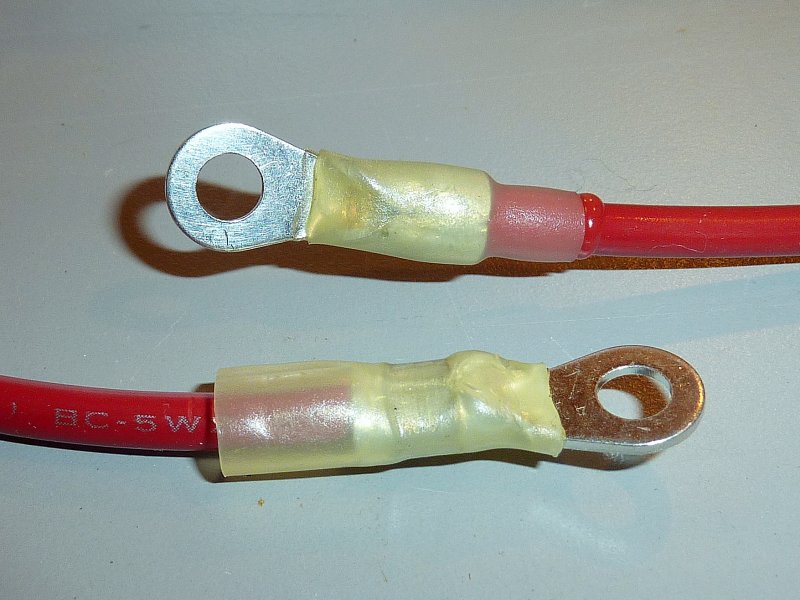
Braided 12v copper wire

Status
Not open for further replies.

Scott

.
Sep 24, 1997
242
Hunter 31_83-87 Middle River, Md
Need to make a good conection for a temporary repair on 12v 16-18 gauge braided copper wire. Cut the wire and stripped 1-inch for new connection. Wire still oxidized after stripping and cannot get a good solder connection. I know that the wiring should be replaced, but I can't do it right now. Is there a flux or chemical that will remove the oxidation to ensure an adequate soldered temporary fix?
 

Ross

.
Jun 15, 2004
14,693
Islander/Wayfairer 30 sail number 25 Perryville,Md.
You can scrape it gently with your knife, you can try lemon juice, you could try plumbers copper pipe flux although I don't recommend it. if the wire were tinned to start with it should solder with a bit of cleaning. It isn't often that we solder connections on a boat. There is a good reason to not use a crimp connection?
 
Feb 2, 2006
470
Hunter Legend 35 Kingston
While you DO still want to have clean (non-corroded) wires to connect together, the consensus is that you should not use solder on a boat. A properly crimped and then heat shrinked (glued lined) connections should be the solution of choice. Soldered connections can fail if overheated, and they often make the wire stiffer beyond the joint, and that can lead to premature failure too.

ABYC says:

ABYC standards (E-11.16.3.7), “Solder shall not be the sole means of mechanical connection in any circuit”.

Chris
 
Jan 22, 2008
8,050
Beneteau 323 Annapolis MD
, the consensus is that you should not use solder on a boat.

ABYC says: ABYC standards (E-11.16.3.7), “Solder shall not be the sole means of mechanical connection in any circuit”. Chris
Your consensus, maybe. Chris, you might re-rad your own post.:doh:
 
Mar 26, 2011
3,968
Corsair F-24 MK I Deale, MD
What Ross said....

In dry locations there is nothing wrong with copper stranded wire. Meets code. However, in damp locations surface corrosion, which wicks up the wire, is a bugger when repairs are due. The primary advantage of tinned wire is repairability in damp locations, which you have learned. There is no reason to replace all of the wire; only wire that is corroded or substandard (extension cord wire).

Yup, until replacement comes, fan the strands, clean with a fine wire brush, coat with waterproof grease (don't worrry--the crimper will push it out), and crimp with a ratchet crimper (very important--not the simple pliers model). The value of the grease is not in the crimp but in reducing the wicking of salt up the wire. Water proof seals work to, but ONLY if they are aplied after crimping. My expereince with the all-in-one crimp conectors is that the crimper pressure too often breaks the seal.

I only solder smaller than #16.
 
Feb 2, 2006
470
Hunter Legend 35 Kingston
Did I say something inconsistent?

crimping + heatshrink = good (ABYC compliant)
crimping + solder + heatshrink = possibly less good, maybe arguable (ABYC compliant)
soldering + heatshrink = least good (NOT ABYC compliant)

ABYC=solder alone is not allowed (in order to be ABYC compliant)

Your consensus, maybe. Chris, you might re-rad your own post.:doh:
 

Scott

.
Sep 24, 1997
242
Hunter 31_83-87 Middle River, Md
Thanks for all the feedback. The wire is in the bilge to the pump, well above the float switch. I fully intended to use heat shrink regardless of method of making connection. Thanks again.
 

LloydB

.
Jan 15, 2006
927
Macgregor 22 Silverton
clean the wire as best you can then use a wire nut (orange) - or did you mean permanently temporary?
 

Ross

.
Jun 15, 2004
14,693
Islander/Wayfairer 30 sail number 25 Perryville,Md.
A soldered western union splice will never fail as an electrical connection. Any connection should be mechanically sound before soldering.
 
Feb 6, 1998
11,760
Canadian Sailcraft 36T Casco Bay, ME
A soldered western union splice will never fail as an electrical connection. Any connection should be mechanically sound before soldering.
WU splices are intended for solid wire not the finely stranded wire we use on boats. No form of wire to wire splicing meets the ABYC definition of mechanical..
 
Jan 19, 2010
12,947
Hobie 16 & Rhodes 22 Skeeter Charleston
Anti Hijack: Another Question about 12V wire

I have a philosophical question about 12V wire on a boat and I didn't want to hijack the other thread on 12V wire so I started a new thread.


So here is my question. If you have a trailer sailboat that does not spend most of its time in the water (i.e. it is not in constant motion) is the use of tinned, braided wire overkill?

:stirthepot:

I've rewired 4 boats now and each time I did so, I tried to use the best practices. I got the good wire, used terminal connectors, shrink wrap etc. But is this a case of there being three options....


1) good enough,
2) better and
3) best

And we often opt for best when good enough is .... well.....good enough?

I know the DIY snobs are cringing right now but follow me for just a moment.

If I were to use solid wire (I didn't) and support it every few inches (I always do), how much motion would the wires actually experience?... for a trailer sailor/day sailor with a boat that sits on a trailer all but 20 to 30 days out of the year... the wires would experience the equivalent of one month of motion per year... how long would it take for the motion of the waves to break one of those wires... I'm thinking not in the life time of the boat. Even if you want to throw in the motion of trailering the boat.... there would not be enough motion to break those wires. So if we take breaking the wire out of the equation we are down to corrosion as an issue...(tinning and wicking). A solid wire would have a lot less surface area = less wicking... so can we assume a slower rate of corrosion (am I thinking about this correctly?). And on top of that, we are back to that 20 or 30 days/year exposure issue so less corrosion overall....


I'm not trying to make an argument for doing a sloppy job. I ceratianly see why a boat that sits in a slip has a lot more to contend with that one that sits on a trailer in a garage most of its life. I'm just wondering if there aren't times when we engage in overkill on our DIY boat projects. I'm thinking of the low budget day sailor who picks up a $1000 boat on Craig's List and wants to rewire the navigation lights. Cheap solid wire with good waterproof connections would seem to make sense in a situation like that. Why spend a $100 when $30 will do the job?

Sacrilege? .. let the @ss kicking begin :)
 
Oct 2, 2006
1,517
Jboat J24 commack
Because a 100' roll of the right wire from a place like GenuineDealz is about 45 dollars ?
 
Mar 26, 2011
3,968
Corsair F-24 MK I Deale, MD
I have a philosophical question about 12V wire on a boat and I didn't want to hijack the other thread on 12V wire so I started a new thread.


So here is my question. If you have a trailer sailboat that does not spend most of its time in the water (i.e. it is not in constant motion) is the use of tinned, braided wire overkill?

:stirthepot:

I've rewired 4 boats now and each time I did so, I tried to use the best practices. I got the good wire, used terminal connectors, shrink wrap etc. But is this a case of there being three options....


1) good enough,
2) better and
3) best

And we often opt for best when good enough is .... well.....good enough?

I know the DIY snobs are cringing right now but follow me for just a moment.

If I were to use solid wire (I didn't) and support it every few inches (I always do), how much motion would the wires actually experience?... for a trailer sailor/day sailor with a boat that sits on a trailer all but 20 to 30 days out of the year... the wires would experience the equivalent of one month of motion per year... how long would it take for the motion of the waves to break one of those wires... I'm thinking not in the life time of the boat. Even if you want to throw in the motion of trailering the boat.... there would not be enough motion to break those wires. So if we take breaking the wire out of the equation we are down to corrosion as an issue...(tinning and wicking). A solid wire would have a lot less surface area = less wicking... so can we assume a slower rate of corrosion (am I thinking about this correctly?). And on top of that, we are back to that 20 or 30 days/year exposure issue so less corrosion overall....


I'm not trying to make an argument for doing a sloppy job. I ceratianly see why a boat that sits in a slip has a lot more to contend with that one that sits on a trailer in a garage most of its life. I'm just wondering if there aren't times when we engage in overkill on our DIY boat projects. I'm thinking of the low budget day sailor who picks up a $1000 boat on Craig's List and wants to rewire the navigation lights. Cheap solid wire with good waterproof connections would seem to make sense in a situation like that. Why spend a $100 when $30 will do the job?

Sacrilege? .. let the @ss kicking begin :)

I do not consider myself a DIY snob, but I can tell you this:


  1. Solid wire will fail any pre-sale or insurance inspection. It might even invalidate a fire claim.
  2. Solid wire cannot be terminated in compliance; crimps don't work.
  3. No wire nuts. See item 1.
  4. THHN wire (machine wire, sold at Home Depot off spools) does comply with Coast Guard standards (except on the motor--use auto wire there, which is more vibration resistant, and is also compliant) and is much easier to work with. Just grease the ends and it should work for freshwater and trailer-sailing. Corrosion isn't bad.
  5. No extension cord. Though it might work for a while, the insulation is too permeable to water and the strands turn black in no time. See also item 1.
If you're trying to save some $$$ in a non-saltwater application, go with THHN and crimps from HD, but get a ratchet crimper. It will be compliant, durable, safe, look good when you sell, and is cheap enough.
 
Jan 19, 2010
12,947
Hobie 16 & Rhodes 22 Skeeter Charleston
  1. Solid wire will fail any pre-sale or insurance inspection. It might even invalidate a fire claim.
Good point...that was not part of my calculus.

Well I'm not trying to save a bucket of money per say... it is just a philosophical question.... These threads often run to the extreme in short order (start a new PDF thread and see what happens :naughty:) and I was wondering if the anxt we put on wiring might be another example.
 
Sep 28, 2008
922
Canadian Sailcraft CS27 Victoria B.C.
If I were to use solid wire (I didn't) and support it every few inches (I always do), how much motion would the wires actually experience?... for a trailer sailor/day sailor with a boat that sits on a trailer all but 20 to 30 days out of the year... the wires would experience the equivalent of one month of motion per year... how long would it take for the motion of the waves to break one of those wires... I'm thinking not in the life time of the boat. Even if you want to throw in the motion of trailering the boat.... there would not be enough motion to break those wires. So if we take breaking the wire out of the equation we are down to corrosion as an issue...(tinning and wicking). A solid wire would have a lot less surface area = less wicking... so can we assume a slower rate of corrosion (am I thinking about this correctly?). And on top of that, we are back to that 20 or 30 days/year exposure issue so less corrosion overall....

Cheap solid wire with good waterproof connections would seem to make sense in a situation like that. Why spend a $100 when $30 will do the job?
Any marine panel I have seen is not designed for solid wire but for eye terminals.

Any light or other item like a vhf for a boat has a stranded wire - how do you join that to solid wire?

A while ago I replaced a solid wire on the inverter output on a boat - 2 of the 3 crimps fell off in my hands - you cannot crimp solid wire.

If you want to use wire that is not tinned to save a few bucks and then seal it properly with heat shrink you can - but it is only a few bucks anyway. Solid wire has no place on a boat.
 
Jan 19, 2010
12,947
Hobie 16 & Rhodes 22 Skeeter Charleston
Any marine panel I have seen is not designed for solid wire but for eye terminals.

Any light or other item like a vhf for a boat has a stranded wire - how do you join that to solid wire?

A while ago I replaced a solid wire on the inverter output on a boat - 2 of the 3 crimps fell off in my hands - you cannot crimp solid wire.

If you want to use wire that is not tinned to save a few bucks and then seal it properly with heat shrink you can - but it is only a few bucks anyway. Solid wire has no place on a boat.
Well I guess that one is settled.:)

Thanks guys....
 

RAD

.
Jun 3, 2004
2,330
Catalina 30 Bay Shore, N.Y.
clean the wire as best you can then use a wire nut (orange) - or did you mean permanently temporary?
Although wire nuts have no place on a boat I do keep a few in the parts box for emergency's and a corroded wire in the bilge would be a perfect quick fix for a wire nut till new wires got installed
I'm an electrician so wire nuts and electric tape are always coming out of my pockets at home or on the boat
 
Feb 6, 1998
11,760
Canadian Sailcraft 36T Casco Bay, ME
Water proof seals work to, but ONLY if they are aplied after crimping. My expereince with the all-in-one crimp conectors is that the crimper pressure too often breaks the seal.

I only solder smaller than #16.
PDQ,

If that is happening it is likely one of two things.

A) Wrong crimp tool

B) Cheap quality heat shrink crimps

I install thousands of these per year and use them almost exclusively. If I had to put a number on it about 90%+ of the crimps I install are factory made heat shrink crimps. I just installed close to 30 of them today alone.

I have not had a ripped one in over a year and the last time I did it was my own fault, not paying close enough attention and inserted the crimp connector into my crimper incorrectly. I use FTZ polyolefin heat shrink crimps sold as Crimp-n-Seal. I find the Ancor brand to be fairly pathetic and not at all consistent..

Phil here at Sailboatowners.com sells the FTZ crimps but I may have bought him out of some sizes just yesterday when I ordered close to $400.00 worth....

His prices are excellent for a top quality connector:

FTZ Rings

FTZ Butt Splices

They crimp & shrink beautifully..

 
Status
Not open for further replies.