K. Please help me from getting "buyers remorse". I just bought a 1994 H26 she seems to be in great shape and the hull looks like new. Please tell me I made the right decision. I currently sail a 22 Capri, but really need the room for the grand kids.

Bought a H26
- Thread starter Willemvan
- Start date

I too am waiting to take delivery of a '96 Hunter 26 and recently sold my '79 Mac/Venture 25. Once the snow melts I will pick it up. I have not seen any posts of previous or current Hunter 26/260 owners who dislike their boats. Water ballast will be new to me so we'll see how that turns out.

Grandchildren is one of the many reasons we bought our '99 H260. They haven't sailed with us yet but we're tickled pink ( actually I'm tickled green) with our purchase. Get out there and sail it. I have a feeling you'll forget you ever had buyers remorse. And welcome to the club!
Teebutch;
Drain all the old gas from engine and gas container. Either buy the straight gas or if only ethanol is available, put the additives in to combat that corn crap known as ethanol. It really fouls up the fine jets in the carb. Therefore, let your gas run out everytime you stop an engine for overnight or longer. You will probably have to take the carb off, take it apart and clean it out. I used 2 plus 2 carb cleaner and would start after that. Remember this that oil over time coagulates no matter what if straight or not but a lot faster due to ethanol. I will never forget the first engine without additive years ago not starting when delivering a boat. I learned very quickly and so did the customer. Some would have fainted but the customer appreciated learning from me too while I was learning also.
crazy dave.
For those with questions on either the 26 or 260 feel free to contact me any time with questions. If with photos, provide a telephone number and where you are located. Once I called CA at 8 a.m. Est and the Mrs. was not a happy camper with me.
Drain all the old gas from engine and gas container. Either buy the straight gas or if only ethanol is available, put the additives in to combat that corn crap known as ethanol. It really fouls up the fine jets in the carb. Therefore, let your gas run out everytime you stop an engine for overnight or longer. You will probably have to take the carb off, take it apart and clean it out. I used 2 plus 2 carb cleaner and would start after that. Remember this that oil over time coagulates no matter what if straight or not but a lot faster due to ethanol. I will never forget the first engine without additive years ago not starting when delivering a boat. I learned very quickly and so did the customer. Some would have fainted but the customer appreciated learning from me too while I was learning also.
crazy dave.
For those with questions on either the 26 or 260 feel free to contact me any time with questions. If with photos, provide a telephone number and where you are located. Once I called CA at 8 a.m. Est and the Mrs. was not a happy camper with me.

H26 are great boats. No need for buyers remorse. I had 1996 H26 for 4 years. We loved the boat. Sometimes I miss having a tiller. At anchor, with the tiller tied off to starboard the cockpit is huge!! These boats also came with an ingenious cockpit table. You can orient the table leg in 4 different positions to suit your needs. I did several mods as have many others here. Check the archives. As to the performance of the boat, she is tender. I'm sure you are used to that with the Capri 22. Just tie a reef in early (15 knts.) and have fun. Ours would quickly heel to 15-20 degrees and sail quite well at that angle. One last thing, don't forget to re-cork the ballast tank vent after filling it. Don't ask me why.  It only took a day to dry out my side of the mattress.
It only took a day to dry out my side of the mattress.We bought a '98 H26 new at the time. Still have it. Have owned other boats since. But I wouldn't sell my 26 for anything. Not just because of the additions I've put in. But I have never seen a boat of that size (trailerable) with the amenities it provides. If you look at the photos of the projects I've done you can see the additions you can do. Or, just go have fun with the way it is. As stated in earlier posts, rule number one, reef early and all will be well.

I went from a Catalina 22 to a H260. The Hunter has fewer sail controls and I went through a learning curve to get to where I was happy sailing the H260. Basically, I needed to relax and not try to constantly trim for conditions.
Think of it as a fun, famly safe, boat and you will enjoy it. Try to turn it into a performance racer and you could be frustrated.
Think of it as a fun, famly safe, boat and you will enjoy it. Try to turn it into a performance racer and you could be frustrated.
Dave;
With time for anyone, the 26/260 can be competitively raced and trust me I did so along with the rest of the water ballast boats and won. One key is never to heel over 14 degrees as the boat sails faster, flatter.
crazy dave condon
With time for anyone, the 26/260 can be competitively raced and trust me I did so along with the rest of the water ballast boats and won. One key is never to heel over 14 degrees as the boat sails faster, flatter.
crazy dave condon

After all that said; I am glad to have one of those too...
Dave, do you really mean to aim of not more than 14 degree of heeling?
Hart
Dave, do you really mean to aim of not more than 14 degree of heeling?
Hart

We owned our 97 H26 W/B for 5 years, and absolutely loved it. Great boats! As others have said, HUGE cockpit, reef early, She's very forgiving, and loves light air. She also will sail JUST FINE on main alone for knocking around, but can be a very sporty boat. Enjoy the boat. You've made a good choice!
Many references to H26/260 being "tender". Is there a technical specification for this attribute? I suspect that it is very relative I.e. Very tender when compared to a full keel boat but maybe not so tender when compared to a centreboard dinghy. Being a "swing keel" boat, My Mac/Venture 25 is some where between a keelboat and centreboard dinghy. I look forward to experiencing how they compare and will report my experience.
If you just compare 26' class C sailboats, the ones with water ballast do feel tender. That's because the weight is carried higher that a boat with the ballast low in the keel.
After all the panic a gust of wind can cause this 'tender' Hunter, the boat is designed safe. It is very difficult to knock one down, even when trying. Truly remarkable for a boat that is road legal on the trailer and leaves a nice chunk of the weight on the launch ramp.
After all the panic a gust of wind can cause this 'tender' Hunter, the boat is designed safe. It is very difficult to knock one down, even when trying. Truly remarkable for a boat that is road legal on the trailer and leaves a nice chunk of the weight on the launch ramp.

My wife and I sold our 94 Mac and went through a grieving period wondering if we did the right thing - as not only did we not have a sailboat, the season was on its way and we needed to find a more quality, comfortable replacement.
Purchased 2001 H260 Wandr'in Star for significantly more of an investment than the value of our Mac - already love the space, comfort and upgrades thanks to the previous owners (x2) who obviously loved the boat (some on this forum may know of this boat) and spent hours vested to make her more than she was. After sorting out an issue with the am/fm radio and some wiring; sitting listening to music in the cockpit at -20 Celsius having a bevy and imagining being on the water, we anticipate the big thaw so we can launch and take her out. Likely will be another 3 weeks or so unless we trailer to Vancouver Island 5 hours south and sail there... I have no doubts we made the right purchase - even contemplating signing on at a yacht club and upgrading to a larger sailboat I don't think we will let this H260 go... Given not only the quality relative to size it's the ability to have your cake and eat it too with the flexibility to pull out and launch where you desire even if you aren't retired and only have a weekend to spare. The options and vistas are endless.
Purchased 2001 H260 Wandr'in Star for significantly more of an investment than the value of our Mac - already love the space, comfort and upgrades thanks to the previous owners (x2) who obviously loved the boat (some on this forum may know of this boat) and spent hours vested to make her more than she was. After sorting out an issue with the am/fm radio and some wiring; sitting listening to music in the cockpit at -20 Celsius having a bevy and imagining being on the water, we anticipate the big thaw so we can launch and take her out. Likely will be another 3 weeks or so unless we trailer to Vancouver Island 5 hours south and sail there... I have no doubts we made the right purchase - even contemplating signing on at a yacht club and upgrading to a larger sailboat I don't think we will let this H260 go... Given not only the quality relative to size it's the ability to have your cake and eat it too with the flexibility to pull out and launch where you desire even if you aren't retired and only have a weekend to spare. The options and vistas are endless.
Most do not realize what or how deeply involved with the 26/260 I was and the amount of hours spent not only selling them, working on them, sailing and so on, I learned from an experienced friend of mine who competively raced in Europe and the Med winning races years ago that smaller boats like this do not have to be heeled over so far as you will be fighting the boat to make it sail. Leaning from him was a valuable experience and with practice, I learned what he was saying and competively won with stock Hunter water ballast boats out of the box against many and even some flying spinnakers and so on. I leaned as a result that 14 degrees was max for me plus you are not scaring the hell out of the rest of the crew. Leaning more than that, I suspect you have more wetted surface in the water, thus more friction not to mention having to hold the rudder to keep you going in the direction you want to exerting forces on that as well.
Dave,
thank you for confirming the 14 degrees on heeling recommendation. I was so wrong, thought in sailing sportsmanship you have to make some heeling, make guests aware that sailing is about heeling, close to 40 degree.
I like to listen to the masters, will definitely take your advice, correct my style for the benefit to sail more comfortably, relaxed and even faster. Thanks,
Hart
thank you for confirming the 14 degrees on heeling recommendation. I was so wrong, thought in sailing sportsmanship you have to make some heeling, make guests aware that sailing is about heeling, close to 40 degree.
I like to listen to the masters, will definitely take your advice, correct my style for the benefit to sail more comfortably, relaxed and even faster. Thanks,
Hart
Attachments
-
 17.2 KB Views: 297
 -
 41.4 KB Views: 352

There is indeed a technical specification of this characteristic; its called the GZ curve, and it measures the righting moment of a boat at any angle of heel.Many references to H26/260 being "tender". Is there a technical specification for this attribute? I suspect that it is very relative I.e. Very tender when compared to a full keel boat but maybe not so tender when compared to a centreboard dinghy. Being a "swing keel" boat, My Mac/Venture 25 is some where between a keelboat and centreboard dinghy. I look forward to experiencing how they compare and will report my experience.
The very early part of this curve is called 'initial stability' (say 0-5 degrees), and is mostly a factor of hull (or form) stability. Beamier, flatter hulls will have more, generally speaking.
The main sailing part is called 'secondary stability', and is mostly a function of the location and density of the ballast but also of hull form. Deeper, heavier ballast resists heel more as the angle increases and the lever arm gets longer. Water ballasted boats, not as much.
The strongest part of the curve (MAX GZ) is typically around 60 degrees. Here the boat is at its stiffest. But note that this is WAY past its optimal sailing angle, as well as past it comfort angle!
At a certain point, the boat actually will be happier upside down. This is called the AVS, or Angle of Vanishing Stability. Bad boats close to 90, better boats 115+.
This curve can be calculated by the designer and on modern boats normally is as part of the performance design and validation. On modern ocean race boats (IMOCA 60, Class 40), they will do an actual test, and 99% of the time, the on-water test matches the expected performance by a degree!
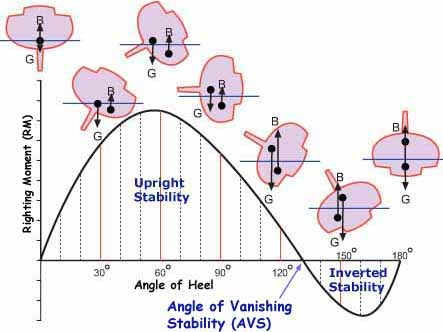
Jackdaw,
Thank you for this very informative graph. It would be interesting to know where the Angle of Vanishing Stability for the H26/260 is on the scale between 90 to 115+.
Thank you for this very informative graph. It would be interesting to know where the Angle of Vanishing Stability for the H26/260 is on the scale between 90 to 115+.
Thanks Jackdaw! Very interesting graphic. I too would be interested in the performance characteristics for the Hunter 26/260 (and the Mac/Venture 25 for comparison). The video entitled "huntercapsize02" gives a good insight into the boat stability as well.http://youtu.be/w00suzaDh_A