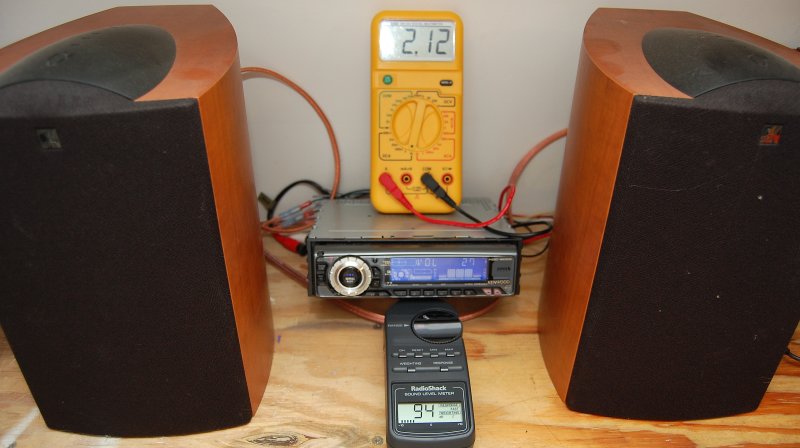
I recently put a linklite battery monitor in my trailer sailor and it seems to work overall well. However, I was asked a question about it which probably needs the manufacture to answer but Ill see if anyone here has an insight.
This has to do with how the monitor measures current. If I have a pure sine wave, I can measure the peak to peak amplitude and using a scaling factor to convert to RMS. If I have RMS of a sin wave, I can compare this directly to a DC measurement.
However, for an unusual current waveform (like from an alternator or car stereo), an inexpensive instrument such as consumer battery monitors would probably sample the current (from a shunt) and then do a running average using a micro.
My outboard likely has three coils in the alternator so at 6000 RPM, puts out maybe 300 current pulses per second (close to what Ive seen with a scope). Depending on how the car stereo is designed, its current variations could occur I would guess into the many Khz region.
So in order for the battery monitor to accurately estimate current that is varying, it needs to sample at least twice the highest frequency content in the signal and preferably sample at significantly higher than twice - like five or ten times.
Cheap micro's like probably used in the battery monitors have clocks which run 4Mhz to even 20 Mhz. So sampling at say 30Khz would only require the 4Mhz micro to sample every 133 clock pulses. Even though the micro must do a bunch of other stuff, this seems not too difficult of a problem since the only thing it needs to do at a fast rate is monitor current.
But I don't know.. and if the current sampling were for some reason to be done at a slow rate (like 200 times a second), the reading could be fairly inaccurate for something like an alternator or car stereo which potentially had fairly high frequency content for the current into or out of the battery..
This has to do with how the monitor measures current. If I have a pure sine wave, I can measure the peak to peak amplitude and using a scaling factor to convert to RMS. If I have RMS of a sin wave, I can compare this directly to a DC measurement.
However, for an unusual current waveform (like from an alternator or car stereo), an inexpensive instrument such as consumer battery monitors would probably sample the current (from a shunt) and then do a running average using a micro.
My outboard likely has three coils in the alternator so at 6000 RPM, puts out maybe 300 current pulses per second (close to what Ive seen with a scope). Depending on how the car stereo is designed, its current variations could occur I would guess into the many Khz region.
So in order for the battery monitor to accurately estimate current that is varying, it needs to sample at least twice the highest frequency content in the signal and preferably sample at significantly higher than twice - like five or ten times.
Cheap micro's like probably used in the battery monitors have clocks which run 4Mhz to even 20 Mhz. So sampling at say 30Khz would only require the 4Mhz micro to sample every 133 clock pulses. Even though the micro must do a bunch of other stuff, this seems not too difficult of a problem since the only thing it needs to do at a fast rate is monitor current.
But I don't know.. and if the current sampling were for some reason to be done at a slow rate (like 200 times a second), the reading could be fairly inaccurate for something like an alternator or car stereo which potentially had fairly high frequency content for the current into or out of the battery..