battery monitor accuracy question

Status
Not open for further replies.

walt

.
Jun 1, 2007
3,550
Macgregor 26S Hobie TI Ridgway Colorado
I recently put a linklite battery monitor in my trailer sailor and it seems to work overall well. However, I was asked a question about it which probably needs the manufacture to answer but Ill see if anyone here has an insight.

This has to do with how the monitor measures current. If I have a pure sine wave, I can measure the peak to peak amplitude and using a scaling factor to convert to RMS. If I have RMS of a sin wave, I can compare this directly to a DC measurement.

However, for an unusual current waveform (like from an alternator or car stereo), an inexpensive instrument such as consumer battery monitors would probably sample the current (from a shunt) and then do a running average using a micro.

My outboard likely has three coils in the alternator so at 6000 RPM, puts out maybe 300 current pulses per second (close to what Ive seen with a scope). Depending on how the car stereo is designed, its current variations could occur I would guess into the many Khz region.

So in order for the battery monitor to accurately estimate current that is varying, it needs to sample at least twice the highest frequency content in the signal and preferably sample at significantly higher than twice - like five or ten times.

Cheap micro's like probably used in the battery monitors have clocks which run 4Mhz to even 20 Mhz. So sampling at say 30Khz would only require the 4Mhz micro to sample every 133 clock pulses. Even though the micro must do a bunch of other stuff, this seems not too difficult of a problem since the only thing it needs to do at a fast rate is monitor current.

But I don't know.. and if the current sampling were for some reason to be done at a slow rate (like 200 times a second), the reading could be fairly inaccurate for something like an alternator or car stereo which potentially had fairly high frequency content for the current into or out of the battery..
 
Dec 25, 2008
1,580
catalina 310 Elk River
I think you maybe confused. The output of any alternator has its A/C turned into D.C with a diode, the a battery than acts like a big capacitor and further smooth out the D.C. voltage. The entire load is coming off the battery so it is pretty clean D.C If you were using a mico to sample either the voltage or current there are no pulses involved just a slowly changing voltage or sudden one time change in current draw as a load is applied or disconnected.
Most battery monitors monitor E (Voltage), not I (Current). If you want to monitor current flow than you need a current meter. These work by using Ohms law. I=E/R.
If you're trying to measure the current output of an alternator before it is turned into D.C that is a more difficult problem. Frankly not sure why you would need to do this?
1) RMS Voltage of a sine wave is calculated by multiplying by .707
2) There is no RMS for current
3) Square waves are measured by P-P and duty cycle. IE 50% duty cycle would be a symmetrical wave form.
Hope this helps.
 
Jun 6, 2006
6,990
currently boatless wishing Harrington Harbor North, MD
How stuff works

The typical battery monitor samples around once every 5 seconds, it samples amps, and they do require re-calibrating once in a while.

Remember, you are on sail time and so is your battery monitor.
 

walt

.
Jun 1, 2007
3,550
Macgregor 26S Hobie TI Ridgway Colorado
Bill, how do you know the battery monitor samples current every 5 seconds? This seems very slow and prone to error.

Witzend, sorry, I dont have a response.
 

Ross

.
Jun 15, 2004
14,693
Islander/Wayfairer 30 sail number 25 Perryville,Md.
Walt, You are making this excessively complicated. A volt meter and an ammeter will give you instantaneous readings but they won't give you cumulative amp readings. Giving you a summary of your current consumption as sampled every 5 seconds is going to be as close as you need to be.
If you were seeking fuel consumtion rates I think that you would want an indication of the average of several seconds displayed in the rate per hour rather than an instantaneous indication which would reflect every wave and wind gust.
 
Feb 26, 2004
23,353
Catalina 34 224 Maple Bay, BC, Canada
The simple answer is that the linklite

uses a shunt, which is essentially a small "bypass" like a flow meter in a water pipe.

DC current is not subject to the same "waves" and is therefore not like AC and the shunt is measuring ONLY DC, both into and from the batteries.

If you want some more detailed discussion of the shunt, I suggest you either check the literature or call the manufacturer. I agree with Witzend that your question seems inapplicable. The alternator is putting out DC.

Maine Sail did a report on the varieties of voltage readings from different meters some time ago, so you could check that out on the archives, here.
 

walt

.
Jun 1, 2007
3,550
Macgregor 26S Hobie TI Ridgway Colorado
Im not sure I made the question clear.

If you have an unusual shaped current waveform and it has some high frequency content, you need to sample the waveform at a much higher rate than the signal is changing or the reading wont be accurate (relates to sampling theory)

I can think of at least three places where current into the battery has relitively fast changing waveforms. The alternator current into the battery (in my case, 300 hz), the car stereo (Ill guess at up to 5Khz) and if Im using an inverter (60 hz). We cant assume any of these waveforms are nice sine waves.

The question is (and is somewhat complicated - sorry), how does the battery monitor current measurement handle current waveforms which have a relitively high frequency content? If I sampled every 5 seconds, I really cant tell much about changes which occur faster than every 10 seconds (way out of the time frame of the three sources above).
 

walt

.
Jun 1, 2007
3,550
Macgregor 26S Hobie TI Ridgway Colorado
Just a clarifiation point - the shunt is a resitor. The resistor creates a voltage (a very small one) when current flows through it which is sampled (somehow) by the battery monitor over a twisted pair wire. This system is certainly capable of measuring very high frequency current changes.

The current from an alternator is not DC. It pulses as the alternator rotates. Dont want to argue some of this stuff (hopefully Im not) but am curious about my original question.
 
Dec 25, 2008
1,580
catalina 310 Elk River
The only way you can accurately measure the amount of current that has been discharged over time from a source is by having the "I" meter in direct line with the load. Any other way and it is only a guess. Your electric, water and gas meters are connected in this manner for that reason.
Not sure what sort of games this Linklite is playing, but if it is not in line it won't be accurate. The only other way to do it would be to measure the "E" at the source and "E" at the load, and calculate the "E" drop, that would tell you the current flow which could be measured over time, but that assumes the "R" is a known fixed value. Without knowing the "E" drop inherent in any system under load (the drop as a result of "R" of the combined cables and connections under a changing load) the calculation of cumulative current draw would be only a guesstement.
 

walt

.
Jun 1, 2007
3,550
Macgregor 26S Hobie TI Ridgway Colorado
Witzend, here is the game the linklite is playing. There is a shunt in the battery ground line which all the current goes through. The shunt is a very small value resistor so that any current going through the shunt creates a voltage. There is a twisted pair set of wires connected to the shunt resistor which is measuring the voltage accross the shunt. Since the resistance of the shunt is known by the battery meter, current through the shunt = V(measured)/Rshunt

There will be frequency limits on this measurement method but they will be much higher than we are talking about here.
 
Dec 25, 2008
1,580
catalina 310 Elk River
"The shunt is a very small value resistor so that any current going through the shunt creates a voltage."
A shunt resistor does not create a voltage, it creates a voltage drop which can be measured.
As long as the all the current that is being used is passing through this shunt resistor it will work because it is direct in-line. This is how a current meter works.
Your concern about current fluctuations in this environment are not measured in the K-hertz range.
They are sudden changes occuring infrequently as load are induced or removed from the circuit.
 

Ross

.
Jun 15, 2004
14,693
Islander/Wayfairer 30 sail number 25 Perryville,Md.
In any case you are still measuring direct current not AC. Rectified ac at any frequency is direct current even when it is not filtered.
 
Dec 25, 2008
1,580
catalina 310 Elk River
Ross, that basically is correct. Unfiltered D.C can have an AC component that is a problem for low voltage electronics. In the boat and automotive applications the battery is acting as the filter. This is why it is important not to disconnect your battery while the alternator is running. Not only will it fry the diodes, but will send nasty spikes to everything else in the circuit.
 

walt

.
Jun 1, 2007
3,550
Macgregor 26S Hobie TI Ridgway Colorado
No, not correct. The current from the alternator will follow the rotation of the coil past some sort of magnetic field. The rectifier will insure that the current always is flowing the same direction into the battery. If you then have a big capacitance on the rectified output AND LOOK AT VOLTAGE ONLY, it will look like DC. But if you were to place a measurement shunt in the line (such as the linklite does), the current will rise and fall as the alternator is putting the current out.

FYI, I sent an email to the manufacture to try and answer my original question.
 

Ross

.
Jun 15, 2004
14,693
Islander/Wayfairer 30 sail number 25 Perryville,Md.
Walt, in this case the DC is not a carrier for the ac component. You are getting amplification circuits mixed up with power supply circuits. A capacitor only will not flatten rectified ac. Without the battery you need both a capacitor and a choke to get a flat dc output from rectified ac.
 
Feb 6, 1998
11,760
Canadian Sailcraft 36T Casco Bay, ME
Walt

I envy your depth of curiosity. I do think you are over thinking it though.:D

I can measure current draw on a car stereo with a cheap multimeter set to measure DC amps so I see no reason why the shunt for the Link Lite would not be able to do the same.


walt

.
Jun 1, 2007
3,550
Macgregor 26S Hobie TI Ridgway Colorado
Ross, I re-read your post and think I understand what you mean. It seems that you are calling the current DC since it only flows one direction. I am calling it "AC" because although it is only flowing in one direction, the current likely has a fairly dramatic change in amplitide as the alternator coil rotates. How the battery monitor handles this changing current (at about 3msec periodic rate in the case I measured) and determines its "average value" is the question Im concerned about.
 

Ross

.
Jun 15, 2004
14,693
Islander/Wayfairer 30 sail number 25 Perryville,Md.
The battery monitor probably has a filter built into its input circuitry to smooth out the high frequency voltage variations. If you energize an incandescent light with 60 hertz ac or with rectified 60 hertz ac filtered with a choke and a capacitor the intensity will be precisely the same. You won't see any flicker because the thermal inertia of the filiment will maintain a uniform heat level.
 
Feb 26, 2004
23,353
Catalina 34 224 Maple Bay, BC, Canada
By the time it gets to the shunt

RIt seems that you are calling the current DC since it only flows one direction. I am calling it "AC" because although it is only flowing in one direction, the current likely has a fairly dramatic change in amplitide as the alternator coil rotates. How the battery monitor handles this changing current (at about 3msec periodic rate in the case I measured) and determines its "average value" is the question Im concerned about.
...which is on the (-) side of the batteries, it's already gone through the batteries at the point the shunt is located. So, what kinda amplitude changes are you thinking about? If you have NOTHING on, except your engine is running and the alternator is charging (assuming the bank is down and the regulator is saying charge!), the Link will show how many amps are flowing through the system and will be + when charging. You can do the same thing with your shorepower charger, which is also converting AC to a DC charge, and STILL being measured AFTER the battery bank on the (-) side of the banks where the shunt is.

My Link 2000 picks up the stereo load (-)(0.8 A) as well as everything else that runs on our boat.

I gotta tell ya, I still don't understand a thing you're discussing or why it's even germaine.

Please help, because I really DO understand this stuff and I've never heard of anything like this before, ever.:)
 

walt

.
Jun 1, 2007
3,550
Macgregor 26S Hobie TI Ridgway Colorado
"The battery monitor has a filter"

This is part of what Im trying to find out. If the battery monitor had a filter, the filter would to some extent find the average level of the current but would mostly get rid of the high freqeuncy content and favor the low frequency content. It is not the way you find the rms value of a changing current. If the battery monitor works like I think it might, it will have a bandwidth limit on the current measurement signal but that is to prevent "aliasing" where high freqency noise gets converted to the measurement band. Note that it is true RMS of the current we are looking for here.

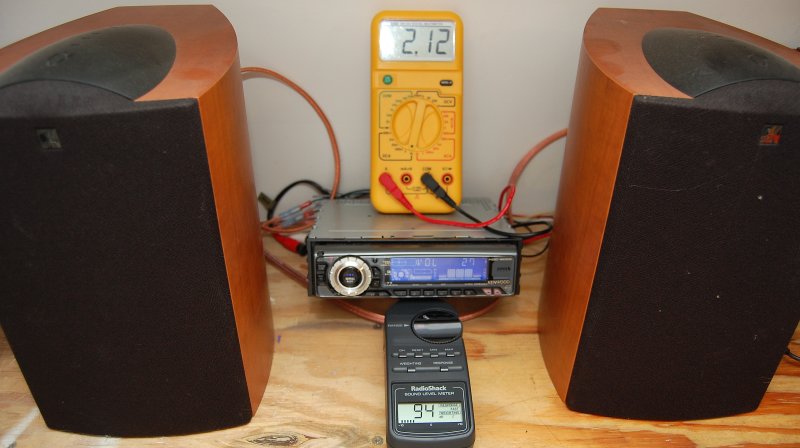
An inexpensive DVM usually has an absolute value measurement and then the convert this to RMS using a fixed scaling value. As mentioned, its accurate for a sin wave but this method suffers from form factor errors (such as the chopped up current waveform on the DC side from a DC to AC inverter). Likely the current measurement in Maine Sails meter is fairly accurate for a sin wave. Im not sure what its bandwidth is and also not sure what it would do for white noise (a broad spectrum of sine waves - which is what Maine Sail had playing on the stereo when he tood the measurement).

Over the top - no doubt..
 
Status
Not open for further replies.