On the Catalina 30 MKIII, the exhaust swirls back into the cockpit and cabin. It stinks and leaves a mess all over the transom as well. The through hull is above the waterline with occasional dips below. Would moving the through hull below the waterline help? What, if any, modifications would be needed to prevent water intrusion?

Moving exhaust below waterline
- Thread starter Project_Mayhem
- Start date
Have you asked the fish how they feel about diesel exhaust in their home? 
The exhaust hose has to rise well above the waterline at any angle of heel. The length of the hose is also an issue. When the engine is shut down any water in the exhaust line before the high loop will drain back into the muffler and potentially into the exhaust elbow if the run is long and the exhaust line isn't cleared.
The exhaust hose has to rise well above the waterline at any angle of heel. The length of the hose is also an issue. When the engine is shut down any water in the exhaust line before the high loop will drain back into the muffler and potentially into the exhaust elbow if the run is long and the exhaust line isn't cleared.


Keeping the exhaust thruhull above the WL ensures that siphoning backwards when shut down cant happen. The gravity loop ( elbow ) won’t prevent that in all cases.

Exhaust exits above water line: gas swirls with the wind.
Exhaust exit 6" below water line: Gas bubbles up 6" and swirls with the wind.
Dont motor downwind, or sail more. My wife hates diesel exhaust as well. Not much you can do about it.
Exhaust exit 6" below water line: Gas bubbles up 6" and swirls with the wind.
Dont motor downwind, or sail more. My wife hates diesel exhaust as well. Not much you can do about it.

Exellently put. Not a trace of difference between the two levels.Exhaust exits above water line: gas swirls with the wind.
Exhaust exit 6" below water line: Gas bubbles up 6" and swirls with the wind.
IT STINKS
!As far as the other predictions that the world will end if the exhaust thru-hull is below water ........... meh, I'm far more worried about leaving my underwear laying around and having one of my female crew members hoist it up on a halyard
.My exhaust loop is high enough that a following sea landing on deck would have to be higher than the coaming leading to the companionway in order to get over the loop. At that point, screw the engine and man the lifeboats.
My exhaust hose is a hair below the coaming. It cant get much higher in the aft end of the boat.
Any ideas on how to prevent exhaust from swirling back in to the cockpit? I'm pretty sure it's the shape of the boat and the walk through transom that are the contributing factors. Putting a board in the walk through portion might help fumes from entering the cockpit but it wont prevent it from building up like crazy on the transom. We usually motor a half mile to get to calmer seas.
Any ideas on how to prevent exhaust from swirling back in to the cockpit? I'm pretty sure it's the shape of the boat and the walk through transom that are the contributing factors. Putting a board in the walk through portion might help fumes from entering the cockpit but it wont prevent it from building up like crazy on the transom. We usually motor a half mile to get to calmer seas.
Going downwind in wind speed greater than boat speed will always bring the exhaust forward, because the apparent wind is blowing forward. Instead of going dead downwind, try a broad reach with the exhaust port on the leeward side.My exhaust hose is a hair below the coaming. It cant get much higher in the aft end of the boat.
Any ideas on how to prevent exhaust from swirling back in to the cockpit? I'm pretty sure it's the shape of the boat and the walk through transom that are the contributing factors. Putting a board in the walk through portion might help fumes from entering the cockpit but it wont prevent it from building up like crazy on the transom. We usually motor a half mile to get to calmer seas.
I'm pretty sure the hull is creating a vacuum of sorts. The curve of the hull starts the upward swirl and the vacuum effect finishes it off. I usually travel around 4.5-5kts
Mentioning that in your opening post would have saved a lot of yacking back and forth.My exhaust hose is a hair below the coaming. It cant get much higher in the aft end of the boat.
Yes, I would describe the location of the exhaust as being faulty, in error, imperfect, flawed and badly in need of relocation.
Next is the need for photos of the aft of your boat showing the location of the thru-hull as it now stands and the surrounding area of the transom.
I know you're a reliable regular here. Please don't do what so many one timers have been doing recently. Ask them for a picture and it's just too bloody much trouble. Thanks.
The height of the hose just dawned on me when I read your post. I'll get a pic of the transom next week. I'm swamped with work at the moment. I have that clogged air filter sitting on my desk waiting for analysis. I could see a noticeable difference in the new one after only a few hours of motoring. The good news is the boat made the 5.5 hour journey without a hiccup. I know the dirty air filter only makes the soot build up on the transom worse.Mentioning that in your opening post would have saved a lot of yacking back and forth.
Yes, I would describe the location of the exhaust as being faulty, in error, imperfect, flawed and badly in need of relocation.
Next is the need for photos of the aft of your boat showing the location of the thru-hull as it now stands and the surrounding area of the transom.
I know you're a reliable regular here. Please don't do what so many one timers have been doing recently. Ask them for a picture and it's just too bloody much trouble. Thanks.
Souds good. Maybe the group can come up with a better location which will sweep away the exhaust gas and avoid the endless browbeatings you endure every day when motoring.I'll get a pic of the transom next week.
You mean the height of the thru-hull in relation to the top of the coaming ?The height of the hose just dawned on me when I read your post.
You mean a difference in that ithe new filter isn't picing up the mysterious black dust any more ? OK but that doesn't mean the black dust has disappeared from the equation. Just means the new filter isn't catching the black dust. Now the engine is choking on it.I could see a noticeable difference in the new one after only a few hours of motoring.
The hose rises up to the underside of the coaming and travels forward 3-4' before turning back downYou mean the height of the thru-hull in relation to the top of the coaming ?
I was shocked at how quickly the new filter looked dirty. I think this is belt dust. It's been cool out and I don't think the filter had been on there long enough for mold/mildew growthYou mean a difference in that ithe new filter isn't picing up the mysterious black dust any more ? OK but that doesn't mean the black dust has disappeared from the equation. Just means the new filter isn't catching the black dust. Now the engine is choking on it.

jssailem
SBO Weather and Forecasting Forum Jim & John
- Oct 22, 2014
- 24,888
Ralph has a Hunter, you have the Catalina, and I have a 53 year Cal. Three different hull shapes. All with diesel engines. Maybe all have had a similar experience with the diesel perfume.On the Catalina 30 MKIII, the exhaust swirls back into the cockpit and cabin.
Looking for a solution, my question is: Does this happen all the time, or only under certain conditions?
The problem is really just basic physics commonly known as the "station wagon effect." When a boat moves through air it creates an area of low pressure behind the cabin and transom. The exhaust rises because it is hotter than the surrounding air and moves into to fill the area of low pressure which we perceive as exhaust odor as it fills the space in the cockpit. The image below shows the effect on a wake board, it is the same on a sailboat.
On a sailboat motoring downwind the problem becomes worse when the wind is faster than the boat. The wind literally blows the exhaust forward into cockpit. Moving the exhaust outlet may have some positive benefit, depending on where it is currently located and the intended location. Lower and on the side of the hull may be a better location, but I have no empirical evidence to support that claim. The reasoning is the exhaust will be pushed into the slipstream and dissipate further away from the boat. The worst place would likely be high and centered on the transom.
The AWS and AWA will have an effect on how quickly the exhaust dissipates and in what direction. A beam on wind will probably be most effective at moving the exhaust away from the cockpit if the exhaust port is on the leeward side of the boat.
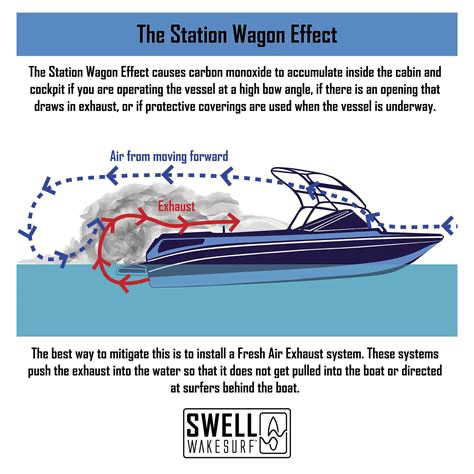
On a sailboat motoring downwind the problem becomes worse when the wind is faster than the boat. The wind literally blows the exhaust forward into cockpit. Moving the exhaust outlet may have some positive benefit, depending on where it is currently located and the intended location. Lower and on the side of the hull may be a better location, but I have no empirical evidence to support that claim. The reasoning is the exhaust will be pushed into the slipstream and dissipate further away from the boat. The worst place would likely be high and centered on the transom.
The AWS and AWA will have an effect on how quickly the exhaust dissipates and in what direction. A beam on wind will probably be most effective at moving the exhaust away from the cockpit if the exhaust port is on the leeward side of the boat.
With your exhaust outlet on the transom like you describe, I think you are correct that this is creating a suction or trapped air effect keeping the exhaust gas close to the boat and even bringing it into the cockpit. Moving it to the side of the boat might help a lot, but could be a major piece of work.
The manufacturer of our boat mounted the exhaust outlets right at the waterline, and they are now below the waterline with loading. As long as the outlet isn't really far underwater enough to create too much back pressure, there is no problem with mounting them below the waterline.
Syphoning isn't a problem because you should have an anti-syphon loop on your raw water circuit to prevent that, as well as a high loop above the waterline in the final length of hose with a straight run down to the outlet.
Your idea of moving it below the waterline on the transom might have some merit. While it is true that exhaust bubbles back up, what others have missed about this is that the boat does move during the time the exhaust gas is underwater, as well as the exhaust gas gets broken up and distributed much more before it rises. I see this with ours. You only need to get the exhaust gas beyond the dead space behind your transom, and exhaust below the waterline might be enough to do this.
Other ideas might be to extend the exhaust outlet to try to have the exhaust exit further away. Or rig a small scoop that takes air from the deck and directs it behind the transom in an attempt to disrupt the dead/suction area.
Mark
That sounds like two anti-syphon loops or am I just readingSyphoning isn't a problem because you should have an anti-syphon loop on your raw water circuit to prevent that, as well as a high loop above the waterline in the final length of hose with a straight run down to the outlet.
this wrong ?
On the Catalina 30 MKIII, the exhaust swirls back into the cockpit and cabin. It stinks and leaves a mess all over the transom as well. The through hull is above the waterline with occasional dips below. Would moving the through hull below the waterline help? What, if any, modifications would be needed to prevent water intrusion?
[/QU
Are you planning on re-designing and modifying the factory exhaust system? There are simpler solutions. Survey the condition of the mixing elbow, water flow and the muffler; the discharged cooling water should capture many of the particles and discharge them into the water. Correct any excessive smoke condition caused be the engine or running gear. Avoid as much as possible those conditions where the fumes are most offensive.
Hand that man a ceegarI was shocked at how quickly the new filter looked dirty. I think this is belt dust. It's been cool out and I don't think the filter had been on there long enough for mold/mildew growth
!Cool weather and a lack of time proves it.
I notice it fairly often. Sometimes its worse than others. I usually don't put my head in the walk through part of the transomLooking for a solution, my question is: Does this happen all the time, or only under certain conditions?
I believe this is exactly what's happening. Thank you for the description and diagram. I've been wanting to install a solar panel on the back. It would be at an angle to capture the sun in the daytime. I'm curious if it would also act as a spoiler. It would be mounted at the same height as my biminiThe problem is really just basic physics commonly known as the "station wagon effect." When a boat moves through air it creates an area of low pressure behind the cabin and transom. The exhaust rises because it is hotter than the surrounding air and moves into to fill the area of low pressure which we perceive as exhaust odor as it fills the space in the cockpit. The image below shows the effect on a wake board, it is the same on a sailboat.
On a sailboat motoring downwind the problem becomes worse when the wind is faster than the boat. The wind literally blows the exhaust forward into cockpit. Moving the exhaust outlet may have some positive benefit, depending on where it is currently located and the intended location. Lower and on the side of the hull may be a better location, but I have no empirical evidence to support that claim. The reasoning is the exhaust will be pushed into the slipstream and dissipate further away from the boat. The worst place would likely be high and centered on the transom.
The AWS and AWA will have an effect on how quickly the exhaust dissipates and in what direction. A beam on wind will probably be most effective at moving the exhaust away from the cockpit if the exhaust port is on the leeward side of the boat.
View attachment 240445