LED from China Update

Status
Not open for further replies.
Apr 27, 2010
970
Beneteau 352 Hull #276 Ontario
Didn't want to hijack someone else's thread, so this is an update to the LED Lamps purchased from Ebay.


Lamp Specs
  • Base: G4
  • LED Chip: 1210
  • Light Color: Warm White (3000~3300K)
  • Input: DC 12V
  • Power:0.9W
  • Lumen: 140 Lm
  • Life time: about 30,000 hours
  • Angle:160
They cost $2.88 each and shipping is free. They do not have voltage regulation.
Purchased a voltage regulator for $0.21 and added to circuit board. The positve lead from the rectifier has been lifted from the PCB so that I could attach the regulator into the circuit.
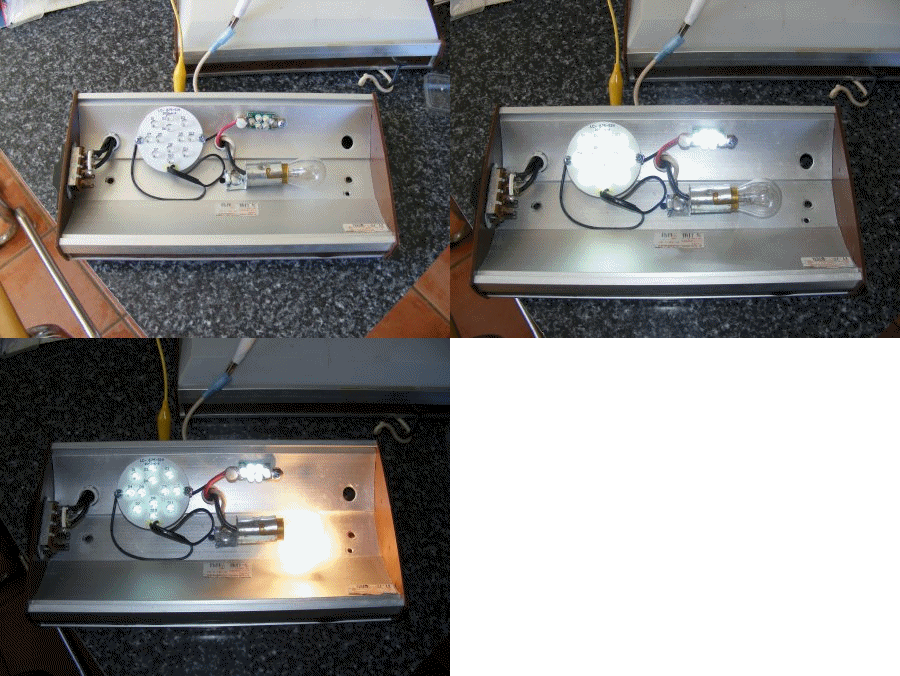
You can see this in the attached photo.

One picture shows the charger on (14.8 volts) and current draw of 127 ma. I ran this for 1 hour. The LED was slightly warm to the touch at the end of that time.
The other picture shows the charger off and the current draw of 80 ma. Battery voltage is 11.9 volts.

Note that the brightness hasn't changed.

Total cost $3.09.
 

Attachments

Last edited:
Feb 10, 2004
4,235
Hunter 40.5 Warwick, RI
Very interesting. Can you provide more details- what eBay seller, what regulator part number and source for that regulator?
 
Oct 10, 2010
269
Hunter H260 Gull Lake
LED bases

Hey Joker, excuse my lack of electrical knowledge, but how do those two pins plug into a bayonet style fixture? Did I read your post right, $3.09 per light? That's incredible.

Shanker
 
Jun 6, 2006
6,990
currently boatless wishing Harrington Harbor North, MD
There are lots of things you can do with stuff from Radio Shack or DigiKey. I replaced the courtesy lights (3 amp draw) with a set of LEDs. Pretty simple stuff just the wires, LEDs and two switches. Rigged it for red and white (and both) modes. There are over 50 LEDs in each bank (red/white) and @ 3 candle power each the pretty much light up the place. The red is particularly nice at night. Total cost was like $15 dollars. Max amp draw is 0.7 amps and 0.0 when off.
I've seed folks take an old bayonet socket and install LEDs in it also for very low cost.
 
Aug 9, 2005
825
Hunter 260 Sarasota,FL
What a great thread on a nice deal. I've wanted to upgrade my interior fixtures and this'll be a great project while the boat is out for the broiling season down here. Thanks for the links but could you post(or share a link to) photos/captions of a step by step change-out on a typical fixture application.
Thanks again. Mike
 

Eric M

.
Sep 30, 2008
159
Island Packet 35 Jacksonville
I have been playing around with these sorts of LED lights also - what is the purpose of the voltage regulator? I have installed two without the regulator and they appear to be working fine. I have 2 more samples of LED pannels in route as I type. The first two I am playing with are not quite as bright as the stand bulbs they are replacing.
 
Apr 8, 2010
1,606
Frers 33 41426 Westport, CT
what is the purpose of the voltage regulator? I have installed two without the regulator and they appear to be working fine.
As I understand it LEDs are very easily damaged by over current of even just a couple volts, and they dim quickly at under voltage. A voltage regulator allows the use of lower voltage LEDs, so they can work correctly with input voltage ranging anywhere from ~10v to 20v without burning up the LED, and in some cases burning being the operative word...

see http://store.marinebeam.com/whyounetokna.html for more info
 
Apr 27, 2010
970
Beneteau 352 Hull #276 Ontario
Fourpoints is correct.

These LED's do not come with any regulation. They work well if the voltage is a constant 12v or close to. The problem comes in when your charging circuit exceeds the 12 volts and especially when you equalize your batteries.

Chargers are usually around 14.8 volts. Without the regulator, the LED's will shine more brightly because more voltage is applied and they will get hotter.

Now, if you equalize the batteries, the voltage can go go above 15 volts. This could cause damage to the LED's.

The regulator maintains a constant 12 volts to the LED which means a constant Brightness no matter what the input voltage is.
 
Apr 27, 2010
970
Beneteau 352 Hull #276 Ontario
@ shanker

These are for G4 replacements only. You would have to buy something similar but with a bayonet base.
 
Apr 8, 2010
1,606
Frers 33 41426 Westport, CT
The regulator maintains a constant 12 volts to the LED which means a constant Brightness no matter what the input voltage is.
I beleive that most of the time the regulators are coupled with lower voltage LEDs, and the idea is to have the regulator apply a constant lower voltage (around 6-10 volts) so they will work normally even when the batteries are very low. To the best of my knowledge, regulators are not also step up transformers, so they won't be able to supply 12 volts unless they are receiving at least 12 volts input, so in order to work at 10 volts, the regulator output and LEDs must be rated for no more than 10v.
 
Jun 21, 2007
2,118
Hunter Cherubini 36_80-82 Sausalito / San Francisco Bay
Good thread and good DIY project. I did something similar several years ago when incandescent to LED conversion "bulbs" were still very pricey. And super-bright LED's even more so. After the holidays, I had noticed that "warm" white LED Christmas lights were locally marked down to $5.00 for a 60 light string. Each LED was reasonably bright. So I removed the individual LED's from the strings and and mounted 12-18 on a PC boards, also using a voltage regulator in each array.

They work fine in my 1980 vintage cabin fixtures. But to put a bit of damper on our DIY enthusiasm in this case, just to mention that the cost of LED "bulbs", with regulators already built-in, has really really dropped. Joker460's project is still cheaper, but the time vs. cost relationship might be tipping away from DIY.

Here's one URL to a well-know boaters' supply store in the San Francisco Bay area. (Sorry SailboatOwners.com store, but I couldn't find a similar selection of LED bulbs here.)

http://www.svendsensmarine.com

Type LED in the search box and scan down the many pages of results. Lot's of economical options for many standard fixtures that originally used old-fashioned filament 12V bulbs.
 
Apr 27, 2010
970
Beneteau 352 Hull #276 Ontario
I had another idea for LED lighting.

If you don't want to modify each LED, you can add a regulator to your electrical panel switch for the cabin lights only. Just be sure to change all incandescenrt bulbs on that circuit otherwise the magic smoke will escape.

These LED's without regulator draw 40 ma. So if you have 12 lamps x 40 ma = 480 ma, so a 1 amp regulator would do.

Attached is a switching regulator rated at 1 amp and doesn't get as hot as a linear regulator would at rated current.

This regulator is $15. A linear regulator would go for under a $1 but you would need to add a heat sink.

Remember you do this at your risk.:eek:
 

Attachments

Apr 8, 2010
1,606
Frers 33 41426 Westport, CT
IIf you don't want to modify each LED, you can add a regulator to your electrical panel switch for the cabin lights only. Just be sure to change all incandescenrt bulbs on that circuit otherwise the magic smoke will escape.
creative solution... :thumbup:
 
Jun 6, 2006
6,990
currently boatless wishing Harrington Harbor North, MD
Or you could design it for 14.4 volts (max seen when the lights are on), use the changing voltage/light intensity as a sign of battery state of charge......... and forgo with all the complicated circuits.
Mine seems to work fine and it has LEDs and wires. And yes when your turn on the engine or bat charger the lights do brighten. Positive indication that the batts are getting a charge!! If a battery ever does go bad the lights will give a quick indication of that.
If you design for 14.4 volts you will have to use 6-7 LEDs in series which will give more light at reduced voltage than designing at 9-10 volts with a regulator which only takes 4-5 LEDs in series and you use less current to boot. Yes Martha, I tried both
 

kenn

.
Apr 18, 2009
1,271
CL Sandpiper 565 Toronto
These LED's do not come with any regulation. They work well if the voltage is a constant 12v or close to. The problem comes in when your charging circuit exceeds the 12 volts and especially when you equalize your batteries.
From your photos, there's a 4-pin IC on the back which I suspect actually is a regulator of sorts. Also, the things are designed for autos and RVs, which implies a similar battery/charger/alternator environment... so I would guess that they could handle up to 15v with out blowing up or changing brightness.

Just a guess; i haven't yet found a spec sheet for the thing. In any event, your regulator is cheap insurance.
 
Nov 22, 2008
3,562
Endeavour 32 Portland, Maine
Also, the things are designed for autos and RVs, which implies a similar battery/charger/alternator environment... so I would guess that they could handle up to 15v with out blowing up or changing brightness.
I bought an inexpensive LED light outfit from Home Depot which was intended to run off the little plug in brick that came with it. It was certainly designed therefore to only expect an exact 12 volts.


I'd previously installed the smaller LED's that were bayonet bulb replacements that I removed the end caps from.

Two seasons and none have failed, even when lit with the engine running or the shore power charger plugged in.
 
Apr 27, 2010
970
Beneteau 352 Hull #276 Ontario
@ Ken

I have the data sheet on the device. It's definitely a full wave rectifier.

It allows you to connect the device either way. No polarity required.
 

Attachments

kenn

.
Apr 18, 2009
1,271
CL Sandpiper 565 Toronto
@ Ken

I have the data sheet on the device. It's definitely a full wave rectifier.

It allows you to connect the device either way. No polarity required.
Ah. You are correct sir. Thanks for clarifying that.

I still expect that the LEDs and resistors used in this device would allow it to tolerate up to 15 v, given their intended use in vehicles.
 
Status
Not open for further replies.