Moving north and now have to store my 41 Hunter on the hard. No more electric power from the dock to keep my house batteries charged. have two brand new AGM 210 A/h - pretty expensive. The marina I am going to does not have any electric I can use for a trickle charge all winter long. Was thinking about a small solar panel, the two big house batteries look like they are wired in parallel. Ideas/suggestions/experiences ?

Protecting My House Batteries in the Winter
- Thread starter spadaforaj
- Start date

I leave my FLA batteries connected to my solar panels while dry-stored for the winter. Haven't had an issue.

And for those who may not know.
Parallel wiring is + to + and - to - this keeps the voltage the same, but multiplies the amp hours by the number of batteries. You CANNOT mismatch voltages. If you want 18v use 3 6v batteries, by combining a 12v and a 6v in parallel the 12v battery will try to charge the 6v to 12v and that isn’t good.
Series wiring is + to - and this will increase the voltage times the number of batteries by the voltage of the batteries, amp hours stay the same. In series you can mismatch voltages but it isn’t recommended. Eg to get 18v you could have a 6v and and a 12v wired in series for the 18v with no issue, but 3 6v would still be better.
Parallel wiring is + to + and - to - this keeps the voltage the same, but multiplies the amp hours by the number of batteries. You CANNOT mismatch voltages. If you want 18v use 3 6v batteries, by combining a 12v and a 6v in parallel the 12v battery will try to charge the 6v to 12v and that isn’t good.
Series wiring is + to - and this will increase the voltage times the number of batteries by the voltage of the batteries, amp hours stay the same. In series you can mismatch voltages but it isn’t recommended. Eg to get 18v you could have a 6v and and a 12v wired in series for the 18v with no issue, but 3 6v would still be better.

Not necessary and usually dangerous when getting them of and back on the bot, especially if it's up on the hard. A known problem.What would be the difficulty in removing them and bringing them home to keep a maintainer on them?
Get a small solar panel AND A CONTROLLER. Do NOT use a solar panel without a controller.
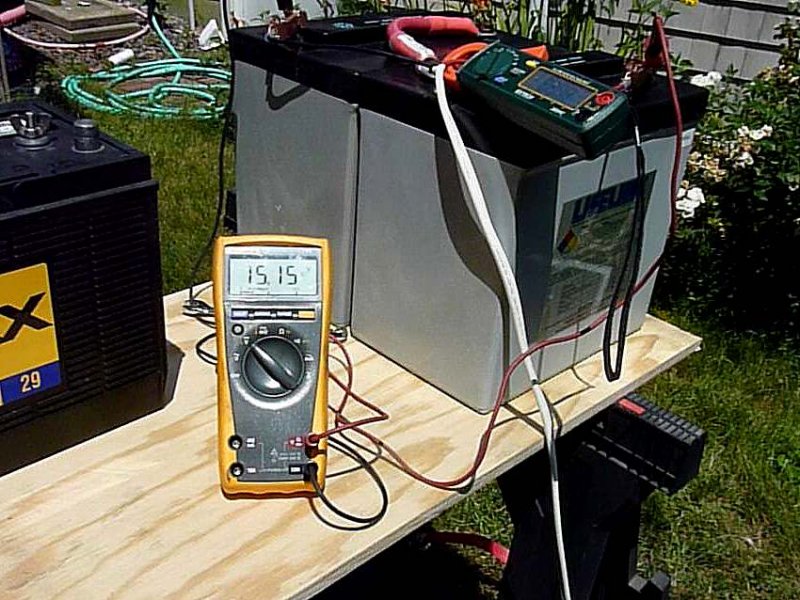
Do I Need A Solar Controller? - Marine How To
Do I Need A Solar Charge Controller? I get asked this question quite often and the answer is almost always a resounding, yes. There are always caveats to everything however. Last summer I finally had the opportunity to set this up for demonstration with
marinehowto.com

MaineSail did a study of lead-acid batteries stored in cold weather for months, and found that they lose very little charge. Top them up before storage and then disconnect them to remove them from small-load discharge.
This article has more authoritative information on proper storage than you probably want to know: Winter Battery Storage & Self Discharge Characteristics - Marine How To
This article has more authoritative information on proper storage than you probably want to know: Winter Battery Storage & Self Discharge Characteristics - Marine How To


2 4D's would be very difficult to get off the boat.What would be the difficulty in removing them and bringing them home to keep a maintainer on them?
My impression is that you can charge your AGM batts at the end of the season and they will not lose charge over the winter. I had mine off the grid all winter (November - March) and never lost voltage or it was negligible, I don't recall.
But if you feel that you have to charge, I would use solar or a portable generator. (I surely wouldn't be moving those batts off the boat!)
Or ... you could bring your boat up to Mariners in Barnegat very easily for the winter and have all the power you want on the hard. There are a lot of boats that come to Mariners for the winter from all over and they seem to have plenty of room for all comers. I'd check into it now though. Your draft may be an issue if more than 6' would probably be the only limitation - not in the marina but in the short channel leading there.

I keep my group 31 AGM’s disconnected all winter long (mid November - early April). I do charge them briefly in January, but the charger only stays in absorption mode for a few minutes before returning to float, so really they’re still quite full. If taking this approach Do be sure to charge them fully beforehand, and disconnect everything from the terminals.

I am in cold country and temps regularly drop well below zero from mid-december to mid-february. I leave my batteries on board, making sure to top them off before disconnecting completely. Boat is unattended and I do not charge at all during the entire winter season. Only when I reconnect them, generally around april 15th. Last Spring, all 3 showed 12.7 Volts before I reconnected them. Been doing this successfully for several years and it does confirm what Maine Sail was demonstrating. No need for any back-breaking moving those 68 pounds batteries on and off the boat, and no need for several trips climbing under the tarp to set-up trickle charger. I do enjoy Florida weather from late November to mid-April without worrying about my batteries. They do endure the winter cold easier than the summer heat !
Make sure the batteries are at 100% charge. Disconnect the negative leads. They will be fine in the spring.
In the spring, as soon as you are able connect them to shore power and recharge with your boat's charger.
The colder batteries are the less likely they are to self discharge. I've been doing that for 35 years never had a problem.
You are more likely to trash your batteries by leaving them in a partial state of charge (PSOC) during the sailing season.
In the spring, as soon as you are able connect them to shore power and recharge with your boat's charger.
The colder batteries are the less likely they are to self discharge. I've been doing that for 35 years never had a problem.
You are more likely to trash your batteries by leaving them in a partial state of charge (PSOC) during the sailing season.

Up here in Michigan boat goes on the hard in October and relaunched in May, batteries remain aboard, fully charged and disconnected been doing this since I have owned the boat and the batteries are always at full charge in the spring. I do occassionally visit the boat about once a month just to make sure everything is AOK never an issue.

Also be sure to throughly clean the top of the batteries so that there is no film of electrolyte to allow a sneak path of a small current. IIRC, baking soda and water makes an alkaline solution which will clean and neutralize any acidic film on the batteries. Or you could just use plain water like I do.
Hopefully there’s no electrolyte film on the OP’s (sealed) AGM’s. But yes it is worthwhile to make sure the terminals and surfaces are clean.Also be sure to throughly clean the top of the batteries so that there is no film of electrolyte to allow a sneak path of a small current. IIRC, baking soda and water makes an alkaline solution which will clean and neutralize any acidic film on the batteries. Or you could just use plain water like I do.

My batteries (flooded lead acid) are fully charged at haul out. I completely disconnect them, just leave them in place on the boat and they hold their charge quite well through cold Chicago winters on the hard. I just top them off in the spring with the shore charger. There is no need for trickle charging through the winter.

Definitely use MaineSail's advice for cold storage of batteries.
The key to leaving them on the boat is to have the water topped off, fully charged and disconnected. The marina where I store has power, but it's not always close enough to where they've parked my boat. I use a little portable generator to give them a solid charge before I walk away for the season. No way I want to remove those 4D's from the boat.
The key to leaving them on the boat is to have the water topped off, fully charged and disconnected. The marina where I store has power, but it's not always close enough to where they've parked my boat. I use a little portable generator to give them a solid charge before I walk away for the season. No way I want to remove those 4D's from the boat.