-50 PG Antifreeze Only Works......

Feb 6, 1998
11,759
Canadian Sailcraft 36T Casco Bay, ME
This morning when I woke up to let the dog out I noticed the bottle of -50 West Marine Pure Oceans propylene glycol sitting on my BBQ grill was frozen solid. The air temperature was approx 4 F.. I reached over and grabbed my point and shoot to make this video.

Once again I want to stress the importance of NOT DILUTING -50 RV/Marine antifreeze! While the label rating is a rather misleading "-50F" this is a BURST POINT for metal pipes. The burst points are significantly higher for plastic fittings and pipe or thin walled copper like is found in our heat exchangers. While at 4 F the -50 had not yet begun to "expand" as you dilute it the temp at which it does exapand rises. Two years ago I had a DIY split a Universal M-25 HX by sucking in a full TWO gallons and shutting down the engine when he "saw pink".... Seeing "pink" at the exhaust tells you little to nothing about its level of dilution.

Six weeks ago I winterized a Grand Banks with a large Ford Lehman diesel & Sea Frost refrigeration system. I "saw pink" at 9 gallons of AF. It was not "undiluted" until 16 gallons had been run through it! This was all confirmed with the use of a sight refractometer as measured with an exhaust outlet capture of AF.

Every spring I see and hear of boats with freezing problems and this can only be attributed to the -50 PG getting diluted by water that is already in the system. Pipes, seacocks, heat exchangers, valves, water heaters and even a water filter. I have seen all of these items SPLIT and destroyed.. When you suck in AF the displacement is not 1 gallon of fresh to 1 gallon of AF it mixes in the system thus diluting the -50F burst rating and moving the burst point upwards.

What comes out your exhaust or your faucets should match exactly what came out of the bottle, if you are in a cold area, and if you don't want to worry about your HX or engine.

DISCLAIMER: Please ignore the poor quality of this video, and my stumbling of words, as I had not yet had my coffee nor thought about what I would say. Please understand that this was a one-take deal at 4F with flip flops, and shorts on.........;)

 
May 10, 2008
392
Catalina 355 Boston
This morning when I woke up to let the dog out I noticed the bottle of -50 West Marine Pure Oceans propylene glycol sitting on my BBQ grill was frozen solid. The air temperature was approx 4 F.. I reached over and grabbed my point and shoot to make this video.

Once again I want to stress the importance of NOT DILUTING -50 RV/Marine antifreeze! While the label rating is a rather misleading "-50F" this is a BURST POINT for metal pipes. The burst points are significantly higher for plastic fittings and pipe or thin walled copper like is found in our heat exchangers. While at 4 F the -50 had not yet begun to "expand" as you dilute it the temp at which it does exapand rises. Two years ago I had a DIY split a Universal M-25 HX by sucking in a full TWO gallons and shutting down the engine when he "saw pink".... Seeing "pink" at the exhaust tells you little to nothing about its level of dilution.

Six weeks ago I winterized a Grand Banks with a large Ford Lehman diesel & Sea Frost refrigeration system. I "saw pink" at 9 gallons of AF. It was not "undiluted" until 16 gallons had been run through it! This was all confirmed with the use of a sight refractometer as measured with an exhaust outlet capture of AF.

Every spring I see and hear of boats with freezing problems and this can only be attributed to the -50 PG getting diluted by water that is already in the system. Pipes, seacocks, heat exchangers, valves, water heaters and even a water filter. I have seen all of these items SPLIT and destroyed.. When you suck in AF the displacement is not 1 gallon of fresh to 1 gallon of AF it mixes in the system thus diluting the -50F burst rating and moving the burst point upwards.

What comes out your exhaust or your faucets should match exactly what came out of the bottle, if you are in a cold area, and if you don't want to worry about your HX or engine.

DISCLAIMER: Please ignore the poor quality of this video, and my stumbling of words, as I had not yet had my coffee nor thought about what I would say. Please understand that this was a one-take deal at 4F with flip flops, and shorts on.........;)

Funny that you posted this. As I stepped out this morning, my first thought was these temps will test winterizing techniques. It is 11 degrees in downtown Boston.
This year I tried the Pure Oceans -200 in my engine. Interestingly enough it was cheaper than the -100 when factoring in the rebate. When I posted the availability of this stuff, some called it snake oil, but as you point out, it is simply a greater concentrate of PG. I used 2 G (undiluted) for my 3YM30, which equates to 4 Gallons of the -100 at half the price....
For my FW system I've always used the -60, but I actually blow it out after I run it through the system so any risidual liquid is just PG...
 
Mar 26, 2011
3,965
Corsair F-24 MK I Deale, MD
I'll be doing 3 articles for PS in the fall, but I did post this:

http://sail-delmarva.blogspot.com/2009/11/marine-winterizing-antifreeze-and.html

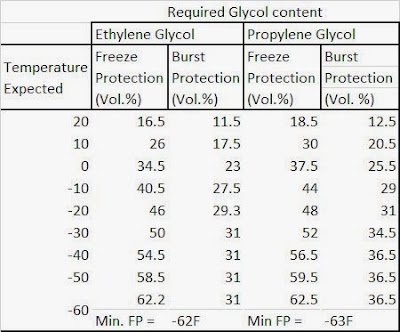
The key point is this: -50F burst products contain 25% PG (per spec sheets, MSDS, and testing). Dow, who makes the stuff, lists the PVC burst point as 0F. As Mainesail pointed out, at 11F, a 25 % mixture is frozen (see the table). If there is ANY dilution (say 20% instead of 25%) it is expanding at 10F. In West Marine's defense, they mention this in small print on the back of the bottle, though most brands do not.

For much of the country, -50F products are marginal and live perilously close to false advertising.

 
Oct 9, 2008
1,742
Bristol 29.9 Dana Point
I use -100 (the blue stuff) on the raw side of the engine. Mostly because I read the labels, and when mixed with water the pink stuff is basically useless (as the OP said). The blue stuff is rated to still retain significant protection even when mixed 1 to 1, which is great when running through the engine, as water lingers in the paths. I don't have the ratings, but I remember the difference between pink and blue is drastic regarding mixing w\ water.
 
Nov 18, 2010
2,441
Catalina 310 Hingham, MA
For a little fun this year I kept my refractometer in my pocket while I was working on my boat. Any time I saw someone winterizing their boat with a different brand of antifreeze I asked if I could test it. I found 4 brands advertised as "-50F" that when tested were less than 0F on the unused antifreeze. I couldn't believe it.

Some stuff that was sold at Walmart as -50F only tested to 20F. It was being sold for $2.99. It was only another $2 per gallon more for good -50F and $6 for -100F.

I didn't see another person at my marina testing with a refractometer. I couldn't believe it. When I asked, most just said that they never had tested and it always worked out fine. Then again, I also talked to a number of people who didn't bypass and drain their water tanks and water heaters. They just dumped gallons (usually 20 or more) into their tanks and ran the water until they saw pink.
 
Feb 6, 1998
11,759
Canadian Sailcraft 36T Casco Bay, ME
For a little fun this year I kept my refractometer in my pocket while I was working on my boat. Any time I saw someone winterizing their boat with a different brand of antifreeze I asked if I could test it. I found 4 brands advertised as "-50F" that when tested were less than 0F on the unused antifreeze. I couldn't believe it.

Some stuff that was sold at Walmart as -50F only tested to 20F. It was being sold for $2.99. It was only another $2 per gallon more for good -50F and $6 for -100F.

I didn't see another person at my marina testing with a refractometer. I couldn't believe it. When I asked, most just said that they never had tested and it always worked out fine. Then again, I also talked to a number of people who didn't bypass and drain their water tanks and water heaters. They just dumped gallons (usually 20 or more) into their tanks and ran the water until they saw pink.
Keep in mind your refractometer is showing you the freeze point not the burst point. This stuff is sold on "burst points" for iron pipe..... Burst points for plastic pipe are significantly higher..... Also you tested some that are alcohol based not PG.

*Freeze point is where it will no longer flow

*Burst point is where it expands and causes damage and is different for different materials.

When using a refractometer just sample the bottle then match that reading to what spits out the faucet or transom.....
 
Mar 26, 2011
3,965
Corsair F-24 MK I Deale, MD
One reason some products may have shown +20F freeze protection is that they contain a mix of PG and ethanol. This mix cannot be accurately read with ANY field meter or method; laboratory GC testing only. The ethanol will read low by refractometer and may show >32F by hydrometer, but not knowing the mix....

I would avoid any mix with ethanol like the plague.
 
Feb 6, 1998
11,759
Canadian Sailcraft 36T Casco Bay, ME
One reason some products may have shown +20F freeze protection is that they contain a mix of PG and ethanol. This mix cannot be accurately read with ANY field meter or method; laboratory GC testing only. The ethanol will read low by refractometer and may show >32F by hydrometer, but not knowing the mix....

I would avoid any mix with ethanol like the plague.
The Wal*Mart / SuperTech stuff JK mentions is ethanol based not PG....
 
Jun 6, 2006
6,990
currently boatless wishing Harrington Harbor North, MD
I think you guys are using the wrong stuff. The clear stuff has a condensing point of -250 F. You just mix 20% oxygen and 70% Nitrogen and blow it into the tubing. a little water left in the tubes will not hurt as it can expand into the clear stuff space.
Oh yea, it is free and does not give you that bad taste in the spring.
 
Mar 26, 2011
3,965
Corsair F-24 MK I Deale, MD
I think you guys are using the wrong stuff. The clear stuff has a condensing point of -250 F. You just mix 20% oxygen and 70% Nitrogen and blow it into the tubing. a little water left in the tubes will not hurt as it can expand into the clear stuff space.
Oh yea, it is free and does not give you that bad taste in the spring.
That can be the very best answer. For exanple, Jabsco recomends draining. However....

a. The boatyard blew out the system on my boat the first winter (before I closed on it). Only problem is that on-demand water heaters have a coil that often does not clear completly. Busted fittings on the bottom. This is a common problem for these.

b. Complex piping can be hard to blow out. Transom showers and anchor washdowns are notorious.

c. I spent a year chasing down small leaks; to blow out the piping you have to break lines. Now that I use glycol, no leaks.

d. Bad taste is generally because either PG went in the tank (install fittings to avoid this) or the owner used to little glycol (anything under 25% is bug food) and left it through warm weather (flush it out as soon as the frost passes--80F spring days are an incubator). I've never had a taste problem. It's not the glycol, it's the biology.

e. Can't used the head if it's drained = no off-season sailing. Not acceptable to me.
 
Jul 1, 2010
990
Catalina 350 Port Huron
Obviously, you need propylene glycol or draining for potable water systems. For engine and head, I'm an ethylene glycol fan. You can't go wrong with a drain and fill with a 50-50 ethylene glycol mix where I live. Simple, cheap, effective and compatible with system components. FWIW, my boat is stored in my yard and I don't have to deal with any marina rules (if there are such things against EG).