Below are my thoughts on this subject. Just to give some background for my opinions below, I have worked in the environmental consulting industry since I graduated from college in 1998 with degrees in geology and chemistry. Most of my work has been related to the redevelopment of older buildings including schools, mills, factories, etc. and the cleanup after a couple of major oil companies. I have been licensed in all disciplines of asbestos consulting (inspection, project monitoring, management planning, project designing) in Massachusetts, Rhode Island, Connecticut, Maine, New Hampshire and Vermont. I have also been certified in Massachusetts to train others relative to asbestos consulting and health effects of exposure. Whoever said that the asbestos industry is a "cash cow" has outdated information, perhaps in the 1980's-early 1990's. Now it is mainly a side note for most construction and environmental projects.

Asbestos was considered the wonder mineral because of the physical properties of the mineral. It is strong, highly resistant to heat, chemicals (mainly acids), abrasion and it is stable over the long term. Because of this, it was put into a large variety of products. I have seen asbestos in just about anything you can imagine: kids pajamas; cigarette filters; wall paper; drinking water filters;
Space Shuttle Solid Rocket Boosters; etc. To be honest, in many applications you can't get a better or even similar performing material as you get from one that is asbestos-containing.
Here is a partial list of where asbestos can be found and
here is a list that claims to be complete. Shipyards are specifically mentioned in the US EPA regulations on asbestos but that is more intended to address thermal system insulation that was used in large naval and cargo ships rather than fiberglass boats.
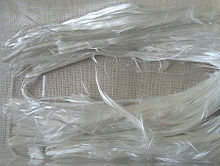
Chrysotile Fibers
Asbestos is still available commercially today. You can find products on the shelves of local home stores that will list asbestos on the labels. A trick often used is to list the mineral name (chrysotile and amosite are often listed) or a trade name (Rockbestos is a popular one). Asbestos is still mined in Canada and shipped to the US in large quantities. Chances are that you come in contact with asbestos-containing materials every day.
From an exposure/health aspect, the largest danger is being exposed to loose, airborne fibers. Significant exposure (long durations to high concentrations of airborne fibers) can cause asbestosis, a debilitating lung disease. Short term exposures can cause mesothelioma however there is some evidence that there may be a genetic component to this disease as well. The most significant risk from exposure it to smokers. Asbestos and smoking has a synergistic relationship and you are 50-90 percent more likely to develop lung cancer if you smoke and are exposed to asbestos. With all asbestos-related health effects the biggest problem is that there is a latency period of 5-30 years from exposure until the health effects are manifested. This typically makes determining the source of exposure difficult.
Most exposures are occupational related. If the asbestos-containing material is in good condition, there is no exposure to the asbestos. It doesn’t leach out or off-gas from the material. Generally, exposure only occurs when the material is damaged or disturbed intentionally. You should not be afraid to be in a boat or a building that has asbestos-containing materials.
As a boater who does his own maintenance, you should be aware of where you may encounter asbestos in your boat. Common items that could contain asbestos include caulking, sealant, bedding compound, adhesives, exhaust riser insulation, electrical wire insulation (cloth style, not plastic), and gaskets. We have also seen anecdotal information that asbestos was used as a thickening agent for resins. If you're lucky enough to find copies of the original design plans you might be able to find out exactly where asbestos was used on your boat. But most aren't that lucky. Also, you will likely never know what previous owners or workers used during repairs or maintenance.
Vermiculite has been mention as being
used in some boats. Vermiculite itself is not asbestos, however it is often
contaminated with asbestos during natural mineral formation. It may also be called Zonolite, the trade name used by W.R. Grace. It would be prudent to treat all vermiculite as asbestos since the fast majority of vermiculite came from the W.R. Grace mine in Libby, Montana that is contaminated with asbestos.
So does this mean you should not work on your own boat unless you are dressed in an outbreak-suite?
Not in my opinion. But everyone is responsible for assessing their own tolerance for risk.*
Here is what I would do.*
Fiberglass, silica and even wood dust have been found to have similar effects as asbestos. And really dust is the issue. So control the dust and protect yourself from exposure while generating dust.
- Wet down the area of cutting or grinding. I typically use a spray bottle with water. You can add some dish soap but that foams and can be difficult. Another good option is windshield washing fluid. But just water and work great. I use a cheap $1 spray bottle for small jobs and a garden sprayer for larger jobs.
- Use HEPA filters in your shop vacuum. HEPA stands for high-efficiency particulate air. At Home Depot, a true HEPA filter will cost you $130, a “HEPA-rated material” filter will cost you $30 and a standard filter will cost you $17. It’s up to you which one to choose, but I don’t use anything less than the $30 filter myself. I have the shop vacuum on with the nozzle by the cut area while working. A large portion of the dust and debris will be sucked up right away. When you go to empty the vacuum or wash the filter, keep it wet and wear your respirator (see below).
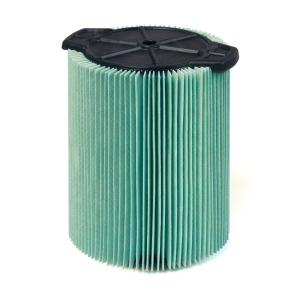
HEPA-related material filter from Home Depot
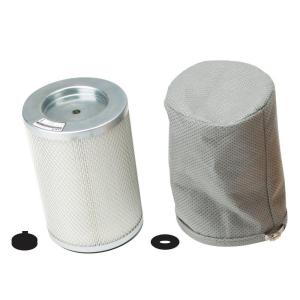
HEPA filter from Home Depot
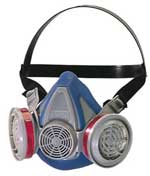
- Buy a good respirator, the appropriate filters and use it. The brand I prefer is MSA and a half-face respirator from Home Depot is $50. The filter cartridges you want for most applications will be the P100, but I would go with the multi-purpose filter so it would cover you for most of what you would come in come across working on your boat. Two things related to respirators, if you are going to wear one make sure you are OK'd by your doctor (when worn for a job you must have a pulmonary function test) and learn how to wear it and care for it properly.
If you are ever truly concerned if asbestos in present, you can collect a sample of the material and submit it to a local laboratory for asbestos testing. It shouldn't cost any more than $25 per sample and take about two weeks for the results. But keep in mind that if you confirm that asbestos is present you might be obligated to follow regulations and laws regarding the disposal of the waste and work practices.
I would dispose of small amounts of waste with my household trash. Place it in one garbage bag with water than seal the bag with duct tape. Then place that bag in a second bag and seal that one with duct tape as well.
*Disclaimer. This is just my thoughts and likely do not comply with recommendations you would get from your doctor or regulatory authorities. Follow at your own risk.
Cross posted on my blog (
http://svsmitty.wordpress.com/2013/04/08/asbestos-in-boats/).


 .
.


