
Yanmar losing coolant
- Thread starter Tim R.
- Start date
- Status
- Not open for further replies.

Those elbows are double walled and the injection point is on the downward leg unless there is a pin hole in that in the engine side of the U..Maybe not. The mixing elbow on this engine is high and the port going into the exhaust manifold is lower than the port exiting to the muffler. I think it could leak back in without filling the hose and muffler.
Sorry for the horrible MS Paint work:
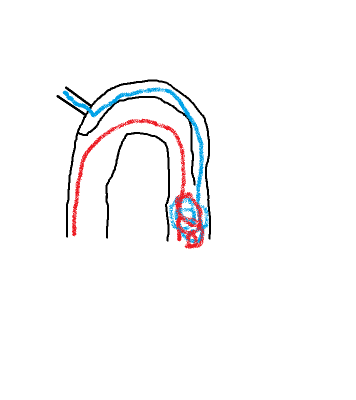
Great, he's a good guy. So will we see you guys out this weekend?Paul at Portland Radiator should be able to test the HE core this afternoon or tomorrow morning. I am going to get some new O-rings and reassemble and test.
Sweet!The inside of the HE housing/exhaust manifold look great. No signs of corrosion.

How adorable! You are getting really good at staying inside the lines! I think I will hang that up on the fridge!Sorry for the horrible MS Paint work:

Not if I do not have this worked out. Heading up to Yankee to pick up new O-rings shortly.So will we see you guys out this weekend?
How adorable! You are getting really good at staying inside the lines! I think I will hang that up on the fridge!
Not if I do not have this worked out. Heading up to Yankee to pick up new O-rings shortly.
Let me know if I can help in any way..
Cool. Thanks. Racing tonight?Let me know if I can help in any way..
Just heard from Chris. no racing. I think I will use my flex camera to take a look inside the HE tonight. Got the O-rings. Waiting to hear back from Paul.
When you get it back together pull the injection hose off the elbow and stick it in a bucket. When you pressurize and test again this will show if it is leaking through the raw water or not. If no AF out the injection hose then that rules it out..
Good point.When you get it back together pull the injection hose off the elbow and stick it in a bucket. When you pressurize and test again this will show if it is leaking through the raw water or not. If no AF out the injection hose then that rules it out..
Here are some photos of the inside of the HE. Hopefully Paul will have the core all done tomorrow.
Attachments
-
 22.8 KB Views: 287
 -
 24.9 KB Views: 299
 -
 19.9 KB Views: 292

Looks fine in there but that is the side that sees the antifreeze with the good anti corrode stuff .. The ID of the tubes see the seawater .. Hoping that ya find that it was just a bad O-ring fit.. There are some industrial shops that can re-tube one for a lot less than a new bundle from Yanmar.. search around on heat exchangers in yellow pages and the 'net if it comes to pass that ya need new tubes. The tubes are generally swedged (mechanically upset) into the tubesheet and can be carefully drilled/ pulled/ re-swedged and finally, pressure tested. not cheap, but sometimes a lot less expensive than a new one. Good luck, Tim
Those are some reeally cool pix from the bore camera!
Those are some reeally cool pix from the bore camera!

Not sure what I'm looking at in your second pic, but it appears from the marks that are on the end of the inner tube plate, there was a connection to that plate that was offset. Does the end cap provide seal against this inner tube plat as well?
Witz, that is the oppoosite cover that has been removed and is hanging by the hoses that I think are still connected..?? same cover ya see in the first picture at the far end..
Tim, is it an optical dillusion (?) that the gasket/o-ring surface in the second picture is showing some flow across the face?? Looks like the bolts may have been overtorqued and deformed the sealing face a little ?? the darker corroded areas at both bolts.. as well as the places at 12 0-clock (crack there?) and 11 o-clock where it looks like some leakage across the face may have been moving?? I would have expected the face to be shiny and smooth like it is between 3 o-clock and 7 o-clock.. ??
Tim, is it an optical dillusion (?) that the gasket/o-ring surface in the second picture is showing some flow across the face?? Looks like the bolts may have been overtorqued and deformed the sealing face a little ?? the darker corroded areas at both bolts.. as well as the places at 12 0-clock (crack there?) and 11 o-clock where it looks like some leakage across the face may have been moving?? I would have expected the face to be shiny and smooth like it is between 3 o-clock and 7 o-clock.. ??
Yes, that is the other end cap hanging at the far end.
The flex camera is fairly low quality and has misrepresented the true condition of the mating surface. The shiny part is actually not the sealing surface. Just inside of that section is a 45° chamfer. The O-ring fits around the outside of the core, inside of the cover plate and then this chamfer squeezes it all together.
See the attached photo. The red is the O-ring, the black is the HE housing and cap and the blue is the HE core.
The flex camera is fairly low quality and has misrepresented the true condition of the mating surface. The shiny part is actually not the sealing surface. Just inside of that section is a 45° chamfer. The O-ring fits around the outside of the core, inside of the cover plate and then this chamfer squeezes it all together.
See the attached photo. The red is the O-ring, the black is the HE housing and cap and the blue is the HE core.
Attachments
-
 13.6 KB Views: 254
Reinstalled the HE last night and it is still losing pressure. Looks like I will be tearing the engine apart this weekend instead of going to our yummy lobster bake.
I am not sure a compression test will do any good as the leak seems to be one way. Somehow the fresh water is getting into the exhaust and if it's not the HE then it will be a pressurized area that should blow exhaust back into the HE but it is not.
Next will be to remove the exhaust riser and exhaust manifold/HE assembly. If those check out, then the head will come off.
My suspicion at this point is the head gasket has failed although I do still have my doubts as that leak would have to be a one way leak based on the symptoms.
My fear is that I will get it all apart and not find the smoking gun.
I am not sure a compression test will do any good as the leak seems to be one way. Somehow the fresh water is getting into the exhaust and if it's not the HE then it will be a pressurized area that should blow exhaust back into the HE but it is not.
Next will be to remove the exhaust riser and exhaust manifold/HE assembly. If those check out, then the head will come off.
My suspicion at this point is the head gasket has failed although I do still have my doubts as that leak would have to be a one way leak based on the symptoms.
My fear is that I will get it all apart and not find the smoking gun.

Tim,
First I am so sorry to follow your leakage problem. A couple of thoughts-
I have personally been mis-lead T/S mechanical problems because I have looked at a condition or a test result and have concluded that it points unequivocally to a certain fault. You may have already thought about the following but I will make the suggestions anyway-
Are you absolutely sure that your pressure test result is not due to a leak in the pressure tester itself? Can you do the same pressure test on another engine to validate the tester itself?
Why don't you run the engine again now that you have tested the HE and installed new gaskets and check if you are still loosing AF?
I would certainly do a compression test to test the head gasket.
My experience when having trouble identifying a difficult fault is that sometimes there are two faults that present themselves in a similar manner. Maybe you had a leaking gasket on your HE and you also have a leaky tester?
Don't let an anticipated fault cloud your T/S procedures.
First I am so sorry to follow your leakage problem. A couple of thoughts-
I have personally been mis-lead T/S mechanical problems because I have looked at a condition or a test result and have concluded that it points unequivocally to a certain fault. You may have already thought about the following but I will make the suggestions anyway-
Are you absolutely sure that your pressure test result is not due to a leak in the pressure tester itself? Can you do the same pressure test on another engine to validate the tester itself?
Why don't you run the engine again now that you have tested the HE and installed new gaskets and check if you are still loosing AF?
I would certainly do a compression test to test the head gasket.
My experience when having trouble identifying a difficult fault is that sometimes there are two faults that present themselves in a similar manner. Maybe you had a leaking gasket on your HE and you also have a leaky tester?
Don't let an anticipated fault cloud your T/S procedures.
I think this suggestion is an excellent one. Why don't you give it a try? It's quick and easy and it might give some more clues.When you get it back together pull the injection hose off the elbow and stick it in a bucket. When you pressurize and test again this will show if it is leaking through the raw water or not. If no AF out the injection hose then that rules it out..
Your statement is true if the head gasket leak is between the coolant passages and the exhaust passages.I am not sure a compression test will do any good as the leak seems to be one way. Somehow the fresh water is getting into the exhaust and if it's not the HE then it will be a pressurized area that should blow exhaust back into the HE but it is not.
If you have a head gasket leak that is between the intake manifold and the coolant passages I think AF could be sucked into the cylinders when the intake valve is open and there is negative pressure in the intake manifold.
This type of leak would not allow exhaust gas to push into the coolant loop thus you would not see any increase of pressure in the system with your pressure tester but you would see AF in the exhaust. This condition could also cause hard starting.
Maybe something to consider?
Thanks Rich but along with the dropping needle is a loss of coolant that ends up in the exhaust. And I did test the tester.Tim,
First I am so sorry to follow your leakage problem. A couple of thoughts-
I have personally been mis-lead T/S mechanical problems because I have looked at a condition or a test result and have concluded that it points unequivocally to a certain fault. You may have already thought about the following but I will make the suggestions anyway-
Are you absolutely sure that your pressure test result is not due to a leak in the pressure tester itself? Can you do the same pressure test on another engine to validate the tester itself?
Why don't you run the engine again now that you have tested the HE and installed new gaskets and check if you are still loosing AF?
I would certainly do a compression test to test the head gasket.
My experience when having trouble identifying a difficult fault is that sometimes there are two faults that present themselves in a similar manner. Maybe you had a leaking gasket on your HE and you also have a leaky tester?
Don't let an anticipated fault cloud your T/S procedures.
- Status
- Not open for further replies.