X-Rating swedge fittings

Status
Not open for further replies.

vetch

.
Dec 3, 2011
111
Prout Manta 38 St. Augustine
I've heard from a few places that the only way to really inspect swedged together fittings is to have them x-rayed. Do any Nondestructive Testing (NDT or NDE) companies do this. I'm curious because I am an industrial X-ray tech and I've never heard of this being done. Maybe I should take a few to work and shoot them see what I see.
 
Dec 2, 2003
1,637
Hunter 376 Warsash, England --
Yes please and please tell us your findings.
This topic is something of a 'black art' and one has no way of knowing if those that do this for a living are genuinely able to detect incipient faults or whether we are being conned!!
 
Nov 6, 2006
10,219
Hunter 34 Mandeville Louisiana
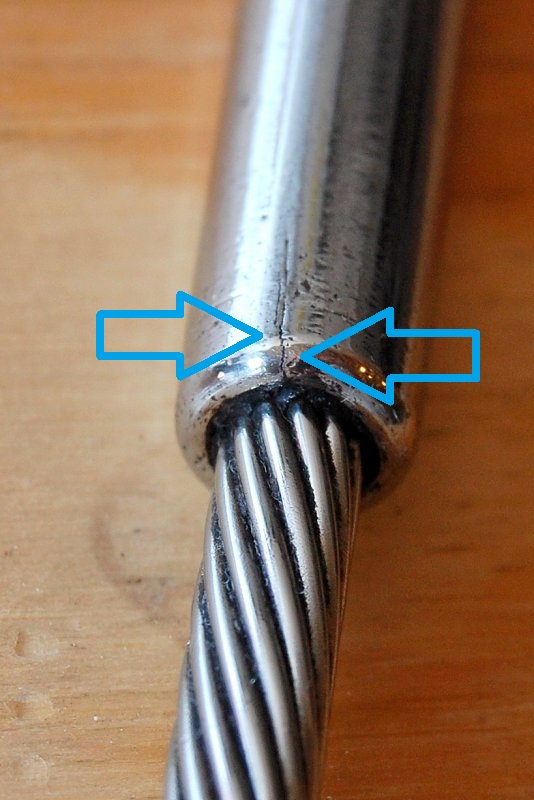
Vetch, I don't think X-ray would tell ya much unless you happened to shoot directly into a defect.. Not likely.. I believe the best for inspecting is PT (dye penetrant) looking carefully at the top lip, where the wire exits, and down the body.. I have never tried to x-ray or UT (shear wave) a fitting, but I don't think that would tell ya much.. I have found a few cracks in the swedge using PT. It would be interesting to see what a good digital x-ray would tell ya.. do let us know !!
Edit; The failure mode I have seen is longitudinal cracking from the lip downward.. I have seen one that had a small longitudinal crack in the middle of the body and not the top lip. The crack relieves the hoop stress in the swedge which then allows the wire to pull out.
 
Last edited:

vetch

.
Dec 3, 2011
111
Prout Manta 38 St. Augustine
PT would be tough to properly clean out esp. around the wire rope. And shear wave would have issues for the same reason. A radiograph (X-ray) could show a crack but your right you would have to have it right in line with the film. I know this is not a service my company offers most of the marine work we do is weld inspections of new vessels. I will do a couple and report back. I'll try a dye pen test on one too.
 
Nov 6, 2006
10,219
Hunter 34 Mandeville Louisiana
I can't tell ya what a mess we made of the gel coat on the first one we did.. That dye was almost impossible to remove ! You are right about the top.. The wire absorbs dye and makes a mess.. I guess I should have said the top area around the lip.. The shear wave can't see because the back wall is really rough and the shell is really too thin.... why we never tried.. We thought that x-ray might work if we could shoot a longitudinal shot to see a crack.. but figured the fitting is too long to get useful results.. Good luck..
 
Mar 26, 2011
3,971
Corsair F-24 MK I Deale, MD
I do ND testing on tanks an piping...

... and on a polished surface like that, 9 times out of 10, you will do better with good light and a magnifying glass. Really. By the time penatrant sees it, you will, and the rough back surface will make X-ray and UT very difficult.

None of these methods will spot the micro cracks that are the beginnings of failure.

Sorry. On the other hand, frequent close visual inspection works.

I had a boat that would fatigue certain fittings ~ every 5 years. I always caught them in time. I learned to inspect them frequently.
 
Nov 28, 2009
495
Catalina 30 St. Croix
Dye penetrant only detects surface indications. The swagging process creates high stress areas because as the fitting passes through the two rollers, the material will tend to ridge. Some companies will run the swage fitting twice at 90 degrees to each other.
If you are using PT, tape the wire and carefully brush the penetrant on the fitting. Cover the deck area first. If not sure of the process, Google ASME for non-destructive testing. It gives you the waiting time for each step. Remember that a very thin, faint line is not a rejectable indication. The brighter the penetrant, the deeper or wider the indication.
I have X-rayed standing rigging many times. Twice a detected problems and corrected them. It works. I used Stone and Webster's lab in Boston when I lived in that area.
You might need two shots to make sure nothing is missed. A rejectable indication will show as a thin lighter line because the density is less. Have also x-rayed chain plates in place with a portable source. I am a retired level II and III in every NDE process and have inspected many pipes and fittings in both nuclear and fossil plants.
 

vetch

.
Dec 3, 2011
111
Prout Manta 38 St. Augustine
Do you just shoot it for the thickness if the fitting? I also imagine you'd want the most sensitive film you have.

I would be useing IR192 as the source


I don't want to thing about what excessive PT would do to white gelcoat. I doubt you'd ever get it out.
 
Feb 6, 1998
11,760
Canadian Sailcraft 36T Casco Bay, ME
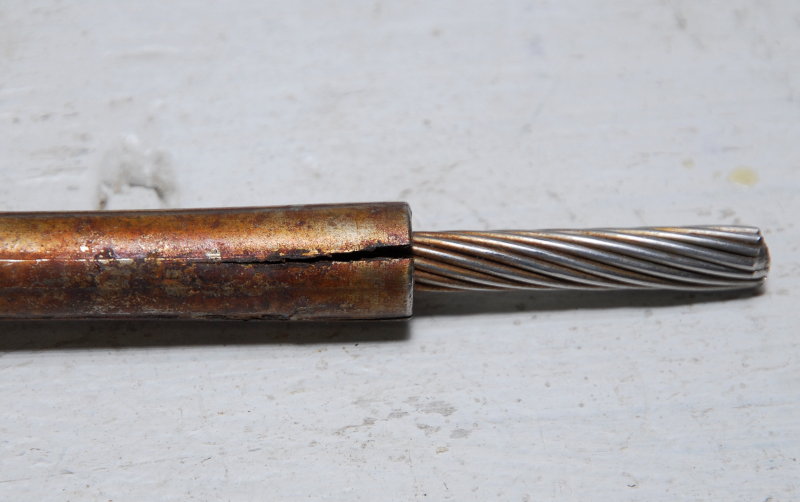
Sometimes failures are easy to spot:


Sometimes a little harder:


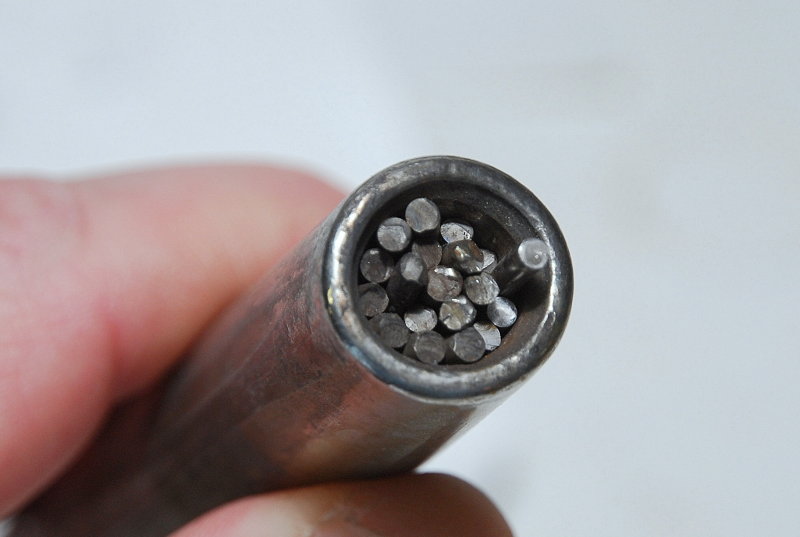
And sometimes I don't even know that an x-ray could predict a failure:
 
Mar 26, 2011
3,971
Corsair F-24 MK I Deale, MD
That is my feeling, specifically reguarding swages...

Sometimes failures are easy to spot:


Sometimes a little harder:


And sometimes I don't even know that an x-ray could predict a failure:
... which was the original question.

The most common cracks start at the wire entry, as you show, and you can almost always see them coming well before failure. Your examples would be easy to spot, even much earlier, with a glass. Yes, an x-ray might see them, but the "line" of indication would parallel the strands and thus be difficult to spot.

The shear failure of the wires, again would be hard to see, as it would line up with the end. Generally, a cracked strand gives early warning.

And really, if there is any indication on any fitting on the boat, you replace them all since they are untrusted. The cost of the x-ray service compared to the depreciated value of the rigging is not, IMHO, a good deal. I'm not sure how you do the masthead fittings without either taking them down (most sailors do not pull masts in the winter, but some in the north do) or taking a lot of trips up-and-down. Then, there are all the worker/community exposure rules. I suspect the rigging labor and testing will approach the residual value of the rigging.

Chainplates, depending on how hard they are to get at, is a completely different matter. Easier to evaluate, higher replacement cost. Often a very good idea, rather than tearing the boat open. Turnbuckles and the like may also make sense, as they are easy.
 
Dec 2, 2003
1,637
Hunter 376 Warsash, England --
Are we really better off with stainless rigging?

Are we really better off with stainless rigging?
  • When I first started sailing rigging wires were spliced around thimbles then parcelled and served. (no swages!)
  • Each winter they were coiled up and left soaking in boiled linseed oil.
  • Failure was very rare and they lasted longer than ten years - 20 more like.
  • Insurance companies were not on our backs.
  • The steel did not work harden or suffer stress corrosion and one could pry the lay open with a marlin spike and look see if the centre was rusting.
  • Rigging was not set up so tight then, though the ultimate loads were unchanged from today.
  • Just a bit messy thats all!
 
Mar 24, 2011
16
parker 31 JAX
After making rigging for 25 years I have come across this very discussion many times, and the result is always the same when in doubt replace!…the industry standard is to replace standing rigging every 7-10 years….that’s not from us riggers or surveyors, that’s from the wire and fitting manufactures, also backed up by most of us riggers…….I have seen rigging that was both x-rayed and dyed but still we found cracks and replaced if after the owner spent a ton of money with the x-ray. Its faulss economy if the rigging is getting close to 10 years old. I inspect hundreds of rigs each year around the world and the first line of my report reads “If your rigging is over ten years old it must be replaced” and I don’t know many good rigging companies that don’t say the say. Think safety first then think about saving your money and replace when the time is right. Most important is to inspect or have your rigging inspected REGULARLEY….
Smooth sailing
 
Apr 8, 2010
2,238
Ericson Yachts Olson 34 28400 Portland OR
Why it's called Preventative Maintenance

Agree with Sparman completely.
Scroll back up to that third picture that Maine posted. That was what was left, down a little ways inside a perfectly-fine-looking lower swage on a boat that was dismasted on a sunny afternoon several decades ago off the WA coast. I was at the tiller, matter of fact.
Zero warning. Just heard a loud bang, and suddenly I had an unimpeded view of the horizon. :cry:

We cut the halyards at the mast base, and pulled the jib aboard. Removed the boom & pulled all the remaining pins. The hair-pinned spar was bouncing and tearing at the housetop hand rail and toe rail, and we soon let it go to the bottom. Once we checked for stray lines, we motored back to Astoria.

As I recall, without finding my notes, that rig was about 13 years old. It had been sailed hard in the salt waters of Puget Sound.

L
 
Dec 2, 2003
1,637
Hunter 376 Warsash, England --
Rig Failures Please

We were bound to hear from those who run successful businesses by striking terror into gullible people's hearts.
How is it that 9 year old rigs are safe yet 11 year old ones are not.
Yes I know that masts are expensive compared to rigging - but rigging is not cheap either.
They have even conned insurance companies into taking up this hue and cry!

What designer would specify rigging knowing that it would be likely to fail after only ten years? Except for a state of the art race boat it is so easy to use the next gauge up and reduce the stress factors considerably.
I prefer to trust the designer.

My last boat was a masthead rigged half tonner with an enormous spinnaker. The rigging loads were phenomenal.
It was 18 years old when I sold it and the only wire I replaced was the forestay and that was only because the UPVC headsail foil had worn the strands of the 1x19 wire flat under the foil at the top bearing.
Everything else inspected okay.

Could we please hear from those who have lost their rigs, at what age and why they failed.
 
Nov 28, 2009
495
Catalina 30 St. Croix
Swaged fittings will show a linear rejectable indication. The wire has twist. Can't confuse the two in an x-ray. Depending on the length of exposure for the metal thickness, you will see a much darker line because of less density. Next time you look at one of your teeth x-ray look at how much lighter the filling looks. If you over expose the x-ray film then all is lost. Everything will look dark.
An example also would be tungsten inclusion on a SS weld. The tunsten will show as a very bright spot.
 

vetch

.
Dec 3, 2011
111
Prout Manta 38 St. Augustine
So does anyone have a procedure for shooting a swedge fitting?
 
Feb 6, 1998
11,760
Canadian Sailcraft 36T Casco Bay, ME
Could we please hear from those who have lost their rigs, at what age and why they failed.
I was on a delivery when we lost a rig. Boat was about 13 years old if I recall though could have been 12. Rig had just undergone a rig survey. Defect was undetectable. Failed at a lower swage for the port upper, similar to pic #3 above. Lucky the new owner was with us when it happened. Insurace covered it but only due to the recent rig survey that passed it. Had it been a hull only survey the concern is that they may not have covered it. Oh and lots of damage to the boat and hull and the vessel required a full re-paint due to the spar banging against the hull after it went over. Due to conditions we were not able to save much of it. I also had a long discussions with Carl Hayn about this and am now dead set on 10 year replacement cycles.

When you lose a rig you get religion. I replace every ten. Simply not worth the risk to my family...
 
Nov 6, 2006
10,219
Hunter 34 Mandeville Louisiana
Interesting, Maine. I can see why picture 3 failure would not be detectable. That is most likely a fatigue failure where the other two are most likely stress-corrosion cracking. No way to read a developing fatigue failure in picture 3 because an x-ray would be almost impossible to read the difference between the taper edge of the swedge and the crack(s) in the wire(s). A dye check would be a mess of un-readability.. This kind of failure would most likely have happened from an off-center, alternating pull on the swedge .. but could have been mechanically damaged initially during a mast down time one winter. ?? could also be a defect in the bore of the swedge internal cavity that caused a pinch point .. just speculating from the appearance of the pictures.. would need a microscope and lab to get real answers.
EDIT: lost backstay on a boat we were delivering .Saved the rig since we had the mainsail sheeted in tightly. The failure was stress corrosion cracking and the fitting looked exactly like Maine's picture #1, except it had progressed to where the wire was gone!.
 
Last edited:
Status
Not open for further replies.