Whats new in the world of sailing? Inflatable sails anyone?

Nov 8, 2007
1,607
Hunter 27_75-84 Sandusky Harbor Marina, Ohio
No, I actually ran a compete series of tests of a symmetrical NASA wing shape in a small wind tunnel through different angles of attack, and wind speeds/Reynolds numbers. The wing was instrumented with 10 air pressure tubes on the top and bottom. I developed a computer program to compute the aerodynamic lift and drag from the pressure data on each run. At the same time, a strain gauge measured actual total lift on the mount of the wing which verified the calculated lift quite well. We saved the beer for the weekends, when there were women around. (And we were too young for the bars at that time.)

Jackdaw, that was my Junior year, and I think it qualifies as solid working experience of what was really happening. Based on this work, my Professor invited me to write a senior thesis for him based on theoretical work, then instrumenting and running our supersonic wind tunnel to study detailed flow patterns at Mach 2-4.
 
Last edited:
Oct 19, 2017
8,030
O'Day Mariner 19 Littleton, NH


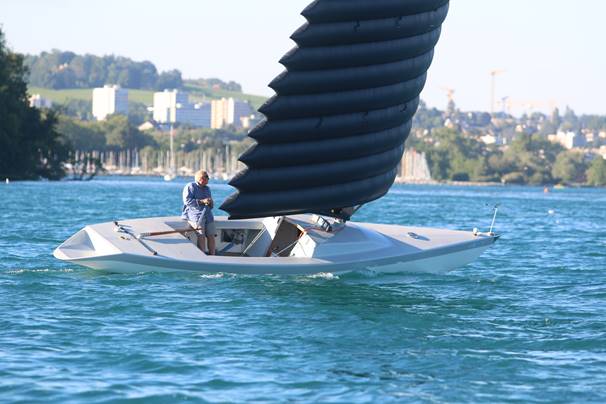
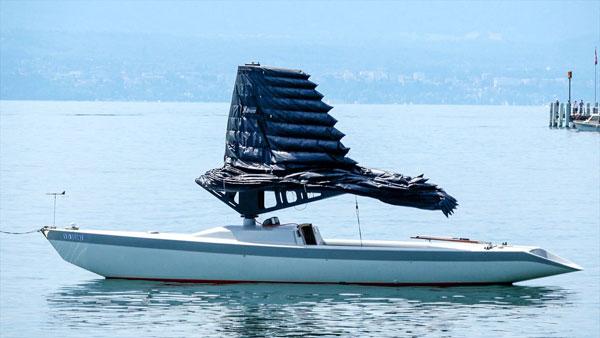
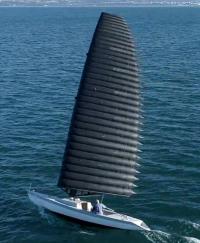
A few more images to help visualize how this thing works.
I'm skeptical of the ability of that sail to take an efficient wing shape. Because the mast pivot base is behind the leading edge, wouldn't that sail tend to flex in the reverse direction? It looks like it would have much less camber or reverse camber, concave on the leeward side. Obviously it sails. It looks like it's moving along, but is it moving along in a competitive class with a traditional sail?
Telltails would be nice to see.

-Will (Dragonfly)
 
Sep 20, 2014
1,330
Rob Legg RL24 Chain O'Lakes
A couple of problems I question. First, the trailing edge is not typical of the well established optimum shape for a wing sail. Its not that it won't work, but just a loss of efficiency. The second issue is what it is supported with. With no stays, the internal support structure must be considerably heavier than a conventional setup. This means the keel must be heavier, and therefore the boat is heavier for a similar setup. With the extra surface area created by all the tucks, you have significantly increased drag. Lastly, how do you control twist?
There are enough problems with the idea, I really question if there is much if any measurable performance improvement.
I like this idea much better:

I actually have an idea to do a wing sail that would actually work and still be nearly as light as a conventional sail. In addition, the windward side would be nearly flat like the underside of an airplane wing.
 
Last edited:
  • Like
Likes: Will Gilmore