

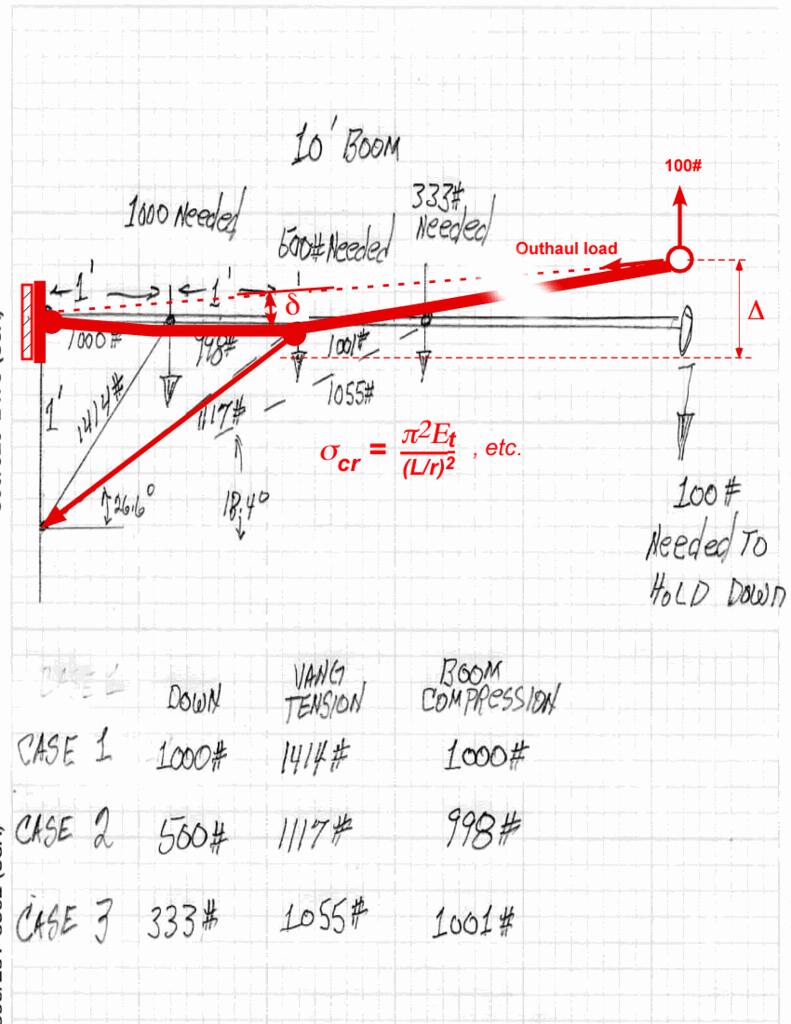
I agree with your static analysis .... but my concerns have always been the presence of enhanced buckling failure mode due to the induced compressional-axial loads from the vang.
Standard 'thin beam' formulas can be applied or derived from the 'generalized Euler Buckling Load formulas or the 'tangent modulus' formulas .... and this certainly isnt the place to discuss them.
Nevertheless as the vang attachment is moved 'aft' and towards 'midspan' of the boom, the 'length to radius ratio" in all such formulas becomes larger and you get greater 'deflection' due to applied load coupled with the 'horizontal' induced compressional forces from the vang system .... the boom becomes more vulnerable to buckling failure ... and more so with a loose footed boom than a boom that has 'slug' attachments (distributive counter-load applied), etc. All depends on I^E3 or 'boom stiffness'.
Ive also broken a more than few (thin sectioned) booms over the years, especially when they become 'dipped' into the water at 'speed'; hence, my interest and curiosity.
Standard 'thin beam' formulas can be applied or derived from the 'generalized Euler Buckling Load formulas or the 'tangent modulus' formulas .... and this certainly isnt the place to discuss them.
Nevertheless as the vang attachment is moved 'aft' and towards 'midspan' of the boom, the 'length to radius ratio" in all such formulas becomes larger and you get greater 'deflection' due to applied load coupled with the 'horizontal' induced compressional forces from the vang system .... the boom becomes more vulnerable to buckling failure ... and more so with a loose footed boom than a boom that has 'slug' attachments (distributive counter-load applied), etc. All depends on I^E3 or 'boom stiffness'.
Ive also broken a more than few (thin sectioned) booms over the years, especially when they become 'dipped' into the water at 'speed'; hence, my interest and curiosity.


