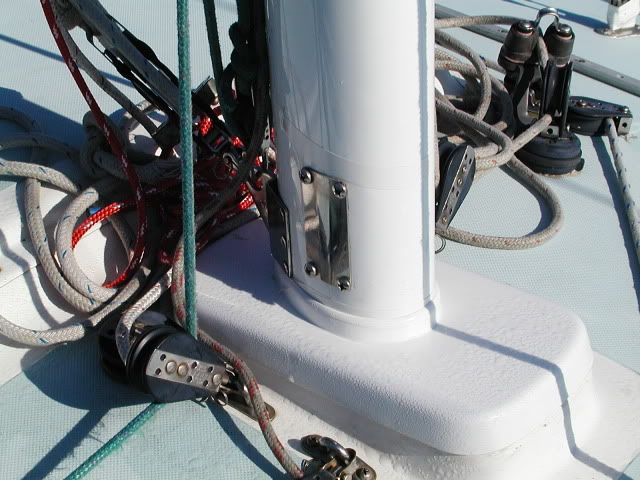
Four years on, the surface quality of my Perfection job is still very much the same very nice as right after I painted it. I needed to paint the smooth cabin top surface because the original factory gelcoat had weathered all the way through to the underlying FRP layer. Perfection is good product, but it has some issues which have prompted me to plan a redo later this summer after the sailing season:
- As already mentioned by others, Interlux's flattening agent will reduce the very high gloss to a semi-gloss. I also wanted to reduce glare -- and also not highlight as much the subsurface imperfections. For this, the flattening agent did work. But also the flattening agent (which is clear) dilutes the opacity of the primary color -- Mediterranean White in my case. Since I primed first with Interlux's epoxy Primecoat (white color), the reduced opacity wasn't an issue. Until about two years later. What has happened is that UV from the sun has penetrated through the flattening agent diluted Perfection finish coat and has caused the underlying Primecoat to gradually discolor which shows through the Perfection coats. Epoxy primers (and epoxies in general) don't do too well under UV attack. Subsequently, I have learned that the work-around is to use the Perfection without the flattening agent for the first coat (and second if that's the plan). Then only use the flattening agent on the final coat. The drawback to this is that any holidays or thin spots on the final coat will result in a splotchy surface sheen. For my next go-around, I'll not bother with the flattening agent.
- As mentioned already in a previous post on this thread, I also have found that masking tape has pulled off the Perfection from underlying epoxy primer such as around my port frames.. Speaking with Interlux, this may because I missed sanding the primer coat in some spots before applying the Perfection. Also the UV (per above) may have damaged the surface of the primer coat a bit.
- On the topic of surface preparation, you mention that the smooth cabin top surface has already been painted. In my opinion, check compatibility with whatever your next product choice is. One test is wet a paper towel with lacquer thinner. Place it on your existing paint surface where you won't be upset if it gets damaged. Check on it several minutes later. If the existing surface has softened/blistered/lifted off the paint, then Perfection will certainly do the same. You would need to remove all the existing paint down the the gelcoat. If you don't have time or inclination for this much surface preparations, then a one-coat enamel/polyurethane mineral spirits based paint is your fall back.
- For brushing application of Perfection, I found that lots of the special thinner is needed. Also, it evaporates quickly in the brushing container, so the tendency is to keep adding more thinner to keep the paint from becoming too thick to flow out. Waiting for a period of cool but dry days is a must.
- I can confirm that overnight dew before the paint has had enough time to set will ruin the gloss.
- Follow the instructions exactly. Also the mixing containers must not have any contaminants, or fish-eyes will result. I found this when retouching a small area after repositioning my cabin top winches. Even though the surface never been wax and had been cleaned first with solvent before sanding, the Perfection fish-eyed. Since it was a small surface, my mixing container was a soda can (ok probably a beer can) that I had cut the top off of. Turns out the inside of aluminum beverage cans have a clear protective plastic coating. Perfection softened the coating allowing it to contaminate the paint.
- People have mentioned spraying Perfection. If you do want to go this route, just make sure that you research and take seriously the safety issues. I have read that a full positive ventilation mask with air supply source outside of the painting area is a must. Also a full suit needs to be worn. Reason is that the chemical compounds in a 2-part are even much more dangerous than 1-part paints when aerosol particles are inhaled. Also the 2-part will settle/harden in the lung tissue and then can't be expelled. For brushing, and following the safety instructions, supposedly the 2-parts are safe for DIY'ers.
- I also used Perfection for my non-skid areas. Although somewhat stained an discolored, the original factory surface was still in very good physical condition. It had never been waxed. Surface preparation was only water and a very stiff nylon scrub brush. The flattening agent was used to the max allowed to dull the final surface sheen. Because the non-skid color was somewhat darker and no primer was used, my non-skid has held up wonderfully. Into the Perfection was mixed Interlux's non-skid granuals product.
Anyway, these are some of my experiences with Perfection. But as I said above, its all worth it because the surface quality stays beautiful for years.
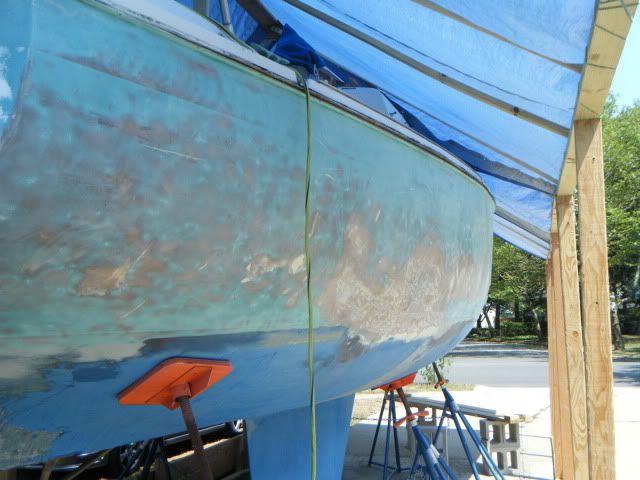
You mention a concern that a newly painted cabin top will be a mismatch for the topsides sections of 30 year old hull . I suggest don't worry about it. I also had this concern. But if your topsides still is in reasonable shape, a good cleaning with oxalic acid to remove embedded stains and mineral deposits, then compounding and then waxing will restore the look at least am acceptable semi gloss finish. You can find lots of info on the process on this forum. However, do the best you can to find a cabin top paint color that matches your topside gelcoat color.
The attached photos show the outcome of my Perfection projects.