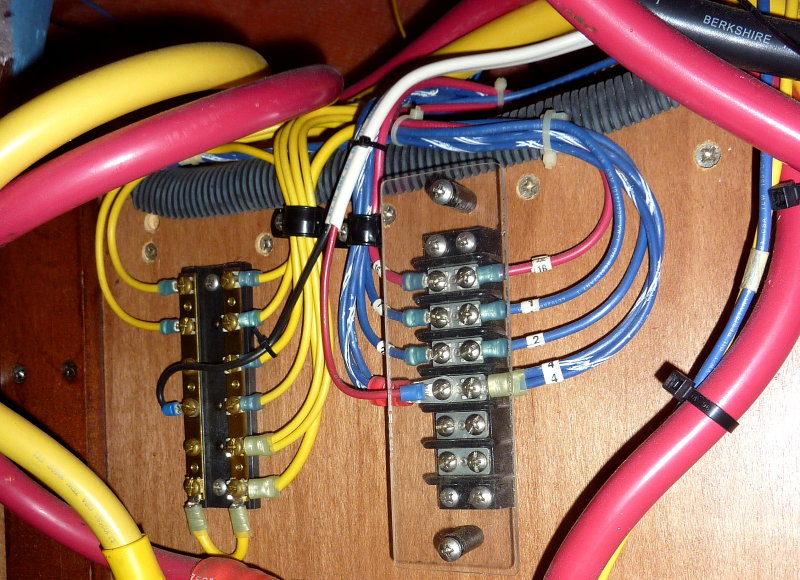
Temp gage, sender, or ??

Jan 27, 2008
3,092
ODay 35 Beaufort, NC
I've recently upgraded my heat exchanger in my Universal M25 engine to the recommended 3" diameter. I also just installed a new exhaust riser and water injection pipe. After powering for about 12 miles on Friday in zero wind my temperature gage was rock steady at 160 degrees (the thermostat setting on the M25).

Leaving the anchorage on Saturday motor was running fine and we were creeping along avoiding other boats and I looked at the temperature gage and it was pinned on the max side of the gage. Needless to say I almost had a heart attack, as we were in close proximity to other boats and entering the channel to leave the anchorage. The engine showed no signs of overheating, meaning no steam in the exhaust, no black or gray smoke, I felt the coolant cap and it wasn't hot so I opened it and there was no sign the coolant was anything other than normal. I had excellent cooling water flow out the exhaust. We powered at low speed to the end of the channel and I hoisted a jib and killed the motor. For the next ten miles the gage stayed pinned at the max. When I turned on the key periodically to power the gage it would tend to move toward the high side but never indicated the engine was cooling down. Entering our inlet I started it (the engine) up and it started fine and ran fine back to our slip, about another 2 miles. The gage just stays pinned at the max.

So my question to the experts here, is the gage fried? Do I need a new temp sender? I read in the archives a temp gage is like an ohm meter, could it just be a bad connection somewhere causing extreme resistance driving the gage to infinity? I see in West I can get a gage and sender for about 50 bucks but will need to see if the sizes will match. As additional information, the gage has had some condensation in it for a while, while running there is some mist on the inside lens of the gage that disappears when not running, so I know the gage is not hermetically sealed.

Any thoughts on this conundrum?
 

DougM

.
Jul 24, 2005
2,242
Beneteau 323 Manistee, MI
I would suggest the simple things first.
Check the connections at both the sender and the gauge.
Check the continuity of the wire between gauge and sender.
Test the sender itself.
Look at the wire itself checking for bare spots in the insulation or broken wire.
 
Feb 8, 2014
1,300
Columbia 36 Muskegon
Check the wire from the sender to the gauge. If you short the wire to ground, the gauge will pin on hot. You probably just have a bit of bare wire touching the block. Of course it could be the gauge, but the wire is more likely.
 
Jan 27, 2008
3,092
ODay 35 Beaufort, NC
Good advice, thank you. I need to do MaineSail's recommended upgrade to the wire harness while I'm at it. It is interesting to note that while looking up the gage on the Universal Engine website I noticed that brand new engines are still being shipped with those trailer light connectors that he rants and raves about being a fire hazard. His fix is very elegant and makes common sense.

On another note, for you sparky's out there, how come 12V terminal blocks don't need to be in a junction box type enclosure to protect against accidental grounding? Shorting out a live 12V circuit can still result in welding style currents, seems dangerous to have those connections exposed. Are butt connectors with adhesive shrink wrap a better choice for safety sake?
 
Oct 17, 2011
2,809
Ericson 29 Southport..
Jibes, for what it's worth.....that is the way that I did mine. I would never dispute Maine on his electronics, as I wholly agree on his ABYC method of the strip, I use them commonly. My thinking was unless you needed the open access of the strip, ie: testing currents or continuities, the heat shrink eliminates a possible corrosion issue.

And, when I cut out that trailer plug, mine indeed almost fell apart from the poor connection; it absolutely needed done. But crimping and heat shrinking made the connections permanent..
 
Feb 8, 2014
1,300
Columbia 36 Muskegon
The trailer connectors are only there to make installing the engine easier. Once it's in, you don't need them anymore. Might as well connect the wires permanently, and without the add resistance everything will work better.
 
Feb 6, 1998
11,759
Canadian Sailcraft 36T Casco Bay, ME
It is interesting to note that while looking up the gage on the Universal Engine website I noticed that brand new engines are still being shipped with those trailer light connectors that he rants and raves about being a fire hazard. His fix is very elegant and makes common sense.
The difference?


  • Both ends are made by Westerbeke, not one end by Westerbeke and another molded from silly-putty by Seward for Catalina or other builders...


  • They no longer pass any substantial current. Glow plus are now driven by a solenoid so that circuit is now under 2A when on for 10 seconds.


  • Alternator no longer passes through the plugs...


  • All the plugs really do these days is power gauges with very, very little current flowing through the plugs... That said they are still HORRIBLE plugs compared to the Delphi type plugs companies like Yanmar use.

On another note, for you sparky's out there, how come 12V terminal blocks don't need to be in a junction box type enclosure to protect against accidental grounding? Shorting out a live 12V circuit can still result in welding style currents, seems dangerous to have those connections exposed. Are butt connectors with adhesive shrink wrap a better choice for safety sake?
They should be covered in certain circumstances... You can put them in a box or put a cover over them... I use a piece of polycarbonate cut to just barely wider than the t-strip and 1" - 1.5" longer. I then drill two holes, one in each end and install it over the terminal strip. Blue Sea argues that the dividers on the stripes protect from accidental shorting because they are taller than the set screws...

This one, in the upper reaches of a lazarette, I added a cover to...


I'll also use t-strips with factory made covers, when the situation warrants it, but they are rather expensive, about twice the cost of the Blue Sea strips..

Beyond that any properly wired vessel should have zero issues if a short is creates because those wires will be PROPERLY fused. At best you blow up a fuse...;)

On a properly wired vessel you should be able to pick any wire, randomly, short it, and only damage a fuse... Course there are TONS of improperly & unsafely wired boats out there so don't try this at home....:D
 
Jan 27, 2008
3,092
ODay 35 Beaufort, NC
Thanks guys, the polycarbonate covers are a great idea MaineSail. Cheap and easy. Going back to my gage, so if high current drives the gage to high temp then I assume turning off the power the gage should go to minimum temp? In my case it is staying pinned at max temp with no power. Is it safe to say the gage is shot and needs replacement? They are pretty reasonable from a cost standpoint.
 
Mar 11, 2015
357
Hunter 33.5 Tacoma, WA
After powering for about 12 miles on Friday in zero wind my temperature gage was rock steady at 160 degrees (the thermostat setting on the M25).

Any thoughts on this conundrum?
Yes... Buy one if these cheap laser temperature gauges, point it at the thermostat housing to really check the temperature. This also validates your gauge.

Besides checking obvious stuff like the engine temperature, you can also check other stuff like the alternator, battery temp, etc. Get to know what "normal" is around the engine.

http://www.ebay.com/itm/Portable-HT...aser-Thermometer-Gun-Temp-Gauge-/151232034134
 
Jan 27, 2008
3,092
ODay 35 Beaufort, NC
Dave, why not just test the gauge? Teleflex has "how to"s on their website.
.
Thanks for the info Stu. The boat is about 85 miles away so I was hoping if I could get confirmation from the symptoms that a gage or sender was needed I'd get them in advance as i'm not sure the retail stores in the area will have them in stock and on line ordering will take several days for receipt. All indications are the gage is shorting driving it to max temp. So it could just be a wire, but with no current I was wondering if the gage would return to zero.

Meanwhile I have to go fight the dinosaurs that are attacking my house :>)
 

Attachments

Feb 6, 1998
11,759
Canadian Sailcraft 36T Casco Bay, ME
Jibes,

Odd that this happened after you did some cooling system work. Check to be sure your system is not air-bound and be sure it is well air-bled. This is the number one issue I come across after "work has been done"... Remember the freshwater pump, unlike the raw water pump, is not really a pump but rather a circulator. If it is air bound it won't move anything yet the sender will read the steam.....
 
Jan 27, 2008
3,092
ODay 35 Beaufort, NC
Jibes,

Odd that this happened after you did some cooling system work. Check to be sure your system is not air-bound and be sure it is well air-bled. This is the number one issue I come across after "work has been done"... Remember the freshwater pump, unlike the raw water pump, is not really a pump but rather a circulator. If it is air bound it won't move anything yet the sender will read the steam.....
Maine Sail, I ran the motor for over two hours the previous day at probably around 80% RPM speed for at least ten miles and the temperature was rock steady at 160 the whole trip. The next day when I saw the gage pinned at the max we had only motored a short distance, maybe a quarter mile and I was able to open the coolant reservoir without any steam or coolant escaping. The engine showed no signs of abnormal operation in terms of sound, smoke, steam in exhaust, etc.

After my coolant system work to burp the engine I pulled the hose at the bottom of the thermostat and filled it. I pulled the top hose off the hot water tank and filled it holding it above the coolant reservoir. I put a spare hose on the water heater outlet (Raritan water heater) and holding it vertically I filled the hot water heater with coolant, then reattached the engine hose to the hot water tank. I hear you about burping the engine, but if it was overheating to pin the gage I think it would have quickly destroyed the engine. I'll test the gage and sender using the info provided and I'll go back through the cooling system to make sure it is circulating and not air locked. I'll let you know what I find.

The reason I think it is a bad instrument or wiring is it will not move off max even after the engine was shut down for at least two hours sailing back. It is odd that it would suddenly fail for no obvious reason, so I have some detective work. Thanks again.
 
Sep 15, 2009
6,244
S2 9.2a Fairhope Al
that sounds more like the temp sensor with it dropping after it cools down it may be sticking some how just a thought....the gauge itself wont do anything without a signal of some sort
 
May 4, 2005
4,062
Macgregor 26d Ft Lauderdale, Fl
1+ on the IR gun. (cheap too).

I use it to monitor water pump impellers on OB's. Just take a (head) reading when its running good for a baseline. once it creeps up, I know the impeller is going bad.

should work on the heat exchanger.
 
Jan 27, 2008
3,092
ODay 35 Beaufort, NC
So here's an update on my troubleshooting today. My conundrum is now a quagmire. I arrived at boat and powered up the panel and the temp gage immediately returned to zero. I checked the resistance of the sender and it was about 88 ohms cold. I removed the wire from the sender for an open circuit and gage pinned at zero. I shorted the wire to ground and the gage pinned at max temp. So the gage and sender seem to be working OK.
So now I'm thinking I really was overheating and the coolant loop must have been air locked. So I pulled the thermostat and cooked it in water on the stove. It opened right up as expected well before boiling the water. So I put it back together again and topped off the coolant tank. I loosened the clamp on the hose that feeds into the coolant pump inlet and as soon as I cracked the hose coolant came out.
I started the motor and ran it for over a half hour with engine in reverse for much of it in the slip. The temperature gage rose to 160 and stayed there rock steady. I checked every hose connection to make sure it wasn't leaking and all seems OK. The resistance on the temperature sender was much lower at operating temperature, I wrote it down so I can use that as a quick check if I have further troubles. I think it was about 76 ohms at temperature, but I left the actual numbers on the boat.

so the quagmire is now wondering why the excursion to high temp on the gage? I checked the wires and no sign of a short, no insulation damage.

On another note I checked the alternator output at the alternator, and had 14.02 Volts right at the output post. I checked the voltage at the battery and it was only 12.7 volts. After shutting down the engine, the battery was 12.66 volts, so the loss in the ammeter circuit is providing almost no boost to the battery. Time to do Maine Sail's voltmeter replacement project and jump the alternator output to the engine starter post.

I didn't pull the gage panel out but plan to do that to check the status of all connections just hoping something jumps out at me as a cause of the high temp reading. The engine did not show any signs of acting abnormally, it started right up and ran fine, no smoke or unusual noises, etc. that would indicate damage from over heating. Very odd problem.
 

Gzito

.
Apr 9, 2015
29
oday 322 hempstead harbor
I just purchased a infrared temp gun. Pointed it at the thermostat housing on my 2gm20 yanmar. Read 163 -165 f. Is that normal or is that high?
By the way mz4wheeler
I thought that was great idea to purchase the temp gun.
 
Sep 15, 2009
6,244
S2 9.2a Fairhope Al
I just purchased a infrared temp gun. Pointed it at the thermostat housing on my 2gm20 yanmar. Read 163 -165 f. Is that normal or is that high?
By the way mz4wheeler
I thought that was great idea to purchase the temp gun.
that is perfect the t stat is a 160 degree and you are right there
 

Gzito

.
Apr 9, 2015
29
oday 322 hempstead harbor
Thanks woodster.
I've never had an actual gauge On the motor so that temp gun is great idea.
I use it for the oven onboard as well.