Start Battery as Deep Cycle.......

Feb 6, 1998
11,759
Canadian Sailcraft 36T Casco Bay, ME
I have a customers boat that is launching this morning and I just got back from replacing the start battery.

The vessel has a bank of 6V golf cart batteries as house, that are now 6.5 years old, and a single G-31 "starting battery" the owner purchased at an auto-parts store in Canada that is now just two years old.

Last winter 2014>2015 the entire vessel was re-varnished, at a yard way Down East, and when the boat yard doing the work re-commissioned the vessel Bank #1 and Bank #2 (clearly labeled BTW) were wired backwards. This was not discovered until fall. The owner used the boat all last summer thinking the start battery was the house bank. D'oh... In the fall the batteries were disconnected and the owners battery maintainers connected to their respective banks as he does every winter..

When I started the motor to commission her a few days ago I used the house bank and it started beautifully. The start battery was showing decent voltage but when I went to start the motor on it the voltage collapsed, the battery was toast. As near as the owner could figure they only did about 20 deep cycles on it last season. They are normally very heavy cruisers leaving in early June and returning in late October, but they had a new grandson last summer and cruised very little compared to what they normally do.

The owner is very careful about not over-discharging and always stops discharging at 12.1V - 12.2V. They did mention that the voltage was dropping much more rapidly than it usually did last summer but just assumed the 6 year old batteries were getting weak. When I winterized in the fall we realized why the voltage was dropping rapidly.

Apparently 20 cycles on a starting battery is about all you get. The house bank has been to Newfoundland and back and likely has a few hundred cycles and is still in quite good shape for the age and use.

Be careful wiring, don't mix up your banks, and don't try using start batteries as house batteries...:wink3:
 
Feb 26, 2004
23,342
Catalina 34 224 Maple Bay, BC, Canada
and don't try using start batteries as house batteries
I would add that since we have been promoting the use of the 1-2-B switch an other wiring arrangements for making the switch(es) USE switches, rather than charging switch(es), that the start/reserve bank CAN be used for LIMITED house loads in an emergency situation if the house bank is down. Turn your fridge off. Use a handheld radio. Run your engine once started. All sorts of ways to do this. And a reserve bank is cheap compared to a set of house batteries.

Combining bad & good banks, like the dual circuit plus switch does, is not the right thing to do. Those switches are good for small powerboats, as you've said many, many times, but not for sailboats.
 
May 24, 2004
7,213
CC 30 South Florida
I would add that since we have been promoting the use of the 1-2-B switch an other wiring arrangements for making the switch(es) USE switches, rather than charging switch(es), that the start/reserve bank CAN be used for LIMITED house loads in an emergency situation if the house bank is down. Turn your fridge off. Use a handheld radio. Run your engine once started. All sorts of ways to do this. And a reserve bank is cheap compared to a set of house batteries.

Combining bad & good banks, like the dual circuit plus switch does, is not the right thing to do. Those switches are good for small powerboats, as you've said many, many times, but not for sailboats.
Sorry I haven't been paying attention; I understand the using of the battery switch 1,2,A just for determining which bank handles the loads but what is the reason and how do you direct the alternator charge current? To prevent any damage I do not want the engine to be able to start with the alternator not connected to a battery.
 
Nov 13, 2013
723
Catalina 34 Tacoma
Sorry I haven't been paying attention; I understand the using of the battery switch 1,2,A just for determining which bank handles the loads but what is the reason and how do you direct the alternator charge current? To prevent any damage I do not want the engine to be able to start with the alternator not connected to a battery.
Connect the alternator out to the house bank. Also connect the voltage sense lead to the house bank. The reason is you want to sense the charge of the house bank which in theory is your larger bank and send the alternator charge to it. Start battery should be connected to an ACR or Exho charger to maintain its charge.
 
Feb 26, 2004
23,342
Catalina 34 224 Maple Bay, BC, Canada
but what is the reason and how do you direct the alternator charge current? To prevent any damage I do not want the engine to be able to start with the alternator not connected to a battery.
Benny, you run the AO direct to the house bank. Reasons explained in the links.

Like this:

Basic Battery Wiring Diagrams This is a very good basic primer for boat system wiring: http://c34.org/bbs/index.php/topic,6604.0.html

This is another very good basic primer for boat system wiring: The 1-2-B Switch by Maine Sail (brings together a lot of what this subject is all about)
http://forums.catalina.sailboatowners.com/showthread.php?t=137615

What are ACRs, Combiners & Echo Chargers? (by Maine Sail)
http://forums.catalina.sailboatowners.com/showthread.php?p=742417
 
Jan 30, 2012
1,154
Nor'Sea 27 "Kiwanda" Portland/ Anacortes
Would you consider using a 100 ah G 24 or 31 deep cycle instead of automotive for the 'start battery'?

Putting a deep cycle in place of the usual start battery would allow the start battery to withstand many more deep cycles than 20. That way one can use the start for house loads in a pinch without having to be too awfully concerned.about killing a standard (not deep cycle) start battery.

Charles
 
Nov 13, 2013
723
Catalina 34 Tacoma
Would you consider using a 100 ah G 24 or 31 deep cycle instead of automotive for the 'start battery'?

Putting a deep cycle in place of the usual start battery would allow the start battery to withstand many more deep cycles than 20. That way one can use the start for house loads in a pinch without having to be too awfully concerned.about killing a standard (not deep cycle) start battery.

Charles
Sure but they are generally more expensive. You should only need the start battery to start your engine. If it's isolated from the house bank, you will be able to start and recharge the house bank. Using the start as a house reserve is an emergency situation. A good option to have but you don't want to defeat the purpose of a start battery by using it as a house bank.
 
Feb 6, 1998
11,759
Canadian Sailcraft 36T Casco Bay, ME
Would you consider using a 100 ah G 24 or 31 deep cycle instead of automotive for the 'start battery'?

Putting a deep cycle in place of the usual start battery would allow the start battery to withstand many more deep cycles than 20. That way one can use the start for house loads in a pinch without having to be too awfully concerned.about killing a standard (not deep cycle) start battery.

Charles
I almost always recommend this for our small AUX diesels. I can't recall the last time I installed a "starting battery" in a sailboat, no need to. I generally see 6-10+ years out of a *decent quality G-24, 27 or 31 "psuedo deep-cycle" battery when used as a starting or reserve battery. (Trojan, US Battery, Crown)

I installed an 8D starting battery today but it is starting a Cat 3206 in a commercial work boat. Customer wanted to go with 6V deep cycle batteries, like he has on his other boat, but we could not fit them due to height issues.....

The deep-cycle versions are usually more durable and generally last longer even when used as a starting battery. I did not put that start battery in nor would I have suggested the owner do that.
 
May 24, 2004
7,213
CC 30 South Florida
Ok it seems to be a system to avoid operator blunders thus relieving the need to move the switch at all except to Off at the end of the day. I have trained myself over the years to work the switch as needed and having put the blunders behind me I do not think I'm going to change my system but I can see the merits of the new approach being recommended. Thanks for the info.
 
Sep 15, 2009
6,244
S2 9.2a Fairhope Al
I almost always recommend this for our small AUX diesels. I can't recall the last time I installed a "starting battery" in a sailboat, no need to
am i to assume that my starting battery (which i never use...it's only there in case all else has failed) is redundant at this point ....
 
Mar 20, 2012
3,983
Cal 34-III, MacGregor 25 Salem, Oregon
What are ACRs, Combiners & Echo Chargers? (by Maine Sail)
http://forums.catalina.sailboatowners.com/showthread.php?p=742417
it is my belief that an ACR/battery combiner is the most dependable, simplest, and best way (and affordable) to connect banks together to insure proper charging from either from a single or multiple charge sources....
Is there any situation where a one of these devices would NOT be the recommended way to connect the charging devices to the banks/system?

am i to assume that my starting battery (which i never use...it's only there in case all else has failed) is redundant at this point ....
you assume correctly... but redundency is not a bad thing, even though it may not be necessary.
depending on where one goes with their boat and for how long, redundency may be a very desirable bit of insurance, and yet a dock queen needs no redundency whatsoever....
with all the on-water insurance companies (towboat, boatus, ect..) that are only a phone call away, most boaters are not as isolated as they once were a few years ago...
 
Oct 26, 2008
6,432
Catalina 320 Barnegat, NJ
Combining bad & good banks, like the dual circuit plus switch does, is not the right thing to do. Those switches are good for small powerboats, as you've said many, many times, but not for sailboats.
Well, the Dual Circuit Plus switch operates the 2 banks independently and only combines a bad & good bank when you set the switch to COMBINE. That's no different than the 1-2-B switch when you set the switch to BOTH. I would think that you would qualify your statement by indicating that it is as much a mistake to set the switch to BOTH on the later as it is to set the switch to COMBINE on the former.
With all of the emphasis on monitoring and preserving battery health, proper wiring and fusing, I fail to see any reason to carry an emergency battery. That is why I use the DCP switch for a house bank and a start battery. If there is no reason to carry an extra battery, why do it?
I do recognize that a sailboat has no need for a separate start battery, the house bank serves the purpose quite easily. That said, why even carry a small auxiliary battery. Because you need an emergency battery, you cry. Well, I just happen to be using my small auxiliary battery with the DCP switch for starting. That's basically the only difference between us.
 
Last edited:
Jan 30, 2012
1,154
Nor'Sea 27 "Kiwanda" Portland/ Anacortes
I suggest using a deep cycle instead of an automotive start battery because when the house battery bank peters out during a cruise you can use the start/reserve battery in place of the crippled house battery and carry on somewhat normally.

Dyno Battery makes a true 12 v deep cycle flooded designated 27MD. The 20 hour is 90 amps. In the field - that would give you just under 30 amps usable between charges (80% to 50% SOC).

To illustrate - this deep cycle in reserve set up got me through last year when the house bank crummped during the second week of a five week tour. Also if combine had been the only choice (DCP) the batteries would probably all have become toasted because one could not use the reserve separately from the (now crippled) house bank.

I do not fancy having to diagnose/fix/rewire during cruises so when asked I recommend a boat should be DCP free.

Charles
 
Last edited:
Mar 20, 2012
3,983
Cal 34-III, MacGregor 25 Salem, Oregon
I do recognize that a sailboat has no need for a separate start battery, the house bank serves the purpose quite easily. That said, why even carry a small auxiliary battery. Because you need an
It could also be said, ligitimately, that a sailboat does not even need an engine... but after that argument is settled, the desirability for a backup battery increases with power demands on the boat... the power consumption of of the contrevences some people have, such as a fridge, forced air heat, electronics, (tv, computer, stereo, ect) in use when at anchor can creep up on a person who is not fully aware, and if there is no solar regeneration, the engine may be unstartable....

So it might be better stated that SOME boats dont need for a seperate start battery...
 
Oct 26, 2008
6,432
Catalina 320 Barnegat, NJ
To illustrate - this deep cycle in reserve set up got me through last year when the house bank crummped during the second week of a five week tour. Also if combine had been the only choice (DCP) the batteries would probably all have become toasted because one could not use the reserve separately from the (now crippled) house bank.
Now, with all the discussion about monitoring and maintaining battery health, there seems to be no excuse for being anywhere when your main house bank becomes "toast". Are you ignoring all of the symptoms and warnings? I can understand running your house bank down too far. Then simply start your engine in the normal "ON" position and charge your house bank. The ACR will take care of that. Ok, maybe you got sloppy and let your start battery discharge fully (don't know how you let that happen, but I'll play along). Put the switch on COMBINED (WARNING, WARNING WILL ROBINSON - oh for heaven's sake) and start the engine with your house bank combined with your discharged small start batt. It isn't going to cause a crisis. Then switch over to the normal "ON" position with your engine running (if you're THAT worried about combining good and bad batteries). Make then break will prevent a crisis with your diodes.
But I do agree that a better auxiliary might be a deep cycle anyway. But they take up a lot of space and weight on a small boat.
Also, if you are concerned about combining your reserve bank and your house bank when it's toast (and you are a long way from a resolution), why couldn't you just disconnect your house bank? How much time would that take? 2 minutes?
 
Last edited:
Jan 30, 2012
1,154
Nor'Sea 27 "Kiwanda" Portland/ Anacortes
Scott - You are dead on right. And - no excuses offered nor sympathy expected on this end.

I did not pay attention on that house bank. Moreover even though there were suspicions that the bank was compromised - I pressed the matter thinking I could get just a bit more out of it. Even worse - my monitor is not SmartGuage so there are at least two unknown critical values one has guess at with the Victron BMV for accuracy.

But none of that really gets to the point. The central point is is that a deep cycle backup (as the start/reserve) provides redundancy exactly as Woody alluded to. The 1 2 B switch is capable of doing everything the DCP switch does but it adds true separation. Furthermore there is no downside to using a deep cycle reserve in place of something more anemic.

I am sure you agree that there are other ways one can experience a sudden comprehensive house bank failure and only one of those is failure to pay attention.

5- 6 weeks in the field - 100 miles or more from a civilized battery vendor - can be a cruel teacher.

Charles
 
Last edited:
Sep 15, 2009
6,244
S2 9.2a Fairhope Al
if every one would wire their alt out put direct to the battery bank and get an echo charger for the start battery there would be no need to use the 1-2-both switch ever except to change the house bank to start bank in an emergency
 
Feb 6, 1998
11,759
Canadian Sailcraft 36T Casco Bay, ME
Now, with all the discussion about monitoring and maintaining battery health, there seems to be no excuse for being anywhere when your main house bank becomes "toast". Are you ignoring all of the symptoms and warnings?
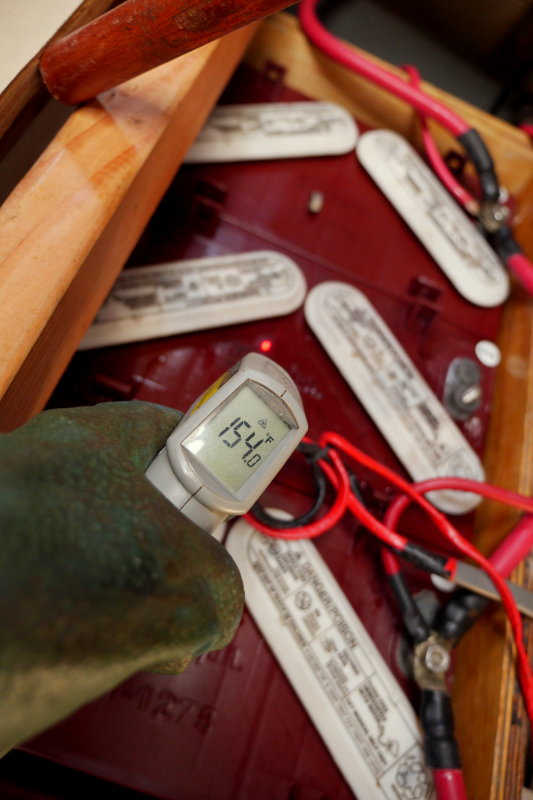
Sometimes there are no real symptoms or warnings and an internal short still happens. One of our SBO members had this happen to him just a few weeks ago and I still need to go over the video and write about it. The text string is actually pretty funny ....


The internally shorted battery was very close to thermal runaway....

I can understand running your house bank down too far. Then simply start your engine in the normal "ON" position and charge your house bank. The ACR will take care of that. Ok, maybe you got sloppy and let your start battery discharge fully (don't know how you let that happen, but I'll play along). Put the switch on COMBINED (WARNING, WARNING WILL ROBINSON - oh for heaven's sake) and start the engine with your house bank combined with your discharged small start batt. It isn't going to cause a crisis.
If all you did is over discharge then yes it won't be a bad situation but if you really over discharged a large bank and combine it with a much smaller one you still may not have enough left over to actually crank the motor. In that case it would be best to isolate the larger bank then start the motor.

On the other hand if one of your batteries shorted internally, it does happen, the last thing you want to do is to combine an 8V or 10V battery with more 12V batteries...