Solent Stay

Jan 10, 2016
127
Islander Wayfarer 37 Sloop Key West
Hello all,
I'm adding a solent stay to my boat and have spent a week reading everything I could and still don't understand something. I read where many sailors leave the sail hanked on to the stay and in a bag on the deck. This leads me to believe the stay is not necessarily fixed to the mast above but is clipped on to an eye below and hoisted with a halyard. If not Dyneema then perhaps a wire rope spliced to a regular rope like in this link,
http://www.westmarine.com/buy/west-marine--wire-to-rope-halyard-kits--P002_065_004_501
To get right to the question, does the top of a solent stay need to be fixed to the mast or can the stay be hoisted through a wire block?
Thanks
 
Nov 8, 2010
11,386
Beneteau First 36.7 & 260 Minneapolis MN & Bayfield WI
The top is almost always attached to the mast. The bottom CAN be lose... if so it is normally attached via a dogbone to a block system designed to put BIG tension on it. Nothing wrong with this inner stay being dyneema; in fact there is a lot to be gained from that.

On the Pogo we often leave the staysail in its deckbag and clipped to the stay and pulled back to the mast. This done to ease tacking the jib. When needed, we pull the whole shooting-match forward and dogbone the stay to the block and tension her up.
 
Jan 10, 2016
127
Islander Wayfarer 37 Sloop Key West
In that picture is the tension from the blue line being put on the stay or the tack? (and I meant to say clew)
OOOPS, nevermind, I opened my eyes!
 
Last edited:
Jan 10, 2016
127
Islander Wayfarer 37 Sloop Key West
Jackdaw, you said the solent stay is Almost always attached to the mast. In what cases is it not?
 
Nov 8, 2010
11,386
Beneteau First 36.7 & 260 Minneapolis MN & Bayfield WI
Jackdaw, you said the solent stay is Almost always attached to the mast. In what cases is it not?
I said 'almost always fixed at the mast side' because I hate to talk in absolutes! ;^)

BY FAR the best way forward is a stay that is fixed at the mast, and secured/adjusted at the deck.

I have seen systems that have adjustments and remote locks on the mast side, but would never recommend them as a general practice. I'm not even sure they were the best solution given the circumstances!
 

weinie

.
Sep 6, 2010
1,297
Jeanneau 349 port washington, ny
What about using a free-luff sail where the stay is built into the luff using dyneema? You could also use a top down furler with an anti-torsion line in lieu of a stay.
ETA: You would need to install sheave in your mast below your jib to facilitate this though.
 
Jan 19, 2010
12,927
Hobie 16 & Rhodes 22 Skeeter Charleston
What about using a free-luff sail where the stay is built into the luff using dyneema? .
I don't remember if it was in SAIL or in Good Old Boat but about two years ago, one of those mags did a piece on solent stays and I believe they used dyneema just the way you describe. I saved the mag in my "idea" drawer. I could go try and dig it out this evening if anyone wants a reference.
 

weinie

.
Sep 6, 2010
1,297
Jeanneau 349 port washington, ny
That sounds interesting, is it something that exists or an idea?
My sailmaker told me about this option when I mentioned I needed a storm jib to comply with the requirements for an offshore race. I was hoping any of you would have some experience with this type of setup before I pulled the trigger on it.
 
Jan 10, 2016
127
Islander Wayfarer 37 Sloop Key West
My sailmaker told me about this option when I mentioned I needed a storm jib to comply with the requirements for an offshore race. I was hoping any of you would have some experience with this type of setup before I pulled the trigger on it.
Thats what I was first thinking of. A sail hanked on to a dyneema stay, the stay and clew hooked to a pad eye behind the furler, then the works hoisted up thru a block and tensioned. The sail I plan to use is about 80 sf. Probably my inexperience is showing.
 

weinie

.
Sep 6, 2010
1,297
Jeanneau 349 port washington, ny
Thats what I was first thinking of. A sail hanked on to a dyneema stay, the stay and clew hooked to a pad eye behind the furler, then the works hoisted up thru a block and tensioned. The sail I plan to use is about 80 sf. Probably my inexperience is showing.
Likewise. We'll have to defer to the experts here! Paging Jackdaw to the courtesy phone.....
 
Nov 8, 2010
11,386
Beneteau First 36.7 & 260 Minneapolis MN & Bayfield WI
Great discussion!

Inner staysails CAN be hoisted on an internal stay, meaning no standalone stay, but I'm not a fan.

1) The stay now has to be hoisted and secured like a halyard. This means the the entire run of the stay (down the mast, and worse back to a winch!) is under tension and can stretch. And abuse gear and fiberglass. On a deck tensioned setup you can put a clutch or halyard lock at the point the blocking ends, greatly minimizing stretch.
2) The sail goes up when the halyard does. It is blowing like stink I promise you that you not have fun. AT ALL. The sail will blow out of the bag and flog way to leeward while you hoist. Only when its up will it start to look like a sail. Until then it's beating the crap out of everything near, including itself.
3) You lose that ability to adjust stay and halyard tension independently. That means you cannot control sag and draft depth/location without effecting the other in a huge way.

The OPs boat is a 25 footer, so some of this becomes more manageable due to size. I'd never do it on a Jenneau 35. Do a dyneema stay, tensioned from below at the deck. Hoist a sail on a halyard.

I quick-read that Joe Cooper post and he knows what he's talking about. Plus he's got Pogo pictures in there as examples. Must be a good man.
 
Jan 10, 2016
127
Islander Wayfarer 37 Sloop Key West
Thanks Jackdaw, you explain it in a way I understand. I also had a discussion about this with a very knowledgeable ( and drop dead cute) girl from the local West Marine who sails a 40' Cheoy Lee. She kept telling me not to do it but wasn't clear why. I'm going with the fixed stay and I'll only be doing a little coastal pleasure cruising. No races or ocean crossings. Thanks again.
I'll try to remember to post pics when it's all up.
 
Nov 8, 2010
11,386
Beneteau First 36.7 & 260 Minneapolis MN & Bayfield WI
Thanks Jackdaw, you explain it in a way I understand. I also had a discussion about this with a very knowledgeable ( and drop dead cute) girl from the local West Marine who sails a 40' Cheoy Lee. She kept telling me not to do it but wasn't clear why. I'm going with the fixed stay and I'll only be doing a little coastal pleasure cruising. No races or ocean crossings. Thanks again.
I'll try to remember to post pics when it's all up.
All good.

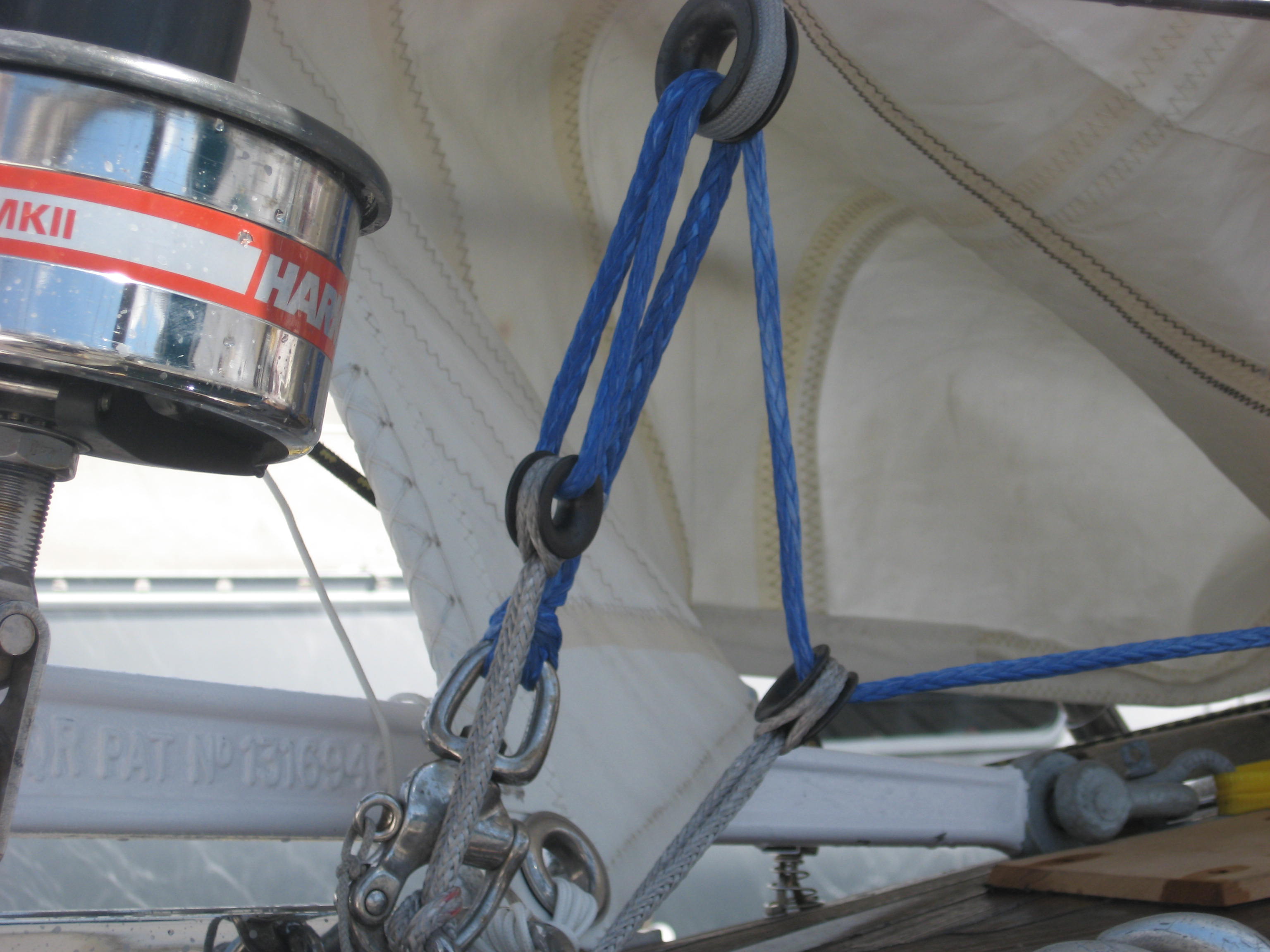
Here is a pic of the Pogo with the stay in place and the sail in its deck bag. This is immediately deployable in this mode, and if the breeze is expected to go up we'll leave it like this for days. Downside is that tacking is more of a chore.


If we expect light airs (or a race!!) we unload the stay block and take the stay off the dogbone. You can see the dogbone and the blue dyneema control line on the centerline of the boat just aft of the anchor locker. We then drag the staysail back to the mast, still hanked onto the stay, and use sail-ties to secure it there. That way we can drag it back forward if needed. If days of <25 knots are expected, we'll put the sail in the locker!


weinie

.
Sep 6, 2010
1,297
Jeanneau 349 port washington, ny
Thank you for the insight Jackdaw!
How do you attach the stay at the mast? I have a padeye above a halyard sheave for this purpose on my mast but not sure what the best way to connect to it with the dyneema stay.
Do you use a block and tackle setup at the base or just the blue control line tensioned with a winch?
Do you use that 2:1 halyard for this sail or for your code 0?
 
Nov 8, 2010
11,386
Beneteau First 36.7 & 260 Minneapolis MN & Bayfield WI
Thank you for the insight Jackdaw!
How do you attach the stay at the mast? I have a padeye above a halyard sheave for this purpose on my mast but not sure what the best way to connect to it with the dyneema stay.
Do you use a block and tackle setup at the base or just the blue control line tensioned with a winch?
Do you use that 2:1 halyard for this sail or for your code 0?
OK!

The Pogo has a carbon mast, so the fitting is built into the laminate schedule. On aluminum masts, normally the fitting is placed FROM INSIDE, with just a slot for the loop and for rivet holes to hold it in place. That way the strength of the section supports it, and not just rivets.

On the Pogo the control line runs down through the deck, and hits an vertical 8:1 block that is secured to the hull bottom along the back side of the anchor locker. This adds advantage pulling straight down on the dogbone. This might be possible on an aftermarket setup, or you can add the advantage on the deck which is more typical. The Pogo line runs through a halyard lock (seen in the picture) and then back to a clutch and a winch on the cabin top.

Because the Pogo Solent is on a stay, the halyard is rather ordinary. It's attached and inside the bag. That 2:1 is for the gennaker and code 0. Even with the 2:1, amazingly high loads are dialed up on that. In the second picture you can see the halyard clutch and winch on the mast. When in use, you do not remove the halyard from the winch. It is needed to help the clutch resist the pull of the code 0. Crazy stuff.


Back to our splicing thread, in the first picture you can see the asym halyard on starboard. No shackle, the sail is tied on with a bowline. In general, there is VERY LITTLE stainless on new high performance boats. Slippery dyneema and low friction rigs, along with soft shackles and knots are replacing it. On your Jeanneau as well I think.
 
Last edited:

weinie

.
Sep 6, 2010
1,297
Jeanneau 349 port washington, ny
Wow...interesting setup!
I have the mast fitting as you described (as well as a padeye on the deck just aft of my anchor locker) , but my question was more mundane...as in how would I attach the dyneema line to the fitting? Do you know of a specific type of terminal one would use? On the bottom end, I think I would copy the setup in one of the above pictures and splice in an antal ring to use for tensioning.

I do have the frictionless jib leads on my boat and they make adjusting lead angles easy even under load. But as they don't move foward and aft, it becomes difficult to change or reef headsails. I think the intent was that one would use a code0 for light upwind performance, the full 'working' 112% jib for mid range, and if really needed, a staysail could be rigged (and of course keep costs down by eliminating a jib car track)

My mast is also setup to run 2:1 halyards which they advise for a code0. Apparently, according to documentation, they are concerend about lateral loads on the halyard sheave. My code0 is more a screecher than a true zero (read: big genoa) so I don't bother with the 2:1 setup.
 
Last edited:
Nov 8, 2010
11,386
Beneteau First 36.7 & 260 Minneapolis MN & Bayfield WI
On the Pogo the mast fitting looks like forestay box; the holding pin is designed to take a 'wheel' that is simply there to increase the diameter of the turn the dyneema makes in the spliced eye.

That's also why they often use loops of smaller dyneema in attachment to places like d-rings, to lower the ratio of turn radius to line diameter. Too tight (<4:1) and the line is weakened.

Yes I've looked at the rigging of your boat; interesting boat and great ideas, but rightly as a cruiser clearly not designed with 100% performance in mind. The Pogo uses a set of in haulers and outhaulers to place the jib lead ring in 3 dimensions. This handles both twist and also acts like a reaching sheet. A trick system that works great once you master it. Sadly that ring can do serious damage to thing like ports. Don't ask me how I know this. It is now held (as well as possible) away from the port with a series of shock cords.


Yes for sure the 2:1 helps spread out the loads due to the wider footprint up top.. The other huge thing the footprint does is prevent the halyard from twisting instead of the top swivel! That's a huge deal because if the halyard twists the sail furls like crap.