Sailing by Gennaker

Aug 7, 2013
52
O'day 39' 25th Anniversary Mystic, CT
We have aboard our O’Day 39 a Gennaker with all the rigging and yet we still motor sail…..
I yearn to learn how to fly this ( would you call it a kite???) sail from hoisting to dousing and all there is to learn in between. I have only hoisted it once, which was a very short lived enjoyable experience until a NAVY Patrol boat in NewLondon Harbor hailed us to alter our course as a SUBMARINE was on a collision course…. Needless to say, this being my first attempt at flying our Gennaker, panic quickly set in! To make a long story short, I gave up the helm to another qualified Captain and went forward to douse, which ended up swallowing me like a sleeping bag… In the end, we got good pics of the Sub, no tears in the sail, but an embarrassing explanation to my sail maker who untangled my BIG mess and sewed me up a new sail bag!!!
Once you all stop laughing at this image, I would appreciate it if you could take a look at my rigging and aside from cleaning it all up, tell me if it looks correct
Note: For illustration purposes, I attached the tack to the halyard.
TIA
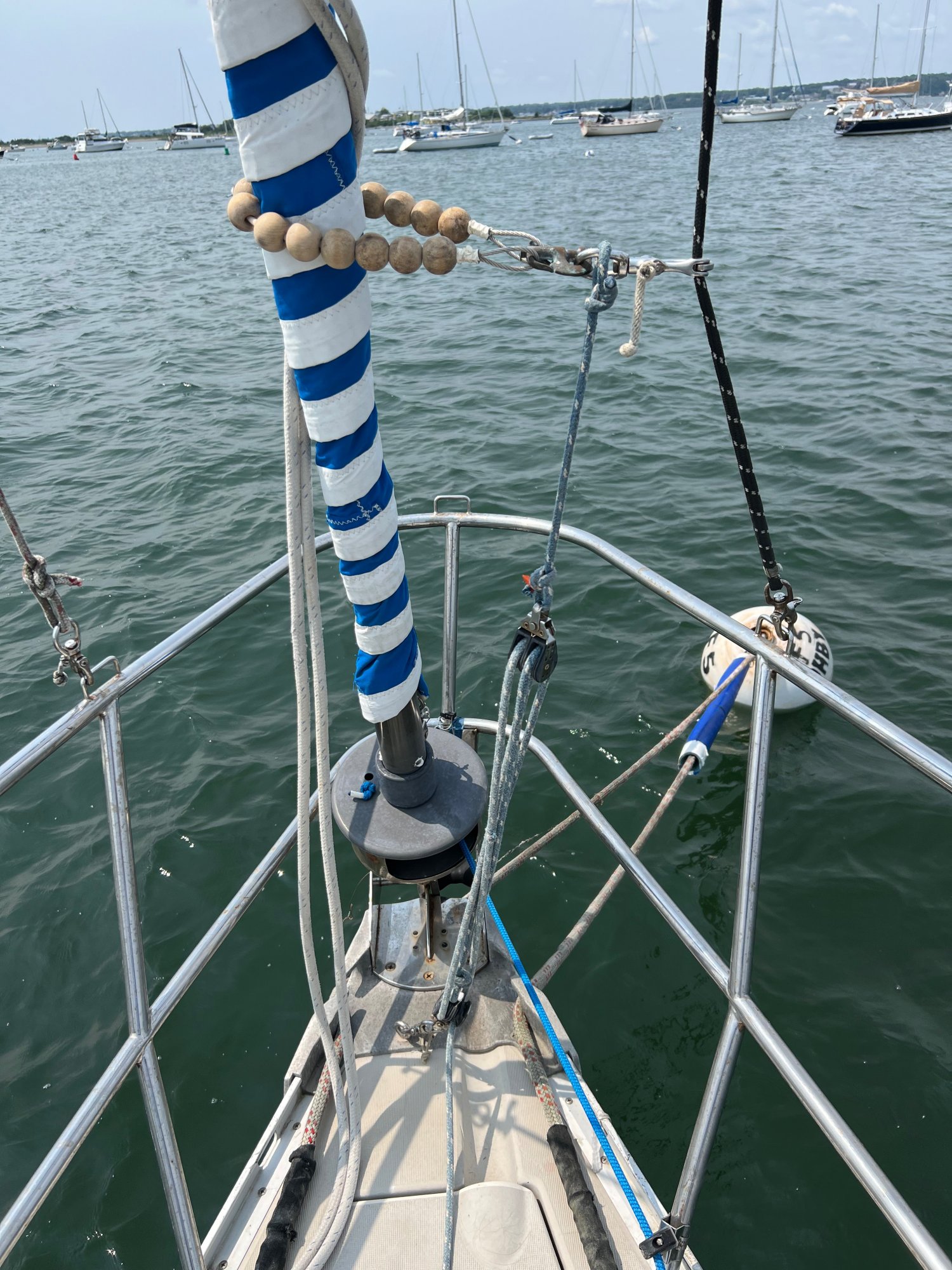
IMG_1375.heic
 

Attachments

  • Like
Likes: rgranger
May 17, 2004
6,173
Beneteau Oceanis 37 Havre de Grace
I think you’ve mostly got it. Where is your spinnaker halyard relative to your head stay? If the spinnaker halyard is above or in front of the head stay you’ll probably want to do outside gybes- let the clew go all the way forward around the front of the forestay and luff and then start pulling it back. That probably means you need to run the lazy sheet around the front of the tack and luff, not through the gap between the luff and the jib. If the sheet is running through that gap you’ll need to pull the whole sail through that small space when you gybe, which won’t be easy.

If the spinnaker halyard isn’t above or in front of the head stay you’d be better off doing inside gybes - bringing the sail through the fore triangle rather than in front of the head stay. If that’s the case you want the lazy sheet just laying on the foredeck, like a jib sheet. That would probably work a little better with that tack line arrangement - with outside gybes the tack line with need to wind around the lower part of the furled jib. But if the halyard is in front of the head stay inside gybes will wrap the halyard around the head stay, which is even worse than having the tack line wrap around.
 
Jun 9, 2008
1,852
- -- -Bayfield
If I tell you something you already know, I'm sorry. Maybe I might type something you don't know and that should be a help. That beaded thing around your furled headsail is a poor man's tacker. It works and I have made the same thing. There is a very expensive one called an ATN Tacker, but what you have will work until the beads start breaking apart. The tack of the spinnaker attaches to that tacker (the tack being the leading edge of the spinnaker at the bottom corner). Then that block and tackle that leads aft to the cockpit also attaches at the same spot and that is a down haul. Then you obviously have the sheets (like the genoa) to trim the sail from the cockpit. The halyard attaches to the head of the sail and that halyard, like most spinnakers, is above and in front of the forestay. So, when you tack the sail from port to starboard and back, you are hauling the sail around the front of the forestay.
Depending on your course in relationship to the wind direction, not only do you adjust the sheets, but you also adjust the luff (leading edge) of the spinnaker with the halyard and the downhaul. As you sail deeper (more down wind, you will ease off on the tack line and even the halyard to give it a larger curve at the luff opening up the sail. As you steer more to windward, you will tighten up the luff by pulling down on the downhaul and pulling in the halyard so that the luff is straighter and you re almost trimming it like a genoa. The beauty of an asymmetrical spinnnaker is you can point closer to the wind than you can with a symmetrical spinnaker with a pole, but you cannot go dead down wind like a spinnaker with a pole can. So, when going downwind you gybe back and forth like tacking to weather, only downwind. You put on more miles, but because your apparent wind is greater, you will be going faster.
For greatest efficiency, the person trimming would tell the person driving how the pressure is in the sail which the trimmer would feel in his/her hands on the sheet. If the pressure eases off, then the trimmer should tell the driver to head up more to increase the apparent wind and if the pressure gets to much, the trimmer would tell the driver to head down.
The trimmer would ease the sheet just so that the luff of the spinnaker starts to luff and then pull back a bit keeping the luff even and not back winding.
Of course, you don't have to be so exact, but that is how the sail is supposed to be used and it is fun to have the helmsperson and trimming working together.
When you are doing a complete gybe so that the sail will go on the other side of the boat on the new downwind tack, the trimmer releases the sheet on the side from which it has been trimmed and haul in on the other sheet on the other side of the boat. The sail will go around the front of the forestay, so you want to let it breath enough to let the wind help it around and if you have someone else to help, they can grab the sheet at the mast and help the sheet around.

Hope this helps. Have fun.
 

jssailem

SBO Weather and Forecasting Forum Jim & John
Oct 22, 2014
24,647
CAL 35 Cruiser #21 moored EVERETT WA
It appears you have similar rig attachments as I do for my Asymmetrical sail.

The only change I have made is to use soft shackles instead of metal ones for lines that can whip about on a sail. The soft shackles are a bit more gentle when they strike a crew member, as the sail is flogging about the foredeck.
 
  • Helpful
Likes: rgranger