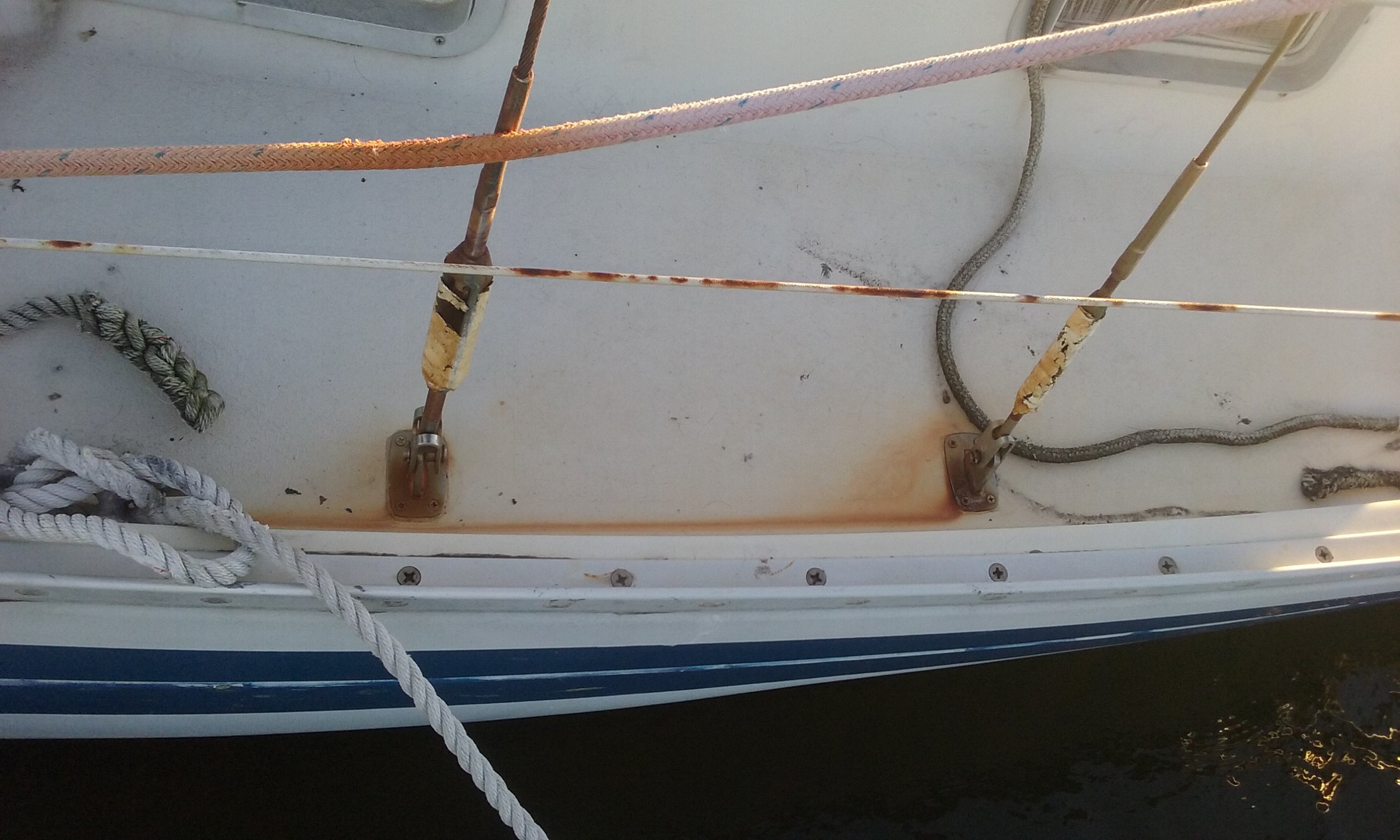
Looking at a boat with Rusty looking rigging looking at a boat rusty love ready. It's just like a coating on the standing rigging going up to the spreaders. Anybody have any luck in cleaning these with oxalic acid or something else and treating them? The actual wire looks pretty good the rusty residue it is running down the wires and then down the deck . I've not seen this anywhere before. Thanks for any help.

Rigging question
- Thread starter Flyflicker
- Start date

Viewing your pictures and description, my first observation is: Consider getting an independent opinion whether the standing rigging appearance is just cosmetic or the condition has deteriorated to an unsafe state. From what I have read, and also in conversation with several rigging companies in my area, depending on the boat's location (temp/humidity/FreshOrSalt water) and usual sailing wind conditions, standing rigging should be replaced every 7-10 years. ( I myself am right at 10 years so I will be re-rigging in the near future!) It's not only the SS wire, but the condition of the chainplates and all of the connecting fittings and bolts/nuts. The protection tape in your pictures also indicates it has been a while since the rigging was inspected and maintained.
But if you are willing to forego the safety aspect, the best product to brighten things up is SpotlessStainless. Use the forum's search function to learn more. It will restore rusted stainless steel with just brushing on, then rinsing off after several minutes. Looking the severity of your rust as shown in your photos, will probably take several applications for you. SpotlessStainless will also remove SS rust leach stains from the gelcoat.
My experience with a failed rigging part happened about 5 years ago. Although 1) the PO had re-rigged the boat just before I bought it, and 2) 5 years later I engaged a professional rigger to do a safety survey, my forestay broke loose in 25 kt winds one morning. The double-jaw toggle connecting the forestay to the stemplate at the hull failed. I was lucky that I didn't loose the entire rig. The foreward shrouds held and I was able to change quickly to a downwind course to relieve the backward pressure on the mast. Inspecting the part afterward (see photos), I realized that although the SS rigging had been replaced, the rigger re-used the original double-jaw toggle fitting. From the outside it looked fine to my surveyor. Underneath, stress cracks had already started. Several months later -- Bam!
But if you are willing to forego the safety aspect, the best product to brighten things up is SpotlessStainless. Use the forum's search function to learn more. It will restore rusted stainless steel with just brushing on, then rinsing off after several minutes. Looking the severity of your rust as shown in your photos, will probably take several applications for you. SpotlessStainless will also remove SS rust leach stains from the gelcoat.
My experience with a failed rigging part happened about 5 years ago. Although 1) the PO had re-rigged the boat just before I bought it, and 2) 5 years later I engaged a professional rigger to do a safety survey, my forestay broke loose in 25 kt winds one morning. The double-jaw toggle connecting the forestay to the stemplate at the hull failed. I was lucky that I didn't loose the entire rig. The foreward shrouds held and I was able to change quickly to a downwind course to relieve the backward pressure on the mast. Inspecting the part afterward (see photos), I realized that although the SS rigging had been replaced, the rigger re-used the original double-jaw toggle fitting. From the outside it looked fine to my surveyor. Underneath, stress cracks had already started. Several months later -- Bam!
Attachments
-
 115.6 KB Views: 223
 -
 1.5 MB Views: 255
Thanks. I appreciate your input call the professional rigger and I'm going to get his opinion and a quote on what it would cost me if I purchase the boat to have the rigging replaced

That Irwin likely has +30 year old rigging. Factor standing rigging AND lifeline replacement in the value of the boat.

Good advice stated above. As you mentioned, this isn't a normal condition. If the sale price and the price to replace the standing rigging exceeds the value, you may want to walk away from this one.
It's pretty salty on the Texas coast. Back when I was a teen, (OMG, it was 1971!) we were camping and fishing along the jetty at Port Aransas. I watched a beach ranger get in his truck, put it in gear, and his driveshaft dropped into the sand !
It's pretty salty on the Texas coast. Back when I was a teen, (OMG, it was 1971!) we were camping and fishing along the jetty at Port Aransas. I watched a beach ranger get in his truck, put it in gear, and his driveshaft dropped into the sand !

jssailem
SBO Weather and Forecasting Forum Jim & John
- Oct 22, 2014
- 24,819
Fly. Minimum get the rigger as advised.
If condition of rigging is an indicator their is likely to be more deferred maintenance issues or no maintenance issues.
Rigging is a 5-7 year issue in tropical climates. The stainless can rust from the inside. In the northern latitudes the 10 year figure is more the norm. Deduct from these numbers how the boat was sailed. Racing puts more strain on the rigging than sitting in the marina.
Just did my rigging last year. About $3k for the materials and another $4k for the professional.
If condition of rigging is an indicator their is likely to be more deferred maintenance issues or no maintenance issues.
Rigging is a 5-7 year issue in tropical climates. The stainless can rust from the inside. In the northern latitudes the 10 year figure is more the norm. Deduct from these numbers how the boat was sailed. Racing puts more strain on the rigging than sitting in the marina.
Just did my rigging last year. About $3k for the materials and another $4k for the professional.


The stainless can rust from the inside.
 on that. Had a chainplate and stemhead snap on me. They were original and showed very little staining on the outside but were totally corroded on the inside. Also, those lifelines look like they need to be replaced. If the rest of the boat was maintained like it looks from the pictures you might want to heed Justin's advice and walk away.
You have "running rust", and like Jackdaw said, look for a source above. I'm thinking there could be a standard zinc coated steel pin or wire on the spreader tip, that is the rust source that is dripping down the length of the wire.Is there a single piece of the rigging/spreaders that is zinc coated steel that is rusting and running down?
Generally speaking, most people would look at that mess and warn you about crevice corrosion. To err on the safety, I would say the same thing, best thing to do is replace the shrouds. Only way to be 100% sure and know you are good for 10 years or better. That said, yes its possible that it superficial. Best way to clean it is to go to a welding supply store and get a gallon of Metal Degreaser/Descaler that is phosphoric acid based. AirGas and Praxair have it, between $12 to $15 a gallon. Coil the shrouds with zip ties and put in a shallow plastic container or the bottom of plastic garbage can. Use hot water and cut the degreaser/descaler 4 to 1. Let soak overnight and all that running rust will come right off.

When you are looking at a used boat and you find stuff like this, you've just got to wonder about how the owner of this boat thought about maintenance. If he let stuff like this get ahead of him, he probably let a lot of other stuff go too. Based on the picture, it looks to me like the lifelines are rusting from the inside out -- water seeped under the vinyl coating. Same may be true for the swages on the shrouds. The whole rig looks like it ought to be replaced to me. If you are otherwise still interested in this boat, get professional advice before going forward.

As for the vinyl coated lifelines, what people don't realize is that stainless steel NEEDS oxygen to oxidize the chromium in the alloy, and create chromium oxide, which is very corrosion resistant. This layer of oxide protects the steel in the alloy. When you prevent the SS from getting oxygen, say, underwater, or under a coating of vinyl, that's when the steel can start rusting. It's why I need to replace the "pretty" white vinyl coated lines on my boat with plain, "ugly" SS wire... Plus then you can see any corrosion starting at swaged ends and such.
Agreed! The 'pretty" white vinyl turns ugly while the 'ugly" SS wire remains pretty. Going to go au natural next lifeline change.
jssailem
SBO Weather and Forecasting Forum Jim & John
- Oct 22, 2014
- 24,819
I went Nude on my ss lifelines this year. Only exception is the gates, which I used dyneema lines. Cruising not racing so went up a size on the wire (minimum weight not an issue). Lifelines now have a good feel and are easier to grab.

I would not waste money on anything other than new rigging. I would not pay someone to tell me to do what I apparently need to do. If your rigging is dripping rust, assume that is a BAD thing, and plan to replace it. Unless the current owner can show you receipts for having replaced it recently, 2-3 years, and you can identify a non-critical part that is rusting, plan to replace the rigging.
Stainless can rust in the crevices where water is held.
Stainless can rust in the crevices where water is held.
Thanks for all the advice and insight. Yeah this is a Hurricane Ike Survivor the interior is pretty awesome but the outside has sat for quite a long time there are some great features on the boat but rigging is not one of them. The Bayfield 32 is an expensive boat when it's in great shape I might be able to pick up the boat for 1500. I do like a project but I might be biting off more the motors out of it. Anyway thanks a bunch if I grab it and start fixing it I'll start posting pics
And yes I agree I believe there's something up at the top of the mast that isn't quite right and it's running down the shrouds because when I clean a section it looks really good underneath. I've used oxalic acid so far and a little elbow grease. Just some test areas
Maine Sail is a big proponent of Spotless Stainless. I don't know if it would clean that dripped down rust or not, but I guess it would.And yes I agree I believe there's something up at the top of the mast that isn't quite right and it's running down the shrouds because when I clean a section it looks really good underneath. I've used oxalic acid so far and a little elbow grease. Just some test areas

I would suggest taking a magnet to that rigging. It should NOT be magnetic. If it is replace it. I was dismasted this past summer on my C30. I lost the mast and sails overboard, not pretty. The stay that let go had been replaced years ago. I was sold some cheap SS rigging. After the mast came down I checked the rigging and the bad one was magnetic.