
Related SS drilling question
- Thread starter Tim R.
- Start date
- Status
- Not open for further replies.


That is what I said but my buddy doesn't want to remove the stemhead fitting.If you can remove the plate, take it to a machine shop and have them do it.

If you can, back the plate with a securely clamped piece of wood and then use a high quality hole saw. Whenever drilling in stainless put some oil on (3 in 1 for example) that will lubricate and absorb heat at the drill tip. Use only sharp tools and keep enough pressure on so that it cuts continuously, thus avoiding work hardening.
3/8 to 1/2 can be a bit tricky as its only 1/16 per flute BUT it should happen with a GOOD hand drill with a REAL chuck
While colbat gets thrown out a lot its a marginal way to go as they tend to shatter in 3 pieces if they stick in a hand drill
1. one piece in drill
2. one piece in work
3. one piece you will be glad you were wearing saftey glasses
I drill SS everyday and we do fine with black oxide 135 split points and offen we have to give a BIT of negtive or netural rake to help control the drill from going through to fast and jaming
While colbat gets thrown out a lot its a marginal way to go as they tend to shatter in 3 pieces if they stick in a hand drill
1. one piece in drill
2. one piece in work
3. one piece you will be glad you were wearing saftey glasses
I drill SS everyday and we do fine with black oxide 135 split points and offen we have to give a BIT of negtive or netural rake to help control the drill from going through to fast and jaming

The issue is going to be how to centralize the drill or hole saw so you are getting an even cut all around. I think you would be better off filling the hole up with epoxy or wood so the drill has a place for the point to start cutting and keep it on center. Otherwise doing this by hand you are asking for trouble as the uneven loading of the drill will cause it to try to walk and chatter before it starts cutting and making a mess. In a maching shop on a bridgeport you could easily bore the hole and that would be the best solution.

Just get some bits that go up in 64ths and drill away. It should get the job done in less time that it took you to read these replies. As I mentioned I've been able to drill stainless like this with the cheap HF titanium nitride coated bits that you can get for less than $20 for a set from 1/16 to 1/2 inch in 64th's.
 http://images.harborfreight.com/cpi/photos/05800-05899/05889.gif
http://www.harborfreight.com/cpi/ctaf/displayitem.taf?Itemnumber=5889
If it doesn't work come back and give me a lashing, but of course I'll tell you that you or only out $20 and you can practice sharpening bits .
Good luck,
Sum
Our Trips to Lake Powell, UT - Kootenay Lake, Canada - Priest Lake, ID
Our Mac Pages
Mac Links
http://www.harborfreight.com/cpi/ctaf/displayitem.taf?Itemnumber=5889
If it doesn't work come back and give me a lashing
, but of course I'll tell you that you or only out $20 and you can practice sharpening bits .Good luck,
Sum
Our Trips to Lake Powell, UT - Kootenay Lake, Canada - Priest Lake, ID
Our Mac Pages
Mac Links


Tim,
Harbor Freight has step drill bits. They work very well for drilling thin materials and still create a round hole. Twist bits end up making an oval often when enlarging holes in sheet metal. Get the titanium nitride coated bits and they should cut stainless fine. Use oil or cutting fluid.
Harbor Freight has step drill bits. They work very well for drilling thin materials and still create a round hole. Twist bits end up making an oval often when enlarging holes in sheet metal. Get the titanium nitride coated bits and they should cut stainless fine. Use oil or cutting fluid.
A "step drill" or shoulder drill will work better than a reamer. Make sure you use light but steady pressure and lub the bit and base mat'l. We used to have to do it frequently on subs, not too hard if you don't force the issue.


I am not sure whay it is necessary to increase the size of a hole in a chain plate. By increasing the size of the hole the chainplate will no longer be able to not brake. That is it is now weak since the distance to its edge has been reduced..

It's funny you ask..
My intermediates and lowers had 3/8 pins on 1/4" wire. This is the way Proctor did it back in 1979. Today's standards call for 1/2" pins on 1/4" wire. I had to drill out all my tangs and chain plates to accommodate the 1/2" pins. Because the chain plates were installed when I did this cutting oil did not help much and I wound up doing it slowly and dry but with compressed air for cooling.
I was at the Black & Decker outlet in Kittery one day and they had a box of 1/2" bits for $1.99 each so I bought a dozen. I used only two. Went quite easy so long as you kept drilling and were still getting shavings. Just don't let it work harden and you'll be fine..
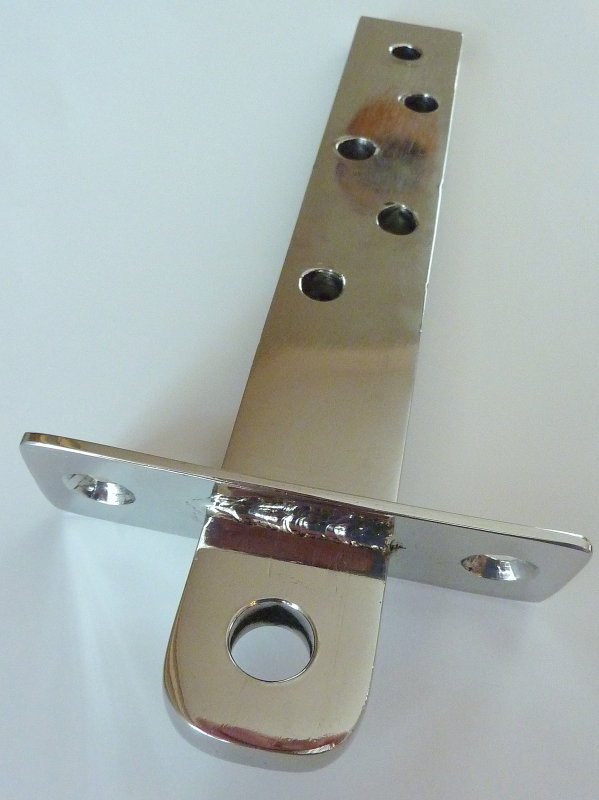
This is one of the ones I drilled out from 3/8" to 1/2"..
My intermediates and lowers had 3/8 pins on 1/4" wire. This is the way Proctor did it back in 1979. Today's standards call for 1/2" pins on 1/4" wire. I had to drill out all my tangs and chain plates to accommodate the 1/2" pins. Because the chain plates were installed when I did this cutting oil did not help much and I wound up doing it slowly and dry but with compressed air for cooling.
I was at the Black & Decker outlet in Kittery one day and they had a box of 1/2" bits for $1.99 each so I bought a dozen. I used only two. Went quite easy so long as you kept drilling and were still getting shavings. Just don't let it work harden and you'll be fine..
This is one of the ones I drilled out from 3/8" to 1/2"..
Joe makes a good point, you are taking considerable strength out of the chainplate. You should calculate the weakest link in the system and see if you are making it the chainplate. A hole in a flat plate is a large stress riser to begin with. You should look at the cross section of the pin, the thread on the turnbuckle, the various components and see if you will be losing your mast in the near future.
A hole is not a stress riser. A notch is. Looking at Mainsail's chainplate, the maximum strength of the part is at the minimum cross sectional area of the steel on either side of the hole if the pull is straight up. Some back of the envelope calculations assuming a 3/8" wide by 1/4" section times 2 (the sections on each side of the hole) would yield a total breaking force required of 13,875 pounds. If the hole were only 3/8" in diameter then the total breaking force would increase to 16,188 pounds total tensile force. The reduction in strength is approximately 14%. This also assumes 74,000 psi tensile strength for 304 stainless. If this is still within the load requirements of the boat with an appropriate safety margin, then it is probably ok for a chainplate with this much meat on it. Thicker on all sides of the hole would be better.
Allan
Allan
Allan both Hayn and my local rigger ran the calculations and I still have a large safety margin.A hole is not a stress riser. A notch is. Looking at Mainsail's chainplate, the maximum strength of the part is at the minimum cross sectional area of the steel on either side of the hole if the pull is straight up. Some back of the envelope calculations assuming a 3/8" wide by 1/4" section times 2 (the sections on each side of the hole) would yield a total breaking force required of 13,875 pounds. If the hole were only 3/8" in diameter then the total breaking force would increase to 16,188 pounds total tensile force. The reduction in strength is approximately 14%. This also assumes 74,000 psi tensile strength for 304 stainless. If this is still within the load requirements of the boat with an appropriate safety margin, then it is probably ok for a chainplate with this much meat on it. Thicker on all sides of the hole would be better.
Allan
- Status
- Not open for further replies.