

Radar installation
- Thread starter Chaz3536
- Start date

jssailem
SBO Weather and Forecasting Forum Jim & John
- Oct 22, 2014
- 24,951
Chaz, is this a new install or a replacement?
I replaced my analog radar with a Furuno digital last year.
You mention your Mast, is this set in your mind, or would a stern radar on a pole be an alternative?
Considerations for me included:
I replaced my analog radar with a Furuno digital last year.
You mention your Mast, is this set in your mind, or would a stern radar on a pole be an alternative?
Considerations for me included:
- exposure to the radar signal
- Optimized signal distance
- ease of install
- routing of wires
- access to power
- location of display


The general advice is to mount the radar as high as possible on the mast. However, that may not be the best position for a number of reasons and the advantage, more range, is not as great as it is assumed.
The additional weight on the mast will make the boat more tender and affect its stability. It may also interfere with sails when tacking. Running the cables from the mast to the chart plotter display is challenging. If the mast has to come down for winter storage or servicing, removing the cable will again be a challenge.
A stern mounted pole avoids all of those problems at the cost of a couple of miles of range. At 10' above the waterline a radar will have a range of 3.37 nm raising the radar to 20 feet increases the distance to the horizon to 4.76 nm.
Speaking of radar range, don't be misled by the marketing hype about range. Radar can't see over the horizon. At the 20 foot height, the radar would see a 100 ft high something (ship, building, hill) about 15.4 miles away and wouldn't see anything 99 feet or shorter. The 10 ft high radar would see it at 14 miles.
Why do you want radar? Is there area you sail in frequented by fog? Do you often sail in poor visibility? Or do you want to see commercial traffic? If the answer is to see commercial traffic, i.e, big boats going fast a better investment would be an AIS transceiver. The range is upwards of 25 miles, the data is easy to interpret, and you learn a lot more about the other boat than you will by looking at a radar blip. AIS has the other benefit of the big boys seeing you and knowing who you are and where you're going.
I have both, radar and AIS. AIS is much more valuable than radar and easier to read and use.
This sChaz, is this a new install or a replacement?
I replaced my analog radar with a Furuno digital last year.
You mention your Mast, is this set in your mind, or would a stern radar on a pole be an alternative?
Considerations for me included:
- exposure to the radar signal
- Optimized signal distance
- ease of install
- routing of wires
- access to power
- location of display
It is a new install, a Quantum 2 Q24d doppler radar and I plan to mount it on the mast, which is deck stepped, and has a hole above the steaming and deck light for running the wiring. I purchased a seaview radar mast mount that I think would go a few inches above the hole for the wiring. I have 15 meters of wiring to run from the radar to the back of the chart plotter.Chaz, is this a new install or a replacement?
I replaced my analog radar with a Furuno digital last year.
You mention your Mast, is this set in your mind, or would a stern radar on a pole be an alternative?
Considerations for me included:
- exposure to the radar signal
- Optimized signal distance
- ease of install
- routing of wires
- access to power
- location of display

Fog is scary with or without radar. With radar you are aware that there is traffic out there but you still don't have visual contact. You are more safe knowing where to keep watch and approximately when to expect visual contact but I wouldn't describe the experience as comfortable.
I agree with Dave that AIS is more useful. I'll add being able to hail a vessel by name is a big plus.
I agree with Dave that AIS is more useful. I'll add being able to hail a vessel by name is a big plus.
jssailem
SBO Weather and Forecasting Forum Jim & John
- Oct 22, 2014
- 24,951
I have a deck-stepped mast. The wires run down through the mast step and into the boat. I inserted pipe stems and attached hoses to the stems so that I can create wire drip loops and prevent water from running down the wires and into my boat. Water at the mast base weeps out onto the deck and overboard.

I located wire junction blocks so that the electrical wires could be disconnected should I need to remove the mast in the future. Not a task I expect to do. The wires for my radar and VHF antenna run, not broken, from the sensor to the back of the hardware at my NAV station.

With your mast down, running the radar cable should be fairly easy.
I located wire junction blocks so that the electrical wires could be disconnected should I need to remove the mast in the future. Not a task I expect to do. The wires for my radar and VHF antenna run, not broken, from the sensor to the back of the hardware at my NAV station.
With your mast down, running the radar cable should be fairly easy.

Stern polr mounted radar on a 29 Lancer, 32 Hunter & 40.5 Hunter. I rarely have the radar set overf 4 miles except for quick checks. The current set up is B&G with the same plotter. I get the AIS feed from the VHF radio. Having the AIS overlay on the radar is the best of both worlds. FWIW.
jssailem
SBO Weather and Forecasting Forum Jim & John
- Oct 22, 2014
- 24,951
For many owners with a modern digital radar, a tall pole on the stern serves their needs.
Where you place your radar affects the effective distance your unit will provide. In a heavy sea, from your deck, you may not be able to see over that 15ft wave, but your radar 20 feet up the mast may have a clear view.
Recognize that radar signals are straight-line transmissions.
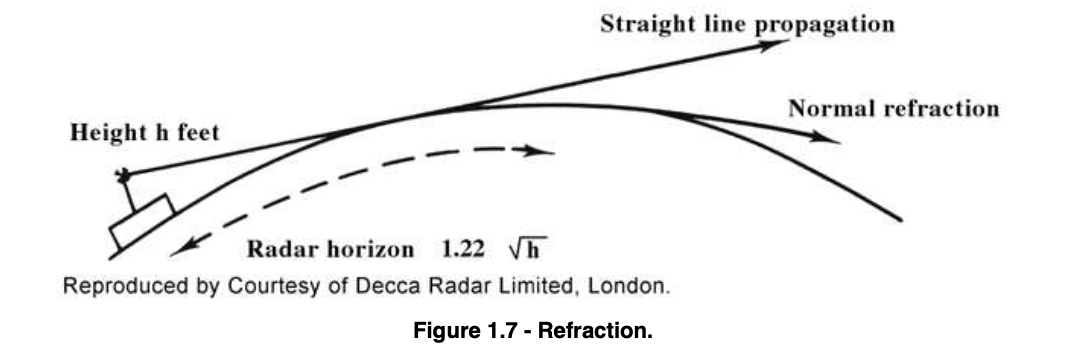
Read the installation manual carefully. The older units produced radio-frequency (r-f) energy that was less focused. At 6 feet above the deck, it might be like getting a constant Dental X-ray while the radar was working. Not a healthy event. The beam looks something like this.
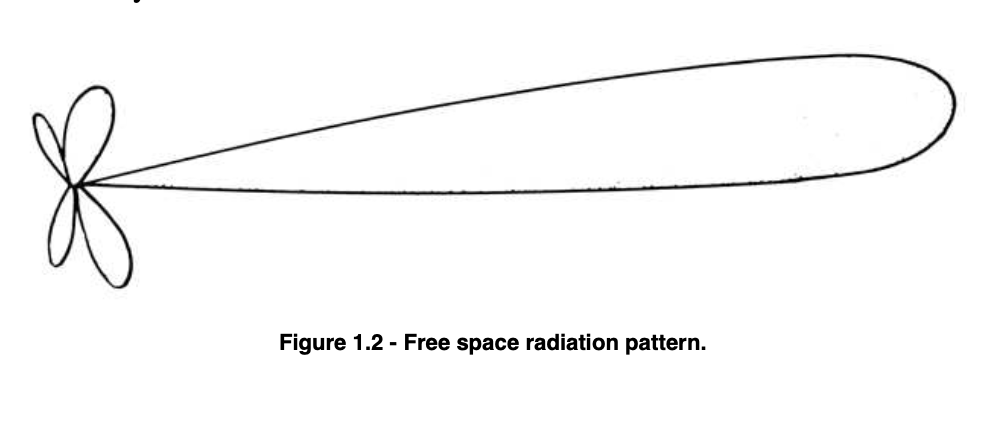
The newer units are more focused. The manual will tell you the safe height needed.
Where you place your radar affects the effective distance your unit will provide. In a heavy sea, from your deck, you may not be able to see over that 15ft wave, but your radar 20 feet up the mast may have a clear view.
Recognize that radar signals are straight-line transmissions.
Read the installation manual carefully. The older units produced radio-frequency (r-f) energy that was less focused. At 6 feet above the deck, it might be like getting a constant Dental X-ray while the radar was working. Not a healthy event. The beam looks something like this.
The newer units are more focused. The manual will tell you the safe height needed.
To clarify. Radio wave propagation patterns are a function of the antenna, not what generates the radio frequency. A good example is the propagation patterns for marine VHFs, same radios different patterns for a long "powerboat" antenna and the short antennas most of us use on our mastheads.
In terms of safety, the big difference is the power out put of the radar. The older magnetron radars used between 4kw and 25kw of power, the new digital units use much less. For example the the Halo 20 radar (Simrad/B&G) meets the FCC's radiation limits at .33 feet or about 4 inches. They are also energy efficient, the Halo 20 draws 20w or less. These are very safe units.
It's not been mentioned, if the boat is going to travel internationally, i.e., Canada or Bahamas the boat needs to have a Ship's Station License and someone onboard must have a Restricted Radio Operator's license to be legal. Canada has similar requirements.